Local Keyword Research: Finding the Regional Keywords UK Customers Search
Search behaviour can differ widely between UK cities, towns and regions. For example, someone looking for an estate agent in Leeds may use different words from a customer in Lewes, even when they need the same service. That is why local keyword research matters. Regional keywords are one part of a wider strategy, which our guide to what local SEO is covers in full.
Adding a town or city name to a service keyword is only the start. In addition, you need to understand how customers search in each area, which local terms show genuine intent and how Google connects those searches with local businesses.
This guide explains how to find, map and track regional keywords, so your UK SEO strategy reflects the places you actually serve.
Why Local Keyword Research Matters for UK Businesses
Most UK customers search close to home, because they want help quickly. They want someone nearby, open now and well reviewed. If your pages use different words from your customers, you miss them. For instance, you may write “heating engineer” while customers type “boiler fix”.
In other words, local keyword research closes the gap between how you describe your services and how people in your area search for them.
How UK Search Behaviour Changes by Region, City and Town
However, people search by location in different ways. One customer might use a city name, while another searches by borough, village, neighbourhood or postcode. Here is what each type of location search can tell you:
So, your keyword list should include several types of local search and area name. That way, you do not miss customers who search by neighbourhood, postcode or landmark.
Google Rankings, the Local Pack and AI Answers
Your business faces two judges:
- Google rankings: the organic results and the Local Pack. Here, Google weighs relevance, distance and prominence, as its own guide to improving your local ranking explains.
- AI answers: ChatGPT, Gemini and AI Overviews pull from your website and your Google Business Profile (GBP). They look at your services, the areas you cover, your prices and the themes in your reviews.
You can win one and miss the other. Therefore, track both.
Why “Near Me” and Implicit Local Searches Matter
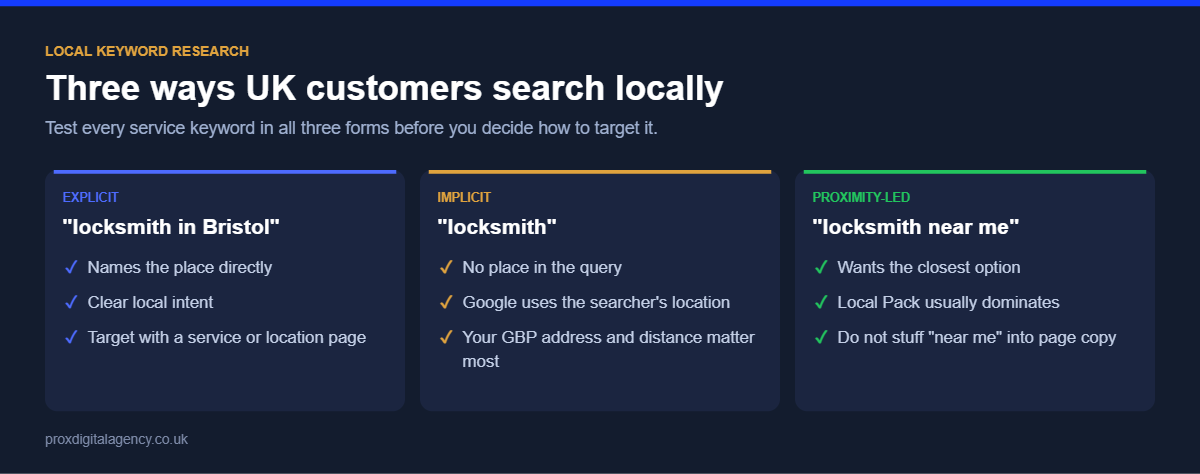
Not every local search names a place, though. When someone types “locksmith”, Google reads their location instead. There are three patterns to know:
- Explicit: “locksmith in Bristol”
- Implicit: “locksmith”
- Proximity-led: “locksmith near me”
Implicit searches lean heavily on distance, so your GBP address matters. However, do not stuff “near me” into your page copy, because it reads badly and adds nothing.
How to Do Local Keyword Research in Six Steps
The six steps below cover the main process. For the full method behind each step, read our guide on how to do keyword research for UK businesses.
1. Start Local Keyword Research With Real Customer Language
Keyword tools show search volume, but they do not always reflect the exact words your customers use. So, start with how customers describe their needs, services and locations. For example, look at call notes, enquiry forms and reviews. Then use keyword tools to check and expand those terms.
2. Build Location Terms From City to Postcode
Next, make a second list for places. Go from wide to narrow:
- City, for example Birmingham
- Area, for example Moseley or Harborne
- Postcode, for example B13 or B17
- Landmark, for example near the Bullring
Now combine each service with these areas. For example, “boiler service” plus “Harborne” gives “boiler service Harborne”. Repeat this for every service. That is how to do local keyword research at a practical level. Even so, do not assume these terms always face less competition. Check the search results before you decide which ones to target.
3. Test Explicit and Implicit Local Keywords
Run each service both ways. First, search “emergency electrician Sheffield”. Then search “emergency electrician” on your phone while you are in Sheffield. If the Local Pack appears both times, treat it as a local keyword and add it to your list.
Explicit terms show clear intent, while implicit terms bring wider reach. Ideally, use both.
4. Check Local Intent in UK Search Results
Look at the results page before you commit to a keyword:
If you see no map and only articles, the local intent is weak. In that case, skip the term or write a guide instead. This simple check helps you find local keywords worth the effort, because many keywords look good in a tool and go nowhere.
5. Use Competitors to Find Local Keyword Research Gaps
Search your main terms and note who appears in both the Local Pack and the organic results. Then study their GBP categories, service lists, review wording and page titles.
After that, a keyword gap tool shows the terms they rank for and you do not. Filter for mobile, top 10 positions and your target areas, and remove their brand names.
For example, a Nottingham accountant notices that rivals rank for “sole trader accountant Beeston”. She has no Beeston page, so that is a gap she can fill in a week.
Here is a quick tip. Rival reviews are also a good source of long-tail keywords for local businesses. Copy the full phrases customers use, and then add questions from “People Also Ask”. Both show how real people describe their needs.
Want to know which towns and postcodes bring you enquiries?
Tell us your services and the areas you cover. We will show you the regional search terms with real local intent and the pages that should target them, free.
Get a free regional keyword reviewSee our Local SEO agency services →
6. Map Keywords to Pages and GBP Fields
Every keyword needs one page, for example:
At Prox Digital Agency, this mapping is part of the work of our Local SEO agency team, which connects regional keywords with the pages and profiles that should target them.
Next, sort your regional keywords by town and build a page for each town. Our local landing pages guide shows how to build them without copying text. If you only change the town name, you create a doorway page, which Google dislikes.
Also, add real detail to each page, such as the areas covered, past jobs, photos, reviews and a map. For your GBP, choose accurate categories and use natural wording. Never add a category for a service you do not offer. Our Google Business Profile optimisation checklist covers every field.
How to Track and Improve Local Search Visibility
Keyword work is not a one-off job. Rankings shift, and customers change the way they search over time. So, keep improving in three areas.
Optimise for Local AI Visibility
In 2026, if you skip AI visibility, you are already losing ground. AI tools prefer clear, specific answers, so help them:
- Pair each service with a place, such as “IT support Birmingham”.
- Use conversational, question-style headings.
- Answer the main question in the first paragraph.
- Keep your phone number, email and address identical on every page.
People usually type long questions into AI tools such as ChatGPT. For example, “Who is the best web developer in Moseley available next Sunday?” That is why knowing how to identify long-tail keywords for local businesses helps here.
Track Organic, Local Pack and Google Maps Separately
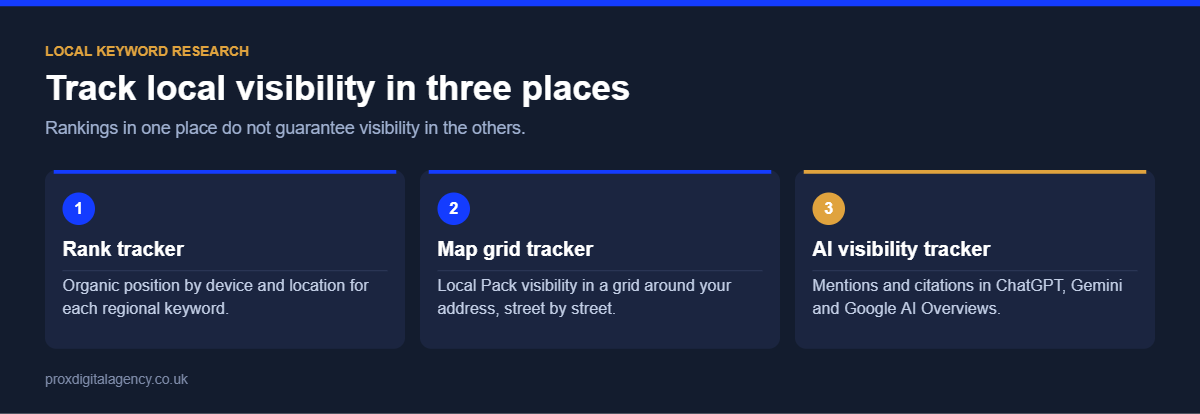
Also, track three things on their own:
- Rank tracker: shows your organic position by device and location.
- Map grid tracker: shows your visibility around your address.
- AI visibility tracker: monitors mentions in ChatGPT, Gemini and AI Overviews.
For instance, a grid tracker may show you first on your own street but fifth two miles away. That tells you exactly where to focus.
Monitor Local Conversions by Region
Ranking well in a location is useful. However, the real value comes from turning that visibility into enquiries and sales. Monitor these four signals:
- Phone calls from your GBP
- Direction requests
- Form submissions
- Bookings and revenue
If Harborne brings twice as many calls as Moseley, build more content for the Harborne audience.
How to Measure the Results of Local Keyword Research
Firstly, review your results every month by area. Start with Google Search Console, filtered by page, to see which regional queries gain impressions. Then compare those queries with calls and enquiries from the same areas. As a result, you will know which towns to expand into and which pages need more work.
Turning Local Keyword Research Into Enquiries
Effective local keyword research starts with how your customers actually search. Use their language, include the places they mention, check what appears in local results, look at what competitors target and give each keyword a clear purpose.
Long-tail keywords are the best place to begin, because they reach customers searching for something specific. Once you know what works in each area, build on those results, target broader terms and grow your visibility across the UK.
Still want a hand? Our regional keyword research service finds the words your customers use, the locations that matter to your business and the right page for each keyword. You can also read our local SEO pricing guide to see what support costs.
Prox Digital Agency
Win the searches customers make in the places you serve
We find the regional keywords your customers use, check which ones trigger the Local Pack and AI answers, then map each one to a service page, location page or Google Business Profile field. Start with a free regional keyword review.
Frequently Asked Questions
What is local keyword research for UK SEO?
Local keyword research is the process of finding the words people use to search for businesses in a specific UK area. It covers cities, towns, postcodes and other local terms, and it helps you plan relevant pages and Google Business Profile content.
How do I find regional keywords UK customers search?
Start with customer language from call notes, reviews and enquiries. Then add location terms at city, town and postcode level. Finally, check the Google results to confirm local intent.
Should I target city, town or postcode keywords?
Use the location types that match your service areas and the way customers search. Cities and towns suit location pages, while more specific terms, such as postcodes, help you reach smaller local areas.
How do I optimise for the Local Pack and Google Maps in the UK?
Complete your Google Business Profile, choose accurate categories, keep your business details consistent and encourage genuine customer reviews. In addition, a relevant website with clear location pages supports your visibility.
Can local keyword research improve AI visibility?
Yes. It shows you the services, places and questions customers search for. As a result, you can create clear content that is more likely to appear in AI-generated answers and citations.
Which SEO providers offer geotargeted keyword matching that aligns with local search intent?
Look for a local SEO provider that maps keywords to places rather than simply reporting rankings. A good provider researches city, town and postcode terms, checks the local results for each one, and assigns every keyword to a specific location page or Google Business Profile field, so each search lands on the page that matches its intent. Ask to see an example keyword-to-page map before you sign. Our local SEO agency builds this map as standard for UK businesses.


 Muhammad Bilal, London
 7 mins
Image SEO: Alt Text, File Names and Formats That Help Pages Rank

Header Tags for SEO: How to Structure H1 to H6 (With Examples)
Title Tags and Meta Descriptions: How to Write Them for Higher Click-Through Rates

SEO Copywriting: How to Write Pages That Rank and Convert

On-Page SEO Checklist: 27 Checks to Run Before You Publish Any Page

On-Page SEO: The Complete Guide to Optimising Every Page for Google and AI Search (2026)

How to Get More Google Reviews (and Handle Negative Ones) Without Hurting Your Rankings

Local SEO for Law Firms: How UK Solicitors Can Win More Local Enquiries