SEO Copywriting: How to Write Pages That Rank and Convert
SEO copywriting is writing that does two jobs at once. It helps a page rank in search. And it persuades the reader to take the next step. If the first step is missing, potential customers may never find you. If the second is missing, they may not convert.
This guide covers how to balance readers and search engines, where to place keywords, when long-form writing wins, how AI-generated content affects rankings and when to hire an SEO copywriter.
SEO copywriting is one part of on-page SEO, so for the bigger picture read our complete guide to on-page SEO.
What Is SEO Copywriting?
SEO copywriting combines search optimisation and copywriting skills. The goal is to create a page that will rank and convert.
For instance, imagine two webpages for a project management software. Page 1 is overloaded with keywords and sounds like it was written using a bot. Page 2, however, answers real questions and ends with a clear CTA, so it wins on both counts, every time.
You’ll often hear two related terms:
- SEO content writing: Usually blog posts and guides that attract traffic. A project management platform might publish a guide on “how to manage remote teams” to attract organic traffic.
- Lead generation copy: Pages built to get visitors to take an action, such as booking a meeting or requesting a product demo.
And SEO copywriting straddles the two. It also includes the finer details, including the use of headings, opening statements, keyword usage, and calls to action.
Start With Search Intent
Before you write, ask what the searcher wants. Then match it. Here’s how that looks:
For example, say someone searches “best VPN for remote teams”. They want to compare options. A page with only a sign-up form misses the point. A page with a comparison table and clear pricing fits.
Local intent needs extra care. If you run an IT support firm in Leeds, name your service areas, add an address and show a phone number high on the page.
Mixed intent happens too. A query like “cloud backup” may demand information as well as a product to be offered. In that situation, give an answer first, followed by your product.
Look at the top results before writing anything. They show you what Google thinks the searcher wants.
Human-Centric vs Search-Engine-First Content: Finding the Balance
The short answer is to go for human-centric content first and then check search-engine requirements. The human-centric approach answers real-world questions, whereas the search-engine-first approach forces your content around keywords. Aim for human-centric content, because Google’s systems are built to reward helpful, people-first content.
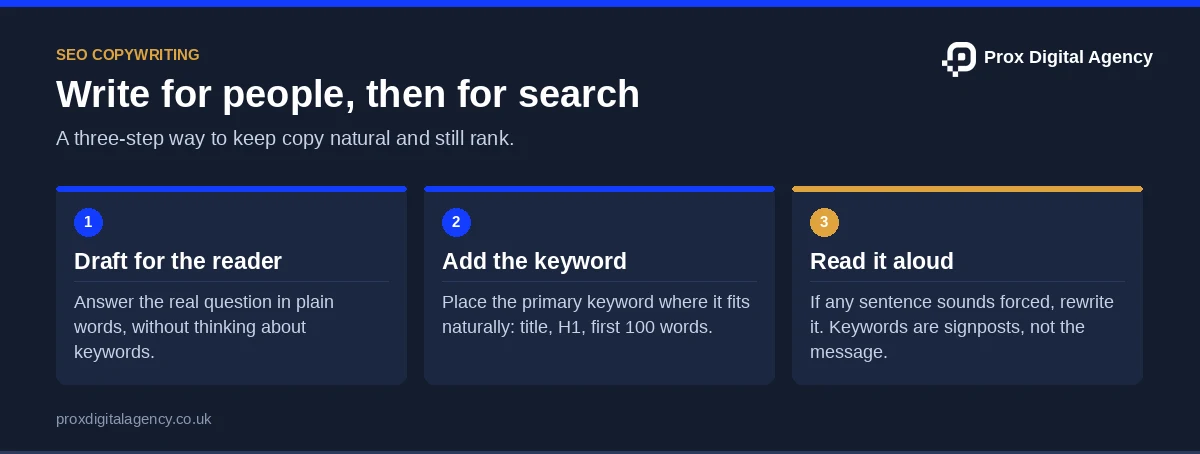
Here’s the difference in action. For example, imagine a page for a cybersecurity audit.
An easy way to create this balance is,
- Write the first draft for your readers, without adding keywords.
- Now, add the primary keyword where it fits naturally.
- Read the final draft and the sentences where you placed keywords. If any line sounds odd, rewrite it.
Search engines are becoming more capable of identifying robotic writing. This makes the person-first strategy the safer long-term choice. Proper SEO copywriting uses keywords as signs rather than the message itself.
Placing Primary Keywords Within the First 100 Words
Mention your primary keyword once, naturally, in your first one or two sentences. This tells readers and search engines the topic fast. It’s a strong signal, not a magic trick. Never force it, and follow it with a clear answer or offer.
Here’s a before and after for a page on “cloud backup”.
- Before: “Welcome to our website. We have been in business for ten years, and we love technology. Read on to learn more.” No keyword. No answer. Wasted space.
- After: “Cloud backup ensures that your documents are safe in case your computer crashes or ransomware attacks. Here’s how to choose a service, set it up and test it.” Keyword in the first sentence. Clear promise.
Why does it help? Readers decide in seconds. A clear opener keeps them on the page. And AI tools often lift opening lines as answers. It’s the simplest form of keyword placement.
Also, keep the opening brief: two or three sentences will do. Ideally the keyword appears in the very first sentence, but anywhere in the first 100 words does the job, as the opening of this post shows. Every brief we give our own writers asks for the primary keyword in the title, H1, URL, first 100 words and one H2.
Keyword Placement: Where Else to Use Your Keywords
Good keyword placement goes beyond the opening, and it starts with choosing the right term. If you need help with that step, our keyword research services map one primary keyword to every page. Here’s where else your keywords belong:
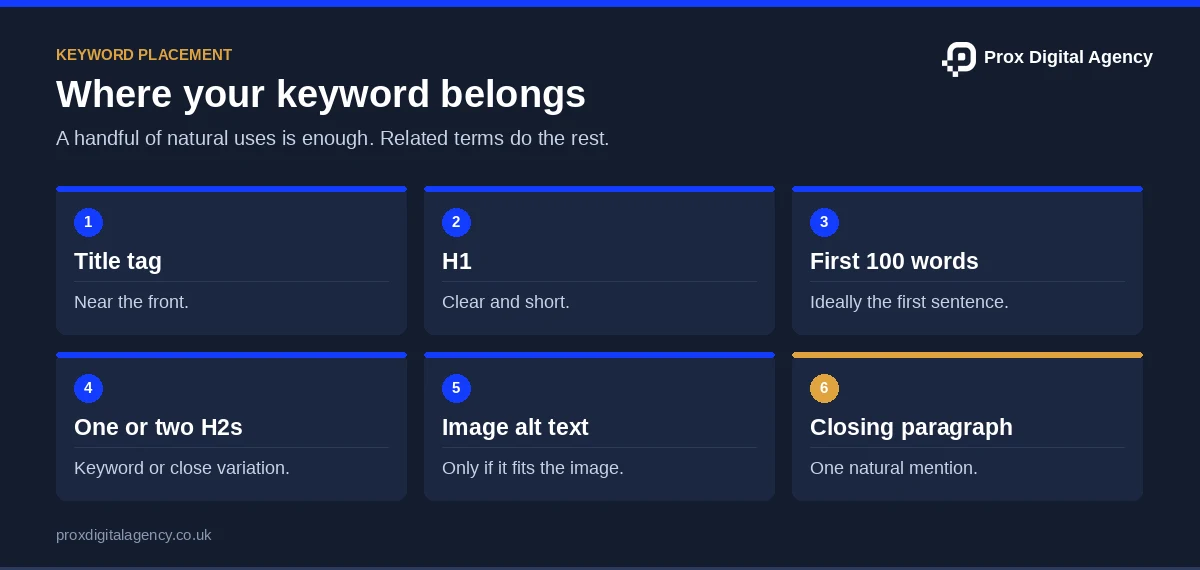
Say you’re writing a page for an API monitoring tool. The H1 includes “API monitoring”. An H2 says “Real-Time API Monitoring Alerts”. The alt text on the dashboard screenshot says “API monitoring dashboard showing error rates”. Three spots, three natural uses, no stuffing. Also, our guides to title tags and header tags cover each spot in detail.
Your page slug should also have your keyword. Also, keep it short, like “/api-monitoring”.
However, avoid stuffing: Google treats it as spam under its spam policies. A handful of natural uses in 1,000 words is more than enough. Also, use related terms for the rest, like “uptime alerts” or “latency tracking”. Our guide to semantic SEO explains why related terms matter more than repetition.
The best keyword placement reads like normal writing. If you notice it, your reader will too.
Pages getting traffic but no enquiries?
Send us the page. We will review the opening, keyword placement and call to action, and show you what to rewrite first, free.
Short-Form vs Long-Form Content: Which Performs Better?
Neither. Content’s performance depends on intent and depth, not word count. Long-form content usually suits research-heavy topics. Short-form suits quick answers and focused offers. Match the length to what the reader needs to decide.
A pricing page doesn’t need 3,000 words. A guide to cloud migration probably does.
Try this test. Read the top three results. Do they answer fully in 500 words? Or do they need 2,000? Match that depth, then add something they don’t have, like a worked example, a table, or an original screenshot.
How Does AI-Generated Content Affect On-Page SEO?
AI-generated content isn’t penalised just because it was made by AI. Google focuses on whether a page is helpful or spammy, not on how it was created.
When AI text is used without editing, it often misses accuracy, experience and original thinking. That can hurt the page’s SEO performance. When used as a starting point and then carefully edited by an expert, AI can actually support better content and help with SEO.
Google’s own guidance on AI-generated content focuses on helpfulness and quality, not the tool used. So the question isn’t “was this written by AI?” It’s “does this help the reader?”
Here’s where AI helps and where it falls short:
For instance, imagine a SaaS team working with AI to write a setup guide. A product engineer goes through each step carefully, finds mistakes, corrects them and adds screenshots. That page has experience and accuracy. Now picture the same draft published untouched. It may look fine, but one wrong setting kills trust.
Also, use this simple rule: AI can draft. A human must verify.
Always check facts, add your own examples, and keep your brand’s voice. That’s what makes SEO copywriting worth reading.
How to Write SEO Copywriting That Converts
Ranking gets people to the page. Copy gets them to act. Here’s how to turn visitors into leads:
- Lead with the benefit. “Back up your whole team in minutes” beats “Advanced backup solution”.
- Put proof next to claims. If you say “99.9% uptime”, add a client quote or status history right beside it.
- Answer objections. Worried about migration downtime? Say how you handle it.
- Use one clear call to action. One page, one next step, like “Book a demo”. In addition, our post on the psychology of CTA copywriting explains what makes people click.
This is where lead generation copy comes in. If your IT support firm advertises a free network health check, lead generation copy must be clear. The landing page should have a headline, three benefits, proof, and one form. Our guide to lead generation web copy shows how to design that page so visitors become enquiries.
Here is a quick example. A managed hosting page could say: “Move your site without downtime.” “See how we handle migrations.” Then one button: “Book a free migration check”.
Also, keep SEO and conversion goals clear. Ranking is the page’s job. The CTA is the reader’s next step. Skim your page like a stranger. Can you tell what to do next in five seconds?
When to Hire an SEO Copywriter
An SEO copywriter researches keywords, writes persuasive copy and shapes it for search. The best ones also understand your product. You can write in-house when you have time and subject knowledge. Consider hiring an SEO copywriter when:
- You have many pages to write or rewrite.
- Your pages rank but do not convert.
- Your team understands the technology but struggles to explain it simply.
For example, picture a cybersecurity firm with brilliant engineers and dull web pages. A good SEO copywriter turns “multi-layered endpoint protection” into “stop threats before they reach your laptops”.
A freelancer or agency also brings tools and a structured process. Our website copywriting services plan keywords before a single line is written. They’ll map keyword placement before writing, not after. Ask for samples in your niche. A writer who’s covered cloud or SaaS before will ramp up faster.
Turn Better SEO Copy into Measurable Results
SEO copywriting is about balance. Then write for people first. Also, use keywords as signposts. Choose length based on intent. Also, use AI carefully. And always give the reader one clear next step.
Start small. Pick one page, check its opening lines, tighten its keyword placement and add a single CTA. Then move to the next. At Prox Digital Agency, we combine SEO research with conversion-focused writing to help businesses communicate their value clearly. Whether you need a single page rewritten or a complete content strategy, our team can help you create content that works for both search engines and readers.
Talk to our team about SEO content writing for your service pages and blogs.
SEO Copywriting FAQs
How is SEO copywriting different from regular copywriting?
Regular copywriting focuses on persuading. SEO copywriting adds search research and structure so the right people find the page. Think of a SaaS landing page. Regular copy sells the product. SEO copywriting also targets the phrases buyers search for.
How long does SEO copywriting take to show results?
Usually a few weeks to a few months. New pages need time to be crawled and ranked. Updates to existing pages can move faster. Competitive terms, like “best VPN”, take longer than niche ones, like “VPN for legal firms”.
Should I rewrite old pages or write new ones?
Start with old pages that already get impressions but few clicks or leads. Rewriting them is often faster than starting fresh. Also, our guide to content optimisation shows how. Write new pages only where you have a real gap, like a service you offer but never explained.
What tools help with SEO copywriting?
Google Search Console shows what people search. A keyword tool helps you pick terms. Grammar and readability checkers keep sentences short. Tools help, but your product knowledge and clear examples matter more.
Does SEO copywriting work for local service pages?
Yes. Name your service areas, add local proof and show contact details early. An IT support firm in Leeds could mention Leeds in the H1, add reviews from local clients and put a phone number above the fold.
Prox Digital Agency · On-Page SEO
Want copy that ranks and brings in leads?
Our writers and SEO team plan keywords before writing, then craft service pages and guides that read naturally, rank and convert.

 Muhammad Bilal, London
 7 mins
Image SEO: Alt Text, File Names and Formats That Help Pages Rank
Header Tags for SEO: How to Structure H1 to H6 (With Examples)
Title Tags and Meta Descriptions: How to Write Them for Higher Click-Through Rates

On-Page SEO Checklist: 27 Checks to Run Before You Publish Any Page

On-Page SEO: The Complete Guide to Optimising Every Page for Google and AI Search (2026)
How to Get More Google Reviews (and Handle Negative Ones) Without Hurting Your Rankings

Local SEO for Law Firms: How UK Solicitors Can Win More Local Enquiries

Local SEO for Dentists and Private Clinics: How to Win Patients Searching Nearby