Competitor Keyword Analysis: How to Find and Win the Keywords Your Rivals Rank For
A competitor keyword analysis shows which keywords bring traffic to your competitors and where you are losing ground. As a result, you stop guessing and start working from evidence about your own market.
Combining keyword research and competitor analysis helps you find the terms your competitors rank for and uncover gaps in your own strategy. It also shows you how to reach buyers at each stage of their journey. However, the goal is not to copy every competitor keyword. Instead, judge each term on search intent, relevance, competition and business value before you target it.
This guide shows you how to find those terms, judge each one and turn the best into a clear SEO plan.
Why Does Competitor Keyword Analysis Matter?
A keyword competitor analysis gives you a clearer view of the search demand in your market. So, instead of building a keyword list from scratch, you use competitor data to decide where to focus. It brings four main benefits:
- Faster ideas: competitor rankings reveal relevant terms you may not have considered.
- Clear gaps: you find services, topics and locations where competitors rank but your site does not.
- Better budget use: you prioritise keywords with proven relevance and search demand.
- Local opportunities: competitor data can uncover valuable town, area and postcode searches.
Here is a quick example. A Leeds dentist finds that a rival ranks for “dental aligners Headingley” and “dentist open Saturday Leeds”. Neither phrase appears on the dentist’s own site, so both are clear gaps.
If you are new to the basics, read our step-by-step guide on how to do keyword research for UK businesses before you expand your list with competitor data.
Finding Your Real SEO Competitors
Your business rivals and your search rivals are often not the same firms, though. In fact, a search competitor is any site that shows up for the terms you want. That includes directories, review sites and big brands.
Therefore, include at least one search rival, not just the firms you already know.
How to Find the Keywords Your Competitors Rank For
Finding competitor keywords works best in two stages. First, use free methods to spot seed terms. Then add SEO tools to confirm volumes, difficulty and rankings.
Start With Free Competitor Keyword Analysis Methods
To begin with, follow these steps:
- Search your target keyword on Google in an incognito window, for example “women’s running shoes UK”.
- Then write down the businesses and websites on page one.
- Open each competitor page and read the page title, headings and URL. Together, these show the terms they target.
- Also scan the page content, such as the products listed, the FAQs and any category terms.
- Next, check Google autocomplete and “People also ask” for related searches and questions.
- In addition, review their Google Business Profiles, if they have one.
- Finally, compare their pages with yours and list any terms or topics your site does not cover.
This gives you a set of seed terms. It is a quick form of competitor keyword research, although it does not show search volume.
Go Deeper With SEO Tools
SEO tools add rankings, volumes and difficulty scores. For this reason, they are key for serious keyword competitor research.
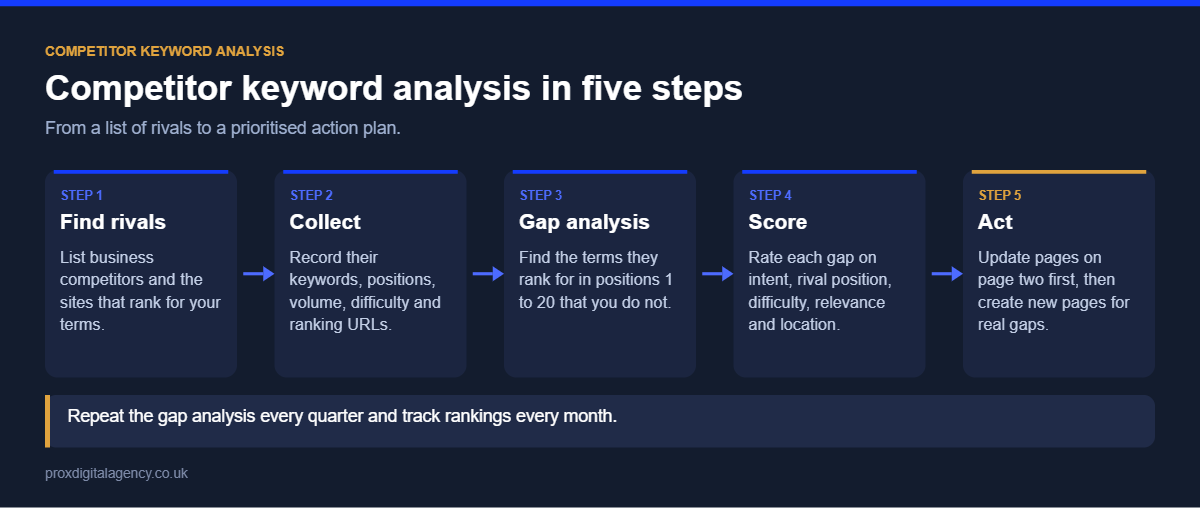
For each competitor, record the keyword, its ranking position, monthly search volume, keyword difficulty, search intent and the URL that ranks. Free tools help too. For example, Google Keyword Planner confirms demand, while Google Search Console shows the queries your own pages already appear for.
Next, remove brand terms unless you plan to target them. Then focus on positions 1 to 20, because these terms are within realistic reach.
Run a Keyword Gap Analysis
Now run a keyword gap analysis. Enter your domain and two or three competitors into your chosen tool, and it lists the terms they rank for that you do not. After that, export the results and sort them by volume and difficulty. This gives you a clear shortlist to start from.
Many teams hand this stage to an expert. Prox Digital Agency is a UK keyword research agency that helps businesses find and win the terms their competitors own. We run the gap analysis with local data built in, and then turn raw exports into a clear action plan.
Want to see the keywords your competitors are winning?
Send us your website and two or three rivals. We will run a keyword gap analysis and show you the terms worth chasing first, free.
Get a free keyword gap reviewSee our keyword research services →
How to Turn Competitor Keyword Gaps Into Rankings
However, a gap list can hold hundreds of terms, and not all of them deserve your time. So, you need a clear method to choose the ones that will bring real traffic and enquiries.
Prioritise the Keywords Worth Chasing
For this reason, score each term against these five factors:
Once you have a shortlist, group the terms by theme. Keyword mapping makes this simple: give each page one main term and list its supporting terms beneath it. As a result, two pages never compete for the same search.
Small, specialist services need extra care. In those markets, niche keyword research finds low-competition phrases that larger rivals often overlook.
Turn Your Competitor Keyword Analysis Into Tasks
A competitor keyword analysis only works when it leads to action. So, give every priority term a clear task, such as “update this page” or “create a new page”. Then add an owner and a date, so the work actually happens.
Improve Existing Pages Before Writing New Ones
Start with what you already have, because updating a page is often quicker than building a new one:
- First, find your pages that already rank on page two.
- Then add missing sections, local details and FAQs.
- Improve titles, headings and internal links.
- Finally, publish new pages only where no suitable page exists.
Let’s look at an example. A UK online garden furniture shop has a category page for “rattan garden furniture” that ranks 14th. Meanwhile, a rival ranks 6th for the same term and includes a section on “rattan sets for small gardens”. So, the shop adds a short buying guide on that topic, with links to suitable products. Now the page answers what shoppers want to know.
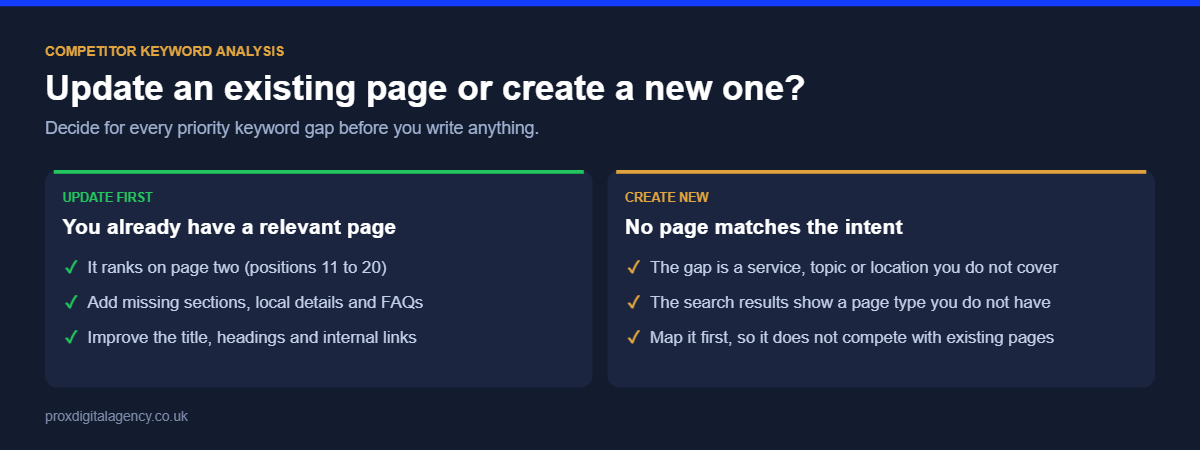
Afterwards, track your rankings every month. In addition, repeat the keyword gap analysis every quarter to catch new competitor pages and fresh opportunities.
Competitor Keyword Analysis for Local Searches
For UK businesses that serve specific areas, location changes the picture. People search differently from one city, town or neighbourhood to the next. So, search with a city or area modifier, such as “electrician Leeds”, and review the Local Pack and organic results separately.
After that, check each competitor’s Google Business Profile and location pages. Also, set your tool’s location to the UK, or to a specific city, so the data reflects local demand.
Win More Search Traffic With Competitor Keyword Analysis
Competitor keyword analysis gives your content a clear direction. You find the right competitors, collect their ranking terms, score the gaps and act on the best ones. Combined with wider keyword research, your plan rests on facts, not guesswork.
Prox Digital Agency helps UK businesses turn these findings into higher rankings and more enquiries. Our team handles the research, builds a clear keyword plan and tracks your progress month by month. In addition, we bring local search expertise to every project.
Ready to win the keywords your rivals own? Contact us today for a personalised analysis of your market.
Prox Digital Agency
Win the keywords your rivals own
We find your real search competitors, collect their ranking terms, score every gap by intent, difficulty and value, and give you a clear plan of pages to update and create. Start with a free keyword gap review.
Frequently Asked Questions
How often should I run a competitor keyword analysis?
Run a full review every quarter and check rankings every month. In fast-moving markets, such as seasonal retail or emergency services, review your main terms monthly.
Can I analyse competitor keywords for free?
Yes. Use incognito searches, Google autocomplete and competitor page titles for a basic check. Google Keyword Planner often shows volume ranges unless you run ads, while Google Search Console adds free data on your own queries. Paid tools then add difficulty scores and full ranking lists.
How many competitors should I analyse?
Start with two or three. Include at least one business competitor and one search competitor. A small set keeps the research manageable.
Should I target every keyword my competitors rank for?
No. Some terms are irrelevant to your services, and others sit outside your service area. Instead, choose terms that match your offer, suit your location and show buying intent.
How do I run a competitor keyword analysis for local searches?
Search with a city or area modifier, such as “electrician Leeds”, and review the Local Pack and organic results separately. Then check each competitor’s Google Business Profile and location pages. Finally, set your tool’s location to the UK or a specific city, so the data reflects local demand.


 Prox Digital Agency, London
 5 mins
Prox Digital Agency Named Second in NeuralAdX Ltd’s “Best Google Gemini Optimisation Agency UK” Comparison

International SEO Keyword Research: How We Research New Markets (UK, US, UAE and Australia)

Keyword Mapping: How to Assign Keywords to Pages and Avoid Cannibalisation

Niche Keyword Research: How to Find Low-Competition Keywords Your Competitors Miss
Keyword Research for PPC: How to Find Google Ads Keywords That Convert

How to Do Keyword Research: A Step-by-Step Guide for UK Businesses (2026)

Headless SEO: How to Rank a Headless CMS or API-Driven Website

Faceted Navigation SEO: Stop Filters Wasting Crawl Budget on Your Ecommerce Site