Local SEO for Law Firms: How UK Solicitors Can Win More Local Enquiries
Local SEO for law firms helps solicitors improve their visibility in location-based searches on Google Search and Google Maps. It focuses on accurate business listings, relevant legal service pages, client reviews, and clear information about the areas a firm serves.
When someone searches for “family solicitor in Manchester” or “conveyancing solicitors near me”, they’re usually looking for legal assistance relevant to their circumstances and location.
But how can a law firm appear in these searches and encourage suitable enquiries?
The answer involves matching legal services to search intent, maintaining reliable business information and demonstrating professional credibility.
This guide explains how UK law firms can improve local SEO, optimise Google Business Profiles, structure practice-area content and attract relevant enquiries while following professional advertising standards.
Why Is Local SEO Important for Law Firms?
Local SEO helps law firms reach prospective clients who are searching for legal services within a particular geographic area.
Although some legal work can be delivered remotely, location remains important for clients who prefer accessible offices, local knowledge, or face-to-face appointments.
For example, someone buying a property in Leeds may search for conveyancing solicitors nearby, while a business owner in Birmingham might look for an employment solicitor.
Improve Visibility for Relevant Legal Searches
For example, a law firm can target searches connected to its genuine practice areas and locations.
Google considers relevance, distance and prominence when determining local results, so firms need accurate listings and useful website information.
However, optimisation doesn’t guarantee a particular Google Maps position.
Help Prospective Clients Evaluate Your Firm
Legal enquiries often involve significant financial, personal or business decisions.
Prospective clients may compare qualifications, experience, services, fees and communication options before contacting a solicitor.
As a result, clear information makes that evaluation easier.
Attract More Relevant Enquiries
Not every website visitor is a suitable prospective client.
A firm specialising in commercial property should distinguish its services from residential conveyancing if it doesn’t handle that work.
In short, the objective is to attract enquiries that match the firm’s actual expertise and capacity.
For a broader explanation of local ranking factors, read our complete guide to local SEO.
How Does Local SEO for Law Firms Work?
Solicitor SEO combines local business information, relevant legal content, website accessibility, and professional reputation.
Google’s local ranking systems consider three principal factors:
- Relevance: How closely the firm matches the search.
- Distance: How far the firm is from the location associated with the search.
- Prominence: How established the business is, including signals such as links and reviews.
For example, a solicitor searching for visibility across Greater London may perform differently in separate boroughs because proximity and competition vary.
A law firm can improve its business information and website content, but it cannot directly control every ranking factor.
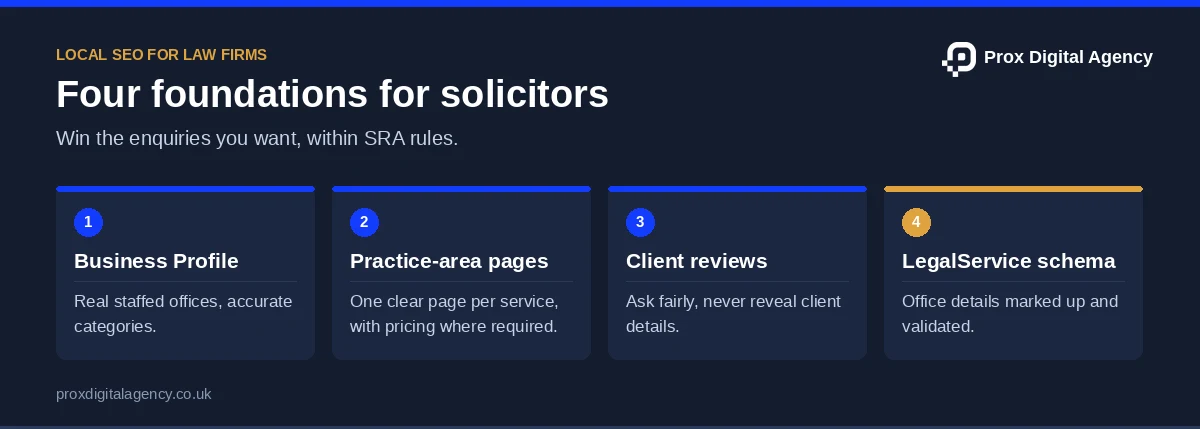
Step 1: Optimise Your Law Firm’s Google Business Profile
Google Business Profile allows eligible law firms to manage information displayed in Google Search and Maps.
As a result, an accurate profile helps potential clients identify your office, services, and contact details.
Choose Relevant Business Categories
Select the category that best represents your firm’s primary activity.
Then, where appropriate, additional categories may reflect genuine legal services.
For example, a specialist family law practice should not select unrelated categories simply to attract more searches.
Also, use your recognised trading name without adding promotional keywords.
Maintain Accurate Office Information
Check your business name, address, telephone number, website and opening hours.
In addition, include genuine office photographs and relevant service information.
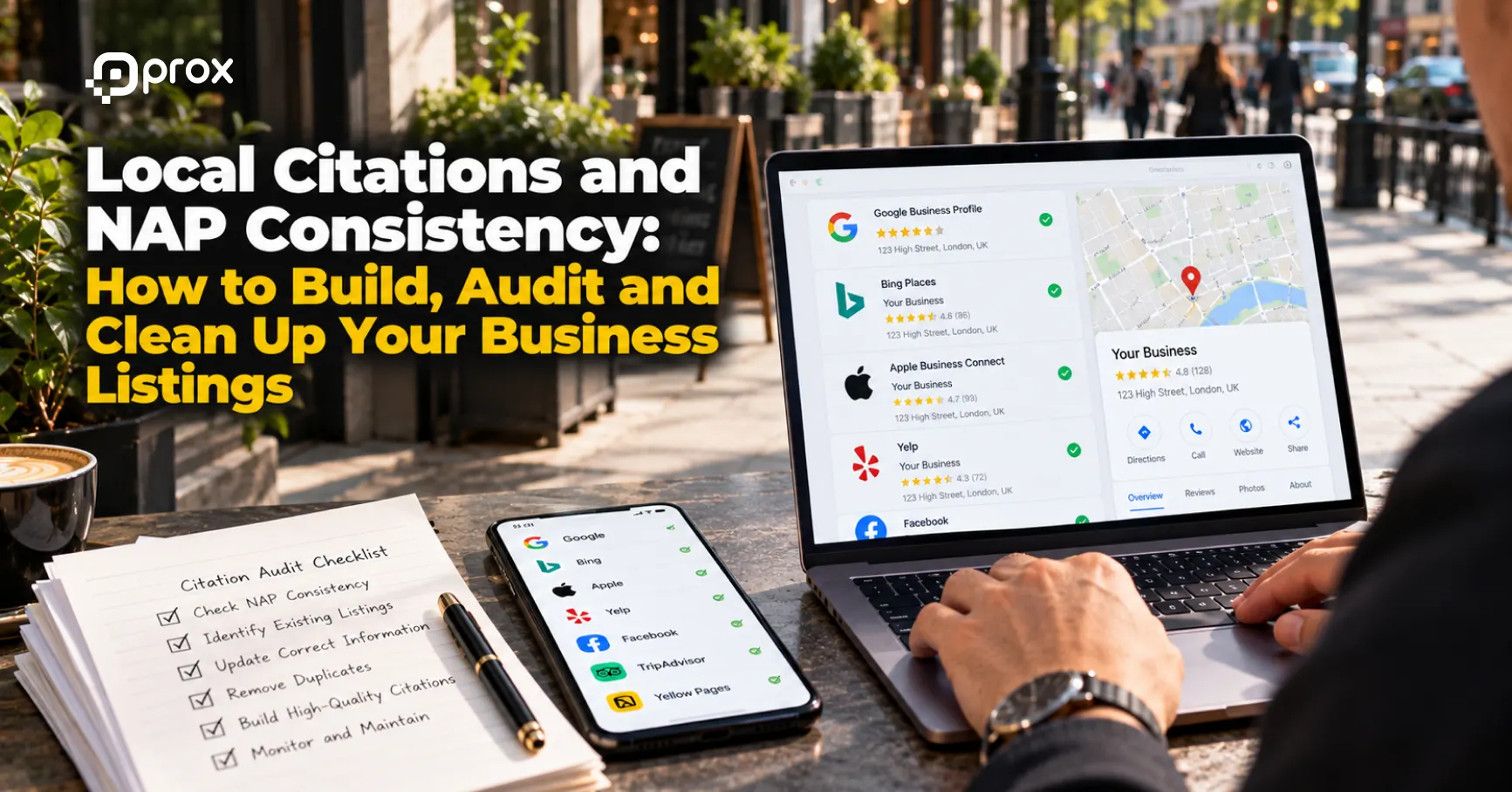
If clients can visit the premises, ensure that the listing reflects an eligible, properly staffed location. Accurate business listings matter too, so see our guide to local citations and NAP consistency.
Avoid creating listings at virtual offices where your firm doesn’t genuinely operate.
Understand Individual Solicitor Listings
Google allows eligible public-facing legal practitioners to maintain separate business profiles under specific conditions.
However, solicitors must be directly contactable at the verified location during their stated hours.
However, separate profiles shouldn’t be created for each legal specialism or simply to gain additional search exposure. Work through our Google Business Profile optimisation checklist to cover every field.
Step 2: Research Local SEO Keywords for Law Firms
Legal keyword research should reflect both the firm’s practice areas and the types of enquiries it wants to receive.
Someone searching for “solicitor Manchester” may have a different requirement from someone searching for “commercial lease solicitor Manchester”.
Group Keywords by Practice Area
First, start by identifying your genuine areas of work.
These are illustrative searches rather than verified keyword-volume recommendations.
Match Search Intent to Relevant Pages
Each important practice area should have a page explaining the services offered.
A family law page, for example, should not attempt to target every unrelated legal service.
Also, use descriptive titles, clear headings, and naturally placed geographic references.
At the same time, avoid repeating the same city and practice-area keywords unnecessarily.
Consider Client Terminology
Prospective clients may use terms such as “lawyer”, “solicitor”, “legal advice”, or “law firm”.
Therefore, use terminology that accurately reflects your professional status and services.
Content should help visitors understand whether your firm can handle their matter, not simply target every possible keyword variation.
Step 3: Create Useful Legal Practice Area Pages
Practice-area pages should explain the scope of your services and help prospective clients understand the next step.
However, they should be informative without providing misleading guarantees.
Explain the Services Clearly
A useful legal service page may cover:
- The types of matters the firm handles
- Who the service is intended for
- The general process and next steps
- Relevant qualifications and experience
- Fees and pricing information, where appropriate
- How to arrange an initial enquiry
For example, an employment law page could distinguish between services for employers and employees where the firm provides both.
Demonstrate Relevant Professional Experience
Include accurate information about the solicitors responsible for the work.
For example, professional biographies can explain qualifications, practice areas and relevant experience.
Avoid unsupported statements such as “guaranteed success” or “the UK’s most successful solicitors”.
In all cases, any claims about expertise, outcomes or professional status should be accurate and supportable.
Keep Calls to Action Appropriate
Contact forms and telephone details should be easy to find.
Explain how prospective clients can make an enquiry and what information they may need to provide initially.
Also, avoid asking for unnecessary sensitive details through general marketing forms.
Step 4: Follow UK Legal Advertising and Transparency Requirements
Law firm marketing must reflect the professional rules applying to the firm’s jurisdiction and regulator.
For solicitors regulated by the Solicitors Regulation Authority in England and Wales, publicity must be accurate and not misleading.
Scotland and Northern Ireland have separate professional regulatory arrangements, so firms operating there should follow their applicable requirements.
Publish Clear Pricing Information
The SRA Transparency Rules require covered firms to publish specified pricing and service information for certain services.
These include residential conveyancing, uncontested probate, immigration applications (excluding asylum), summary-only road traffic offences, employment tribunal claims for unfair or wrongful dismissal, debt recovery up to £100,000 and licensing applications for business premises. Clinics can see how this works in practice in our guide to local SEO for dentists.
Where the rules apply, information must cover relevant costs, what is included, likely disbursements, key stages and typical timescales.
Firms should review the official requirements rather than assuming that every legal service has identical publication obligations.
Represent Professional Status Accurately
In addition, website content should clearly explain the firm’s regulatory status.
Avoid presenting unregulated services as SRA-regulated or making inaccurate claims about professional qualifications.
Required regulatory and complaints information should be accessible. SRA-authorised firms must also show their SRA number and the SRA digital badge in a prominent place on their website, which doubles as a strong trust signal for local visitors.
Avoid Misleading Claims
Legal marketing shouldn’t promise particular outcomes or suggest that previous results guarantee success in future matters.
For example, a personal injury firm should avoid advertising a guaranteed compensation amount.
Ultimately, the purpose of legal content is to help prospective clients make informed decisions.
Want more enquiries for the work you actually want?
We will check your firm’s profile, practice-area pages and reviews against what local clients search for, free.
Step 5: Manage Google Reviews for Solicitors Responsibly
Client reviews can help prospective clients understand a law firm’s service and communication standards.
Google also identifies review quantity and positive ratings among the factors that can contribute to local prominence.
However, legal reviews require care because clients may discuss confidential matters.
Request Genuine Client Feedback
Where appropriate, invite clients to leave voluntary, honest feedback.
Avoid incentives, fabricated reviews, or requests designed to collect only positive ratings.
Any review process should also respect the firm’s professional responsibilities and applicable privacy requirements.
Respond Without Revealing Confidential Information
A client may mention a legal matter publicly, but the firm should not disclose confidential details in its response.
A suitable reply might be:
“Thank you for sharing your feedback. We take client concerns seriously and would welcome the opportunity to discuss this directly through our usual contact channels.”
Above all, avoid confirming that someone is a client or discussing the details of their case.
Handle Negative Feedback Professionally
Negative reviews should be assessed carefully before responding.
Where necessary, refer the matter to an appropriate member of the firm.
Don’t attempt to remove genuine criticism simply because it’s unfavourable.
For more guidance, read our guide on how to get more Google reviews.
Step 6: Maintain Accurate Legal Directory Listings
Law firms may appear across mapping services, professional directories and regional business listings.
As a result, keeping those records accurate helps potential clients find correct contact information.
Check NAP Consistency
NAP stands for Name, Address, and Phone number.
Review your firm’s important listings for outdated addresses, incorrect telephone numbers, and duplicate records.
A client should be able to identify the correct office and contact details regardless of where they discover the firm.
Review Relevant Professional Directories
Consider appropriate professional listings, including directories associated with recognised legal organisations.
However, make sure the firm is eligible for each listing and that any claims about accreditation or membership are accurate.
Don’t submit the business to irrelevant directories solely to acquire backlinks.
Update Information After Office Changes
Relocations, rebranding, and telephone number changes should trigger a review of important listings.
Where a firm has multiple offices, maintain accurate details for every eligible location.
Step 7: Improve Local Relevance Through Helpful Legal Content
Useful legal content can address questions people ask before contacting a solicitor.
However, legal information must be accurate, appropriately qualified and kept current.
Answer Common Client Questions
Relevant subjects may include:
- What documents are needed for a conveyancing enquiry?
- How are solicitor fees calculated?
- What happens during an initial legal consultation?
- How can someone check a solicitor’s professional status?
These topics help prospective clients understand legal services without promising advice for their individual circumstances.
Review Legal Accuracy
Laws, procedures and regulatory guidance can change.
Identify when content was last reviewed and arrange appropriate checks by qualified legal professionals.
Therefore, avoid presenting outdated information as current.
Use Genuine Local Context
Where relevant, explain the areas your firm serves, available appointment arrangements, and actual office locations.
Don’t manufacture local case studies or imply a presence in towns where the firm doesn’t operate.
Step 8: Implement LocalBusiness Schema for Law Firms
In short, structured data helps search engines interpret information about a business.
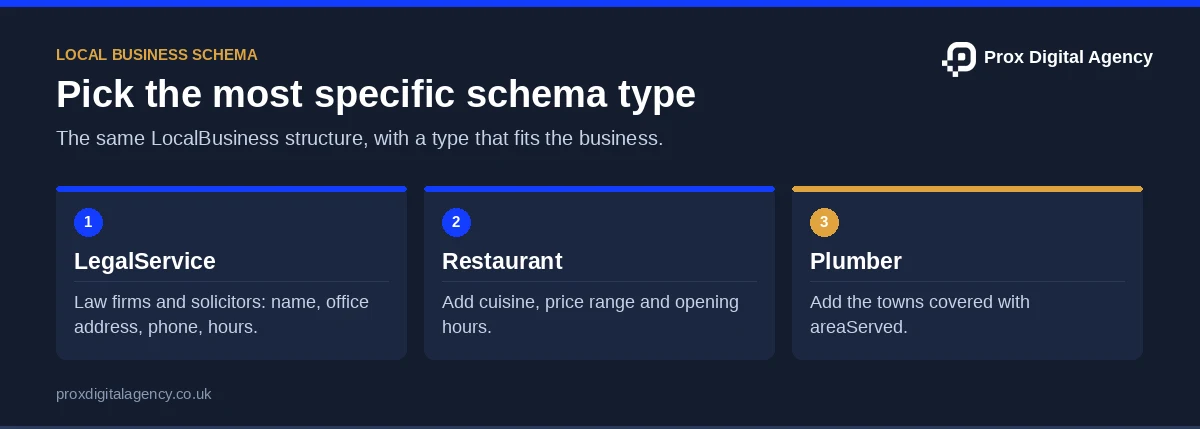
A law firm can use an appropriate schema.org type, such as LegalService or a more specific supported type, to describe relevant business information.
Include Accurate Business Details
Useful properties may include:
- @type: Relevant business type
- name: Official business name
- address: Genuine office address
- telephone: Contact number
- url: Website address
- openingHoursSpecification: Applicable opening hours
Where relevant, firms may also describe their geographic coordinates and associated location information.
Example: LegalService Schema
The following simplified JSON-LD example illustrates the structure for a fictional law firm.
{
  "@context": "https://schema.org",
  "@type": "LegalService",
  "name": "Example Legal LLP",
  "url": "https://www.example.com/",
  "telephone": "+44 20 0000 0000",
  "address": {
    "@type": "PostalAddress",
    "streetAddress": "Example Street",
    "addressLocality": "London",
    "postalCode": "SW1A 1AA",
    "addressCountry": "GB"
  }
}
Replace the fictional information with accurate business details before implementation.
Examples: Restaurant and Plumber Schema
The same structure works for any local business. Swap the @type for the most specific schema.org subtype that fits, then add the details customers care about. A restaurant might add its cuisine, price range and opening hours:
{
  "@context": "https://schema.org",
  "@type": "Restaurant",
  "name": "Example Kitchen",
  "servesCuisine": "Italian",
  "priceRange": "££",
  "telephone": "+44 161 000 0000",
  "address": {
    "@type": "PostalAddress",
    "streetAddress": "1 Example Road",
    "addressLocality": "Manchester",
    "postalCode": "M1 1AA",
    "addressCountry": "GB"
  },
  "openingHours": "Mo-Su 12:00-22:00"
}
A plumber who travels to customers can list the towns it covers with areaServed, and show only the town in its address if it does not receive visitors:
{
  "@context": "https://schema.org",
  "@type": "Plumber",
  "name": "Example Plumbing Ltd",
  "url": "https://www.example.com/",
  "telephone": "+44 121 000 0000",
  "areaServed": [
    "Birmingham",
    "Solihull",
    "Sutton Coldfield"
  ],
  "address": {
    "@type": "PostalAddress",
    "addressLocality": "Birmingham",
    "addressCountry": "GB"
  }
}
Validate Your Markup
Use Google’s Rich Results Test and a suitable schema validator to review the markup. Our schema markup guide walks through testing step by step.
Ensure structured information matches the visible website content.
Schema can help describe your business, but it doesn’t guarantee higher Google Maps rankings or a special search result.
Step 9: Improve Website Usability and Enquiry Quality
Law firm websites should make important information accessible without unnecessary navigation.
Prospective clients may be dealing with unfamiliar legal processes and need straightforward explanations.
Make Contact Information Easy to Find
Provide clear telephone numbers, office details, and enquiry options.
Explain whether consultations are available in person, remotely, or through other arrangements.
Review Mobile Usability
Check that important pages work correctly on smartphones.
Forms, navigation, and contact links should be accessible and functional.
Avoid requiring excessive personal information before someone can make an initial enquiry.
Protect Client Information
Enquiry forms should use appropriate security and privacy safeguards.
Collect only the information needed for the stated purpose and avoid unnecessarily requesting confidential case details through general marketing forms.
Step 10: Measure Local SEO Performance for Law Firms
Local SEO performance should be assessed through relevant enquiries rather than rankings alone.
Google Search Console can help identify searches generating impressions and clicks.
Google Business Profile performance data may provide information about calls, website clicks, and other interactions.
Track Relevant Enquiry Metrics
Useful measures include:
- Search visibility for priority practice areas
- Visits to relevant legal service pages
- Telephone and form enquiries
- Initial consultation requests
- Enquiries from target locations
- Qualified enquiries matching the firm’s services
Evaluate Enquiry Quality
More enquiries don’t always mean better results.
For example, a commercial law firm receiving residential property enquiries may need to clarify its website content.
Review which pages and search terms attract suitable prospects, while respecting confidentiality and data protection requirements.
Monitor Performance Over Time
Compare results across meaningful periods.
Account for changes in demand, marketing activity, and the firm’s available capacity.
Avoid assuming that a short-term ranking movement reflects the effectiveness of the entire SEO strategy.
Common Local SEO Mistakes Law Firms Should Avoid
Several issues can limit the usefulness of a law firm’s online presence.
Targeting Unrelated Legal Services: Pages should reflect work the firm actually undertakes.
Making Unsupported Claims: Professional achievements and expected outcomes must be described accurately.
Publishing Outdated Legal Information: Review content when relevant law or guidance changes.
Disclosing Confidential Information in Reviews: Public responses should protect client privacy.
Creating Ineligible Office Listings: Virtual locations don’t automatically qualify for Google Business Profiles.
Ignoring Pricing Transparency: Publish required information in accordance with the applicable regulator’s rules.
Measuring Traffic Alone: Qualified enquiries are more meaningful than irrelevant website visits.
When to Get Professional Help With Local SEO for Law Firms
Professional support may be useful when a firm struggles with inconsistent local visibility, outdated website content, technical issues, or multiple office listings.
A coordinated approach can help connect practice-area pages, accurate business information, internal linking, and performance measurement.
At Prox Digital Agency, our approach focuses on improving relevant search visibility and making it easier for businesses to attract suitable enquiries.
Explore our local SEO agency London services to understand how professional support can fit your firm’s marketing objectives.
Frequently Asked Questions About Local SEO for Law Firms
How Can Solicitors Rank Higher on Google Maps?
Maintain an accurate Google Business Profile, relevant legal service information, and genuine reviews. Google considers relevance, distance, and prominence, so no single optimisation guarantees better rankings.
Does Every Solicitor Need a Google Business Profile?
No. Google allows separate profiles for eligible public-facing practitioners who can be contacted directly at their verified location. Individual solicitors shouldn’t create multiple profiles for different specialisms.
What Is the Best Local SEO Strategy for Small Law Firms?
Begin with accurate business information, clear practice-area pages, relevant local keywords, and a manageable review process. Focus on the legal services and locations that matter most to the firm.
Can LegalService Schema Improve Google Maps Rankings?
The LegalService schema can help search engines interpret accurate business information, but Google doesn’t guarantee higher Map Pack rankings from implementing structured data.
How Long Does Local SEO for Law Firms Take?
There is no fixed timeframe. Progress depends on the firm’s existing visibility, location, competition, and website condition. Some corrections may be reflected quickly, while broader improvements require ongoing work.
Conclusion: Building a Local Presence Clients Can Rely On
Choosing legal representation requires confidence in a firm’s experience, professionalism, and ability to handle a particular matter.
Local search visibility helps prospective clients discover relevant solicitors, but the information they find must also support an informed decision.
For law firms, a reliable online presence should reflect genuine expertise, accurate business details, and clear communication.
The goal is to make the right legal services easier to find while giving prospective clients the information they need to take the next step.
Prox Digital Agency · Local SEO
Need solicitor SEO that respects SRA rules?
We help law firms win qualified local enquiries with accurate profiles, clear practice-area pages and compliant review management.

 Muhammad Bilal, London
 12 mins
How to Get More Google Reviews (and Handle Negative Ones) Without Hurting Your Rankings
Local SEO for Dentists and Private Clinics: How to Win Patients Searching Nearby
Local SEO Audit: How to Find What Is Holding Back Your Map Pack Rankings

Local Link Building: 12 Ways to Earn Links From Your Community, Press and Partners
Beyond Google: How to Set Up Apple Business Connect and Bing Places for Local Visibility
Local SEO for Service-Area Businesses: How to Rank Without a Shop or Office

The Complete Guide to Hiring a Web Development Agency in the UK (2027)
Local SEO for Multiple Locations: How to Rank Every Branch Without Duplicate Content