What Is Local SEO? A Complete Guide to Ranking in Google Maps and Local Search (2026)
Local SEO helps businesses appear in location-based searches when potential customers are looking for nearby products or services. For example, someone in Manchester searching for an emergency plumber, a parent in Birmingham looking for a dentist, or a homeowner in London finding a reliable electrician.
But what happens when your business offers those services, yet competitors appear more prominently in Google Maps?
Local SEO (Search Engine Optimisation) focuses on improving your business’s visibility in Google Search and Google Maps, making it easier for nearby customers to discover your services.
However, improving local rankings involves more than adding location keywords to your website or creating a Google Business Profile.
This guide explains what local SEO is, how Google determines local rankings, the key factors influencing visibility, and how to build a practical local SEO strategy in 2026.
What Is Local SEO, and How Does It Work?
Local SEO is the process of improving a business’s online presence to make it more visible when people search for products or services within a particular geographic area.
Unlike traditional SEO, which can target audiences nationally or internationally, local SEO focuses on searches where location matters.
Consider these examples:
- “Accountant near me”
- “Best Italian restaurant in Leeds”
- “Emergency Electrician Birmingham”
- “Private Dental Clinic Manchester”
In each case, the search shows that the person wants a business connected to a specific location.
Google uses information about the search, the user’s location, business listings and relevant websites to determine which results to display.
For example, someone searching for “coffee shop” while standing in central Bristol will likely see different local businesses from someone using the same search term in Edinburgh.
That’s because Google recognises that geographical relevance is important to the search.
How Does a Local Search Work?
A typical local search journey might look like this:
- A customer searches for a nearby product or service.
- Google identifies the searcher’s likely location and intent.
- Relevant businesses appear in Google Maps, local listings or organic results.
- The customer compares reviews, opening hours, services and locations.
- They visit the website, request directions, call or make a booking.
Local SEO works on improving your business’s ability to appear and compete throughout that journey.
This means your Google Business Profile, website, business information, customer reviews and online reputation should work together rather than operate separately.
Why Is Local SEO Important for UK Businesses?
For local businesses, visibility is valuable because it connects your services with people who can realistically become customers.
A London-based plumbing company probably doesn’t need to attract homeowners searching for plumbers in Glasgow. It needs to reach people within the areas its team can serve.
Local SEO helps make that targeting possible.
Reach People with Immediate Buying Intent
Many local searches happen when someone has already identified a need.
A person searching for “emergency locksmith near me” may be ready to call immediately, while someone researching “how do door locks work” probably isn’t.
By appearing for relevant local queries, your business has an opportunity to reach customers further along their buying journey.
Build Trust Before the First Enquiry
Search visibility alone doesn’t guarantee a new customer.
People often compare several businesses before deciding whom to contact. Accurate business information, relevant services, useful website content, and genuine customer reviews help them make that decision.
A complete online presence makes it easier for potential customers to understand what your business offers and whether it meets their needs.
Compete More Effectively in Your Area
Local SEO allows smaller businesses to compete for geographically relevant searches rather than relying entirely on broad national visibility.
A well-established independent dental practice, for example, may be highly relevant to nearby patients even when larger healthcare brands have greater overall marketing resources.
The goal isn’t simply to attract more website traffic. It’s to attract the right people in the right locations.
For a more practical starting point, follow our 90-day plan for small businesses.
Local SEO vs Organic SEO: What’s the Difference?
Local SEO and traditional organic SEO share many principles, but they serve different search needs.
Organic SEO generally focuses on improving website visibility for relevant search queries, regardless of whether those searches have a specific geographical intent.
Local SEO places additional emphasis on geographic relevance, business location, local listings and proximity to the searcher.
Here’s how they compare:
Can Local SEO and Organic SEO Work Together?
Absolutely. In fact, separating them completely can weaken your overall strategy.
Consider an accountancy practice in London.
Its Google Business Profile can help potential clients discover the business through local searches. Meanwhile, its website might rank organically for queries such as “accountant for limited companies in London” or “how to prepare small business accounts”.
Both search journeys can contribute to new enquiries.
The strongest approach combines local business visibility with useful, well-optimised website content.
Local SEO isn’t a replacement for organic SEO. It’s a specialised approach that builds on many of the same foundations.
Understanding Google Maps, the Local Pack and Local Search Results
When someone performs a location-based search, Google may display several types of results.
Knowing where your business can appear is essential before you decide what to optimise.
What Is the Google Local Pack?
The local pack, commonly called the Map Pack, is a prominent section of Google Search that can display a map alongside a selection of relevant local businesses.
For example, a search for “dentists in Nottingham” might show local listings with business names, ratings, locations, and other useful details.
Users can then explore additional results in Google Maps.
The local pack provides a convenient way to compare businesses without visiting multiple websites.
However, its appearance and layout can vary depending on the search query, device, and Google’s available features.
Google Maps vs Traditional Organic Results
Google Maps focuses on helping users discover businesses and places.
Traditional organic results typically point to webpages that answer the search query.
In fact, a local business can appear in both.
For example, a Birmingham-based roofing company might be visible through its business profile and separately through a useful service page on its website.
These are different opportunities, which is why optimising a business listing without improving the website can leave valuable visibility untapped.
Why Local Rankings Change by Location
One important difference between local and traditional organic rankings is that location can significantly change the results.
A business may appear prominently when someone searches from one neighbourhood but be less visible several miles away.
However, this doesn’t automatically mean its SEO is failing.
Proximity is part of how Google evaluates local searches, and rankings can also change with query wording and competing businesses.
Rather than treating one fixed ranking as the complete picture, businesses should assess visibility across the areas that matter commercially.
Local SEO Ranking Factors: How Google Ranks Local Businesses
Google uses three main factors to determine local rankings: relevance, distance and prominence. These help Google identify businesses that best match a user’s local search. Google explains all three in its own guide, Tips to improve your local ranking on Google.
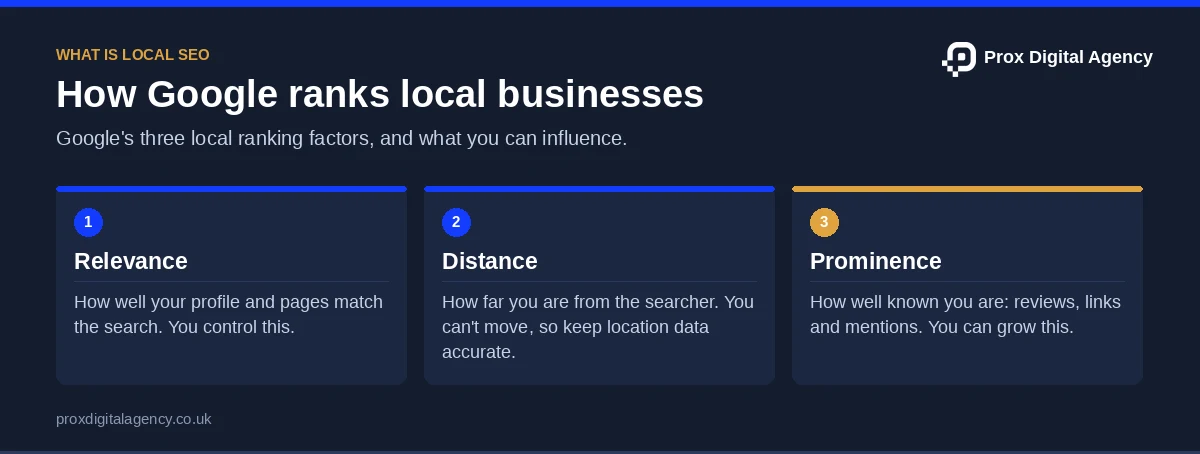
1. Relevance: Does Your Business Match the Search?
Relevance measures how closely your business matches a search query. Accurate business categories, service descriptions and website content help Google understand what you offer. For example, a dental practice offering children’s dentistry should clearly mention that service.
2. Distance: How Close Is the Business?
Distance refers to how far your business is from the searcher’s location or the area specified in their search. While you can’t control proximity, keeping your location information accurate helps Google identify where your business operates.
3. Prominence: How Established Is the Business?
Prominence reflects how well-known a business is, with factors such as customer reviews and links from relevant websites contributing to its online presence. However, prominence works alongside relevance and distance, and Google doesn’t disclose their exact ranking weights.
The Core Pillars of a Successful Local SEO Strategy
A successful local SEO strategy combines accurate business information, relevant website content, customer reviews and technical optimisation to improve local search visibility.
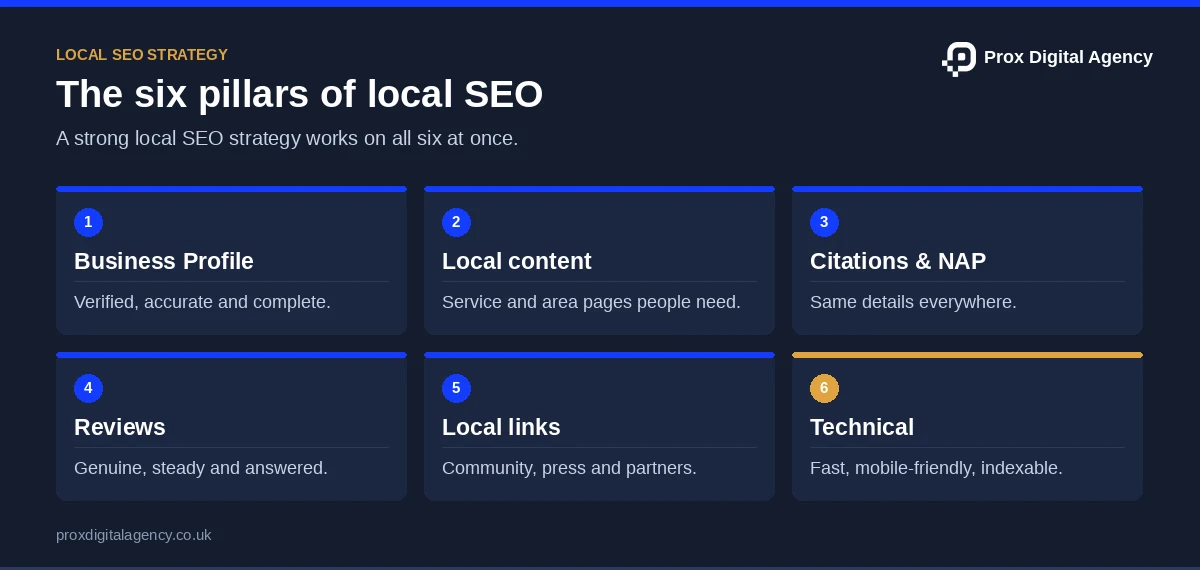
1. Google Business Profile Optimisation
Your Google Business Profile helps customers find your business on Google Search and Maps. Claim and verify your profile, choose accurate categories, and update your contact details, services, opening hours and photographs.
Use your genuine business name, avoid ineligible addresses and keep information current.
For a detailed walkthrough, use our Google Business Profile optimisation checklist.
2. Local Keyword Targeting and Relevant Website Content
Local keyword research identifies how customers search for your services in specific areas. Create useful service and location pages with clear descriptions, relevant keywords and contact information.
Avoid duplicate pages that simply replace city names without providing additional value.
For further guidance, see our regional keyword research guide and our guide to building landing pages for each area you serve.
3. Local Citations and NAP Consistency
Local citations are business mentions on directories and other websites, often including your Name, Address and Phone number (NAP).
Keep these details accurate across relevant platforms and update outdated listings whenever your business information changes.
Our guide to citations and NAP consistency explains how to review and maintain those listings.
4. Customer Reviews and Reputation Management
Genuine customer reviews help build trust and can contribute to local search prominence. Encourage honest feedback, make reviewing easy and respond professionally to both positive and negative reviews.
Avoid fake reviews, incentives or practices that manipulate ratings.
For practical methods and response examples, read how to get more Google reviews.
5. Local Link Building and Business Authority
Backlinks from relevant local publications, business associations and community organisations can support your online presence.
Focus on genuine partnerships, useful resources and local PR rather than purchasing irrelevant links.
Read our 12 ways to earn backlinks from your community for a deeper look at community partnerships, local PR and relevant link opportunities.
6. Mobile Usability and Technical Foundations
Your website should work smoothly on mobile devices, with clear navigation, accessible contact details and fast-loading pages.
Ensure important pages are crawlable and indexable, fix broken links and use accurate LocalBusiness structured data where appropriate.
If technical problems or local ranking issues are difficult to identify, a step-by-step map pack audit can help reveal where to concentrate your efforts.
Not sure why competitors outrank you in Google Maps?
Send us your business name and the area you serve. We will check your Google Business Profile, local rankings and website, and tell you what to fix first, free.
How to Build a Local SEO Strategy Step by Step
Understanding individual ranking factors is useful, but meaningful progress requires a coordinated approach.
Here’s a practical framework for bringing those elements together.
Step 1: Understand Your Customers and Competitors
Start by identifying the services people search for and the locations that matter to your business.
Next, look at the businesses appearing for relevant local queries.
What information do they provide? Are their websites useful? Which services do they explain clearly?
Then use those observations to identify opportunities rather than simply copying competitors.
Step 2: Establish Accurate Business Information
Review your Google Business Profile, website contact details, and important directory listings.
Make sure customers can identify your genuine location, service areas, opening hours, and contact information.
Correct any outdated information before expanding your optimisation efforts.
Step 3: Improve Your Most Important Website Pages
Prioritise the pages most closely connected to customer enquiries.
Write clear service descriptions, answer common questions, and explain the areas you genuinely cover.
Make relevant calls to action visible without overwhelming readers.
If you operate from several locations, each eligible branch may need its own useful location information.
Step 4: Build Trust Through Consistent Activity
Encourage genuine customer feedback, respond to reviews, and maintain your online business details.
In addition, look for relevant opportunities to earn local mentions and links.
These activities should reflect the day-to-day operation of the business rather than exist solely for search engines.
Step 5: Measure Results and Refine
Review performance regularly and compare it with your original objectives.
If one service generates meaningful enquiries while another receives little attention, investigate why.
You might need clearer content, improved business information, or better alignment with local search intent.
Local SEO works best as an ongoing process of improvement, not a one-off checklist.
Local SEO for Different Business Types
Although the foundations remain similar, businesses with different operating models need different approaches.
Single-Location Small Businesses
A café, salon or independent retailer typically needs to establish visibility around one physical location.
Priorities include an accurate business profile, relevant website content, genuine reviews and helpful business information.
Budget and staff availability also matter, so a focused approach is often more practical than trying to improve everything at once.
Multiple-Location Businesses
Businesses with several branches face additional challenges.
Each location needs accurate, distinct information, while the brand must maintain consistency across its wider online presence.
Separate eligible Business Profiles and useful branch-specific website content can help customers find the correct location.
For further guidance, explore our guide to ranking every branch without duplicate content.
Service-Area Businesses
Plumbers, mobile mechanics, electricians, and other professionals often travel to customers instead of serving them at a shopfront.
Eligible service-area businesses can maintain a Google Business Profile without displaying a residential or non-customer-facing address.
However, they must follow Google’s eligibility and address requirements. A virtual office does not automatically qualify as a legitimate business location.
Read our guide to ranking a service-area business without a shop for a more detailed explanation.
Industry-Specific Local SEO
Some industries need additional consideration because customers have different expectations.
Dental practices must communicate their services clearly and handle patient-related information appropriately. Law firms need to demonstrate relevant practice-area expertise while helping potential clients understand where they operate.
These differences deserve more than generic location keywords.
Our specialist guides cover SEO for dentists and private clinics and SEO for solicitors and law firms.
Local SEO Trends in 2026: AI Search, Voice Search and Changing Search Behaviour
The way people discover local businesses continues to evolve.
Google Maps and traditional search results remain important, but AI-powered search experiences are creating additional ways for users to research and compare options.
AI Overviews, AI Mode and Local Discovery
Google’s AI Overviews and AI Mode can help people explore questions that require more detailed answers.
For example, someone researching local accountancy services might ask what qualifications to look for, which services a small business typically needs, and how to compare local providers.
Businesses should prepare for more detailed and conversational research journeys, not just short keyword searches.
However, there is an important distinction between established guidance and speculation.
Google’s official documentation on AI features and your website states that existing SEO fundamentals continue to matter for AI search features. Businesses don’t need a special AI-only schema or additional technical requirements to become eligible for supporting links in AI Overviews or AI Mode.
Accurate content, accessible webpages, clear internal linking, and up-to-date business information remain useful priorities.
There is also no guarantee that optimising a page will cause an AI system to recommend a particular business.
Voice and Conversational Local Searches
People using voice-enabled devices may phrase searches naturally, such as “Where can I find a reliable electrician nearby?”
This makes clear service descriptions, helpful answers, and accurate local information valuable.
Rather than creating separate pages for every conversational variation, focus on answering genuine customer questions in language people understand.
Local Visibility Beyond Google
Google isn’t the only platform where customers discover nearby businesses.
Apple Maps and Bing Places can also play a role in business discovery.
Keeping information accurate across relevant platforms helps customers find consistent details wherever they search.
Explore our Apple Business Connect and Bing Places set-up guide to understand how these platforms fit into a broader local visibility strategy.
How to Measure Local SEO Performance
A successful local SEO strategy needs measurable business outcomes.
Ranking reports can be useful, but they don’t tell the complete story.
A business appearing prominently for an irrelevant search term may receive little commercial benefit. Meanwhile, fewer visits from people ready to enquire can be much more valuable.
Track Local Visibility
Monitor relevant searches across important service areas.
Remember that rankings may vary by geographic position, so avoid relying on a single location or one isolated search.
Look for patterns over time rather than reacting to every fluctuation.
Monitor Customer Actions
Google Business Profile performance reporting can provide information about customer interactions, including calls, website clicks, and direction requests where available.
These metrics help explain how customers engage with your listing.
However, a call-button click doesn’t necessarily mean a completed phone conversation, and a direction request doesn’t guarantee a store visit.
Connect Visibility With Enquiries
Website analytics and enquiry tracking can help assess whether local search traffic supports business goals.
Useful measures include:
- Relevant organic traffic from target locations.
- Enquiry forms and qualified leads.
- Phone enquiries and booking requests.
- Completed appointments or purchases where tracking is possible.
- Engagement with priority service pages.
Compare performance across meaningful periods and account for seasonal demand.
If your business needs a more systematic diagnostic process, start with a full audit of your map pack visibility rather than making changes based on rankings alone.
When Should You Consider Professional Local SEO Support?
Some businesses can handle the basics internally, especially when they have one location and a manageable number of services.
However, professional support may become valuable when rankings remain inconsistent, competitors dominate important searches, locations are expanding, or internal resources are limited.
An experienced team can help connect technical SEO, local content, business profile management and performance measurement into one coordinated strategy.
At Prox Digital Agency, our local search approach helps businesses improve relevant visibility and create more opportunities for meaningful customer enquiries.
If you want to understand how professional support could fit your business, explore our local SEO agency services.
Frequently Asked Questions About Local SEO
Can I Do Local SEO Myself?
Yes. Business owners can handle many foundational activities themselves, including managing an eligible Google Business Profile, reviewing contact information, collecting genuine reviews, and improving website content.
The main challenge is maintaining consistency and knowing which activities deserve priority.
A structured approach is more useful than making occasional changes without measuring their impact.
How Long Does Local SEO Take to Work?
There isn’t a universal timeframe.
Progress depends on factors such as competition, your existing online presence, the quality of your website, and the problems that need correcting.
Some improvements, such as fixing inaccurate contact details, can become visible relatively quickly. More competitive visibility goals may require sustained work over several months.
Avoid anyone promising a guaranteed ranking within a fixed period.
Do I Need a Website for Local SEO?
An eligible business can manage a Google Business Profile without having a separate website.
However, a website provides more space to explain services, answer customer questions, demonstrate expertise, and attract organic search traffic.
For most businesses, combining an accurate business profile with a useful website creates a stronger overall foundation.
Is Local SEO Only About Google Maps?
No. Google Maps is an important part of local discovery, but local SEO also involves traditional search results, relevant website content, business information, online reviews, and other discovery platforms.
A balanced strategy considers how customers find and evaluate businesses throughout their search journey.
How Much Does Local SEO Cost?
Costs depend on the size of the business, its target locations, competition, and the work required.
A single-location business with an established website will typically have different needs from a company managing dozens of branches.
For a more detailed breakdown, read our guide to UK local SEO pricing.
Conclusion: Turning Local Visibility Into Business Growth
Local SEO isn’t simply about appearing higher on Google Maps. It’s about making your business easier to discover, understand, and trust when potential customers are searching nearby.
A strong foundation combines accurate business information, relevant website content, genuine reviews, local authority, and consistent performance monitoring.
As search experiences continue to evolve in 2026, these fundamentals remain important.
Whether you’re building visibility for a single shop, managing several branches or serving customers across a wider area, the objective stays the same: connect the right local customers with the services your business genuinely provides.
Start with the basics, measure what matters, and build a local search presence that supports sustainable business growth.
Prox Digital Agency · Local SEO
Want to rank in the map pack where your customers search?
Our local SEO team handles Google Business Profile optimisation, citations, reviews, local content and tracking, so more nearby customers find and contact you.

 Muhammad Bilal, London
 13 mins
Local Citations and NAP Consistency: How to Build, Audit and Clean Up Your Business Listings
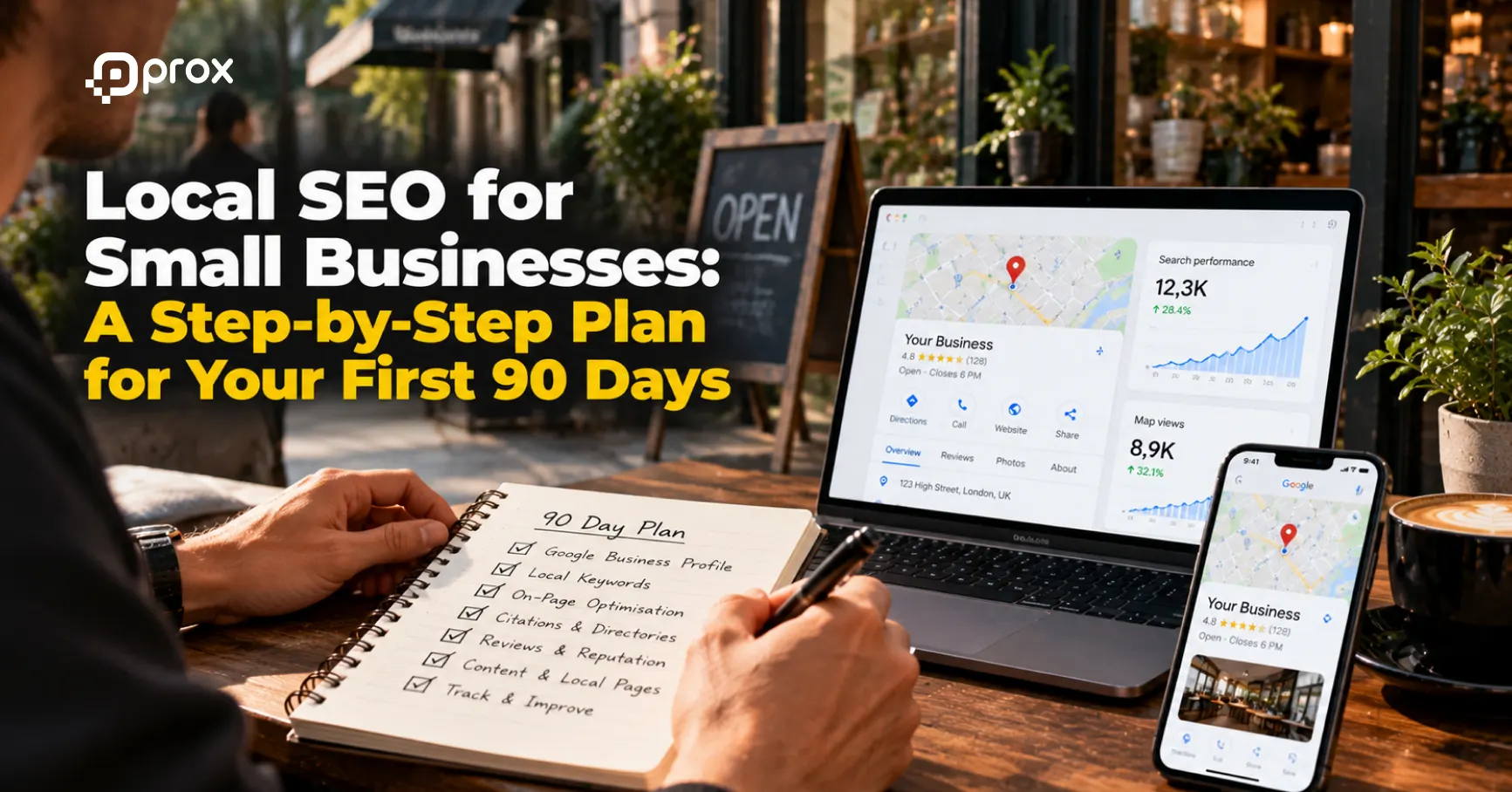
Local SEO for Small Businesses: A Step-by-Step Plan for Your First 90 Days

Prox Digital Agency Releases Free 2027 Website Checklist as Fewer Than Half of Mobile Sites Pass Google’s Speed Test

B2B SEO Case Study: How We Took Aegotel from Hacked and Invisible to Full Tracking

Prox Digital Agency Named Second in NeuralAdX Ltd’s “Best Google Gemini Optimisation Agency UK” Comparison

International SEO Keyword Research: How We Research New Markets (UK, US, UAE and Australia)
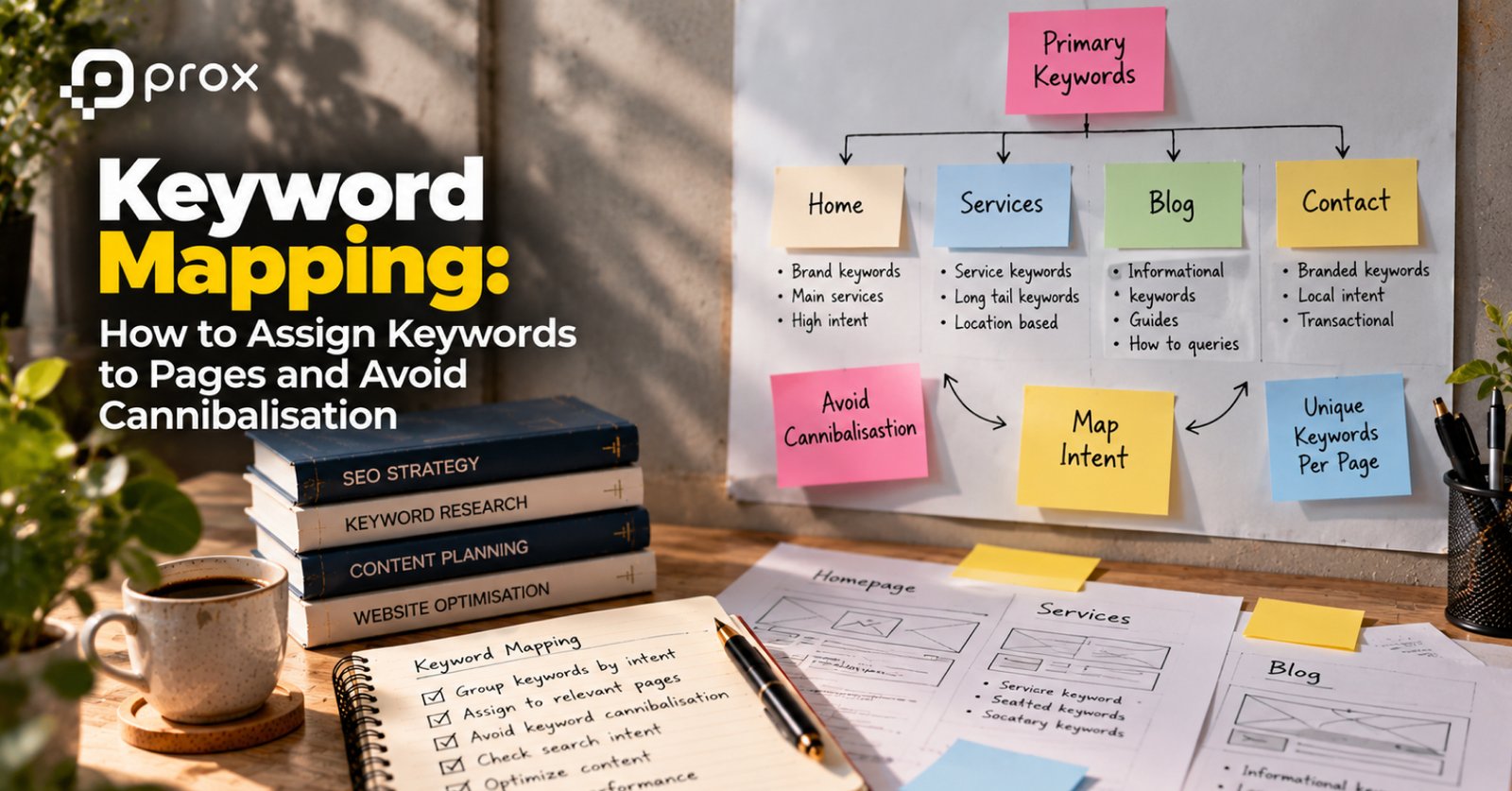
Keyword Mapping: How to Assign Keywords to Pages and Avoid Cannibalisation

Niche Keyword Research: How to Find Low-Competition Keywords Your Competitors Miss