How to Do Keyword Research: A Step-by-Step Guide for UK Businesses (2026)
Knowing how to do keyword research is where every strong SEO strategy begins. For UK businesses, keyword research means finding the words people actually type into search engines, understanding what they want, and choosing terms your website has a realistic chance of ranking for.
Search behaviour is changing in 2026. People now use voice search, AI-generated answers and far more specific queries to find businesses online. As a result, high search volume alone is no longer enough when you choose which keywords to target.
This guide walks you through the full keyword research process in ten steps. You will learn how to find relevant keywords, read search intent, study your competitors and spot opportunities in both traditional and AI-powered search results.
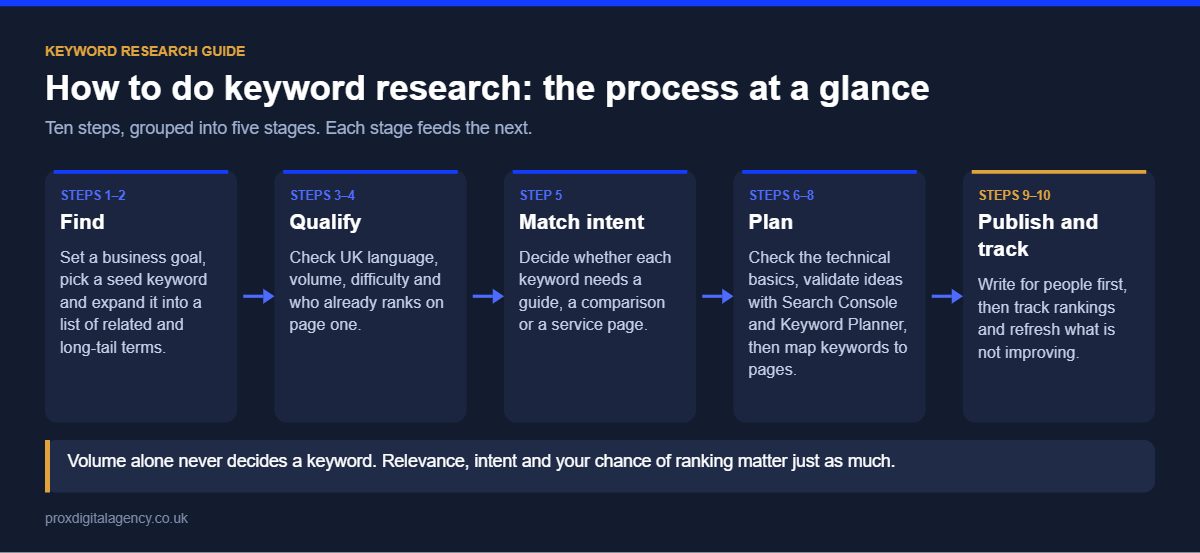
Step 1: Know Why You Are Doing Keyword Research
Before you learn the “how”, be clear about the “why”. Keyword research should support a business goal, such as more enquiries, more sales or more bookings. Also, remember that not every keyword you find needs its own blog post.
First, make a list of keywords and match each one to your audience’s search intent. Then use them naturally and in context within your content. Avoid keyword stuffing, because it makes content look spammy and lowers its quality.
If you skip this step, you can easily attract traffic and clicks that never turn into enquiries or sales.
Start With a Seed Keyword
Every list starts with a “seed”. This is a broad topic that describes your business, for example:
- If you sell coffee machines, your seed is “coffee machines”.
- If you are a plumber, your seed could be “plumbing repairs”.
In short, the seed is the foundation of your keyword research and strategy. Everything else grows from it.
Step 2: Build Your Keyword List
Next, take those first ideas and expand them into a wider list of relevant keywords. This is an important part of the keyword research process in SEO, because it uncovers far more opportunities to target.
Don’t overlook long-tail keywords. These are longer, more specific phrases that usually have lower search volume but clearer intent. Because they are so specific, they also help you reach people who are closer to taking action.
The Four Types of Keywords to Find
- Informational: people looking for answers, for example “how to fix a leaky tap”.
- Navigational: people looking for a specific brand or website, for example “Prox Digital Agency services”.
- Commercial: people comparing options before they decide, for example “best plumber in Leeds”.
- Transactional: people ready to act or buy, for example “emergency plumber near me”.
Ideally, you need a mix of all four. For new websites, however, long-tail keywords are a practical starting point because they often face less competition. If you work in a small or specialist market, our guide to low-competition niche keywords shows how to find terms your competitors miss.
Evaluate Your Keyword Opportunities
Is every relevant keyword worth targeting? No. In 2026, Google does not judge relevance on keywords alone. Instead, it looks at the whole page and the intent behind a query. So, before you add a keyword to your final list, check its relevance, intent, competition and search volume.
A high-volume keyword may be hard to rank for or may bring the wrong type of visitor. On the other hand, a lower-volume keyword can be more valuable when it closely matches your services. Ask yourself three questions:
- Is this keyword relevant to what my business offers?
- Can my website realistically compete for it?
- Does the search intent match the content I want to create?
This way, you prioritise keywords by their potential value rather than by volume alone.
Step 3: Make Your Keyword Research Fit UK Search Habits
When you target UK customers, your keyword research strategy should reflect how people in the UK actually search. For example, UK searchers spell “optimisation” with an “s”, search for “lorries” rather than “trucks” and use “postcodes” rather than “zip codes”.
Using the wrong terms makes your keywords less relevant to UK searchers. Consequently, you attract traffic that doesn’t match your audience. Local language matters, and regional searches matter too. Our guide to finding the regional keywords UK customers search covers towns, cities and “near me” terms in detail.
Use a Keyword Research Template
To stay organised, use a keyword research template. A simple spreadsheet works well. Set up these columns:
With this template, a long list of keywords becomes a clear plan. As a result, it is much easier to see which topics and search terms to target first.
Of course, collecting and analysing all this data can feel overwhelming at first. At this stage, professional support saves time and keeps the campaign focused. For example, our keyword analysis services in London turn raw keyword data into an SEO plan you can act on.
Not sure which keywords will bring you enquiries?
Send us your website and three competitors. We will pick out the keywords worth targeting first, with volume, difficulty and intent for each, free.
Get a free keyword reviewSee our keyword analysis services →
Step 4: Analyse the Competition
Now that you have your keywords, find out which ones you can win. Type each keyword into Google and note who ranks on page one. Then look at the type of content that ranks. Ask whether it is a blog post, a product page or a video.
If Google shows videos, consider whether a video would satisfy the intent better. Similarly, if listicles dominate the results, a well-structured listicle may be the right format.
This is also where competitor research becomes useful. Study the top-ranking pages and look for gaps they leave. Then create a more detailed, more useful resource that gives searchers a reason to choose your page. For a deeper method, read our guide to competitor keyword analysis.
Step 5: Match Every Keyword to Search Intent
Google’s algorithm in 2026 understands the difference between “best project management software” and “how to use project management software”. So, your content has to match what the searcher wants.
For instance, if you target “best project management software”, a product page alone will not match the intent. Searchers are comparing options, so a detailed comparison or buyer’s guide fits far better.
Conversely, if you try to sell on a “how to” keyword, users will leave. They want information, not a sales pitch. In fact, this is the most common mistake people make when they first learn how to do keyword research for SEO.
The table above shows how to match each type of search intent with the right type of content.
Step 6: Check the Technical Foundations
You have your keywords, and you are writing content. But can Google find it? This is where technical SEO comes in.
Above all, your site must be fast and mobile-friendly. Google uses mobile-first indexing, and many UK users search on their phones during their commute.
If your site is slow or hard to crawl, even strong keyword research will struggle to deliver results. Therefore, fix site speed, repair broken links and submit your XML sitemap. A solid technical foundation helps your keyword strategy perform properly.
Step 7: Use AI and Tools to Speed Up Keyword Research
We are in the AI era, and it would be a mistake not to use AI in your keyword research. The key, however, is to use it in the right way.
AI should support your SEO keyword strategy, not replace it. For example, it can help you understand audience intent, suggest content ideas, group related keywords and summarise what competitors cover. After that, check these ideas with reliable tools before you act on them.
Two free tools are especially useful. Firstly, the Google Search Console performance report shows the queries that already bring impressions and clicks to your site. Secondly, Google Keyword Planner helps you discover new keyword ideas and estimate their search volume. If you also run Google Ads, our guide to finding Google Ads keywords that convert explains how paid search changes the process.
Used this way, AI becomes a time-saving assistant rather than a replacement for strategic thinking.
Step 8: Map Keywords to Pages
Don’t stuff every keyword into your homepage. When several pages target the same term, they compete with each other. This is called keyword cannibalisation, and it confuses Google.
Instead, create a simple map:
- Homepage: your brand name plus your main broad term.
- Service pages: the specific services you provide.
- Blog posts: the informational questions people search.
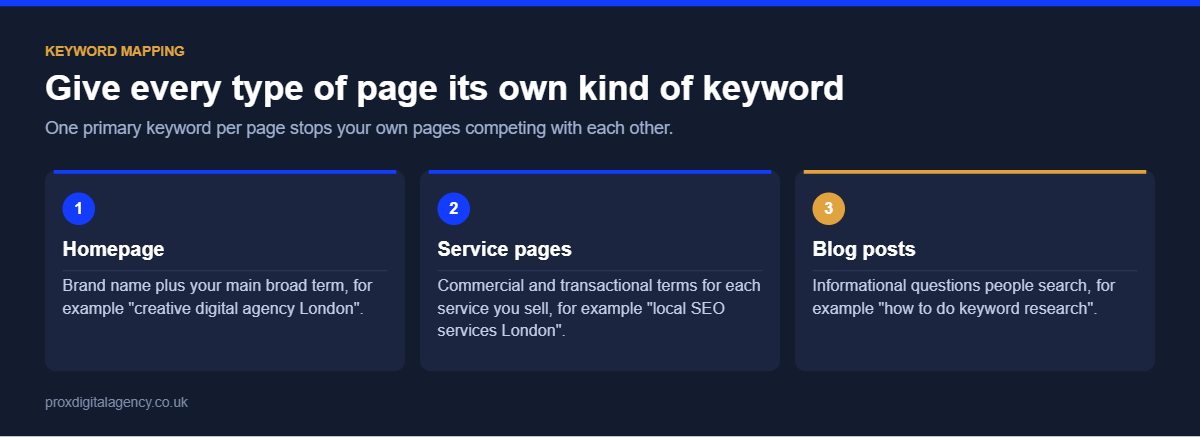
This structure is the backbone of a healthy SEO keyword strategy, because it tells Google exactly what each page is about. Our step-by-step guide to keyword mapping shows how to build the full map and fix pages that compete.
Step 9: Create and Optimise Your Content
Now you can start writing. Write for people first and search engines second. Then follow three simple rules:
- Use your main keyword in the H1 heading.
- Include it in the first 100 words.
- Add synonyms and closely related terms that cover the topic naturally.
Above all, a keyword should sit naturally in the text rather than appear at every opportunity. Google’s guide to creating helpful, people-first content is a useful checklist before you publish.
Step 10: Monitor, Track and Refresh Your Keyword Research
Once your content is live, monitor how it performs. SEO takes time, so give each page a few months to gain visibility before you judge it.
Meanwhile, track your rankings and organic traffic in Google Search Console. If a page isn’t improving, work out why. Check whether the content is too thin, whether the competition is stronger and whether the page matches search intent. Also check whether it needs more internal links.
Finally, use what you learn to refine your keywords and content. SEO isn’t a “set it and forget it” task. Instead, it is an ongoing strategy that improves with testing, tracking and optimisation.
Where to Go Next: Specialist Keyword Research Guides
This guide covers the core method. However, some situations need a more specialist approach, so we have written a dedicated guide for each one:
- Small or specialist markets: how to find low-competition niche keywords your competitors miss.
- Local businesses: how to find the regional and “near me” terms UK customers search.
- Rivals ranking above you: competitor keyword analysis, including a keyword gap analysis.
- Google Ads: finding Google Ads keywords that convert, with match types and negative keywords.
- Several pages on one topic: keyword mapping, so each page targets its own terms.
- Selling abroad: planning keywords for the US, UAE and Australia.
Conclusion: Turn Keyword Research Into Enquiries
Keyword research is not something you master in a few days. Rather, it is a practical skill that takes time to understand and apply. For UK businesses, it means thinking about local search intent, search behaviour and the technical foundations that support SEO.
But you don’t have to manage the whole process alone. If you want to know what an SEO agency actually does day to day, start there. Alternatively, talk to our team. At Prox Digital Agency, we find valuable keyword opportunities and turn search data into focused SEO strategies that attract the right traffic.
Prox Digital Agency
Turn your keyword research into a plan that brings enquiries
We find the search terms your customers use, check what it takes to rank for each one and map them to the right pages, so every new page has a clear job. Start with a free keyword opportunity review.
Frequently Asked Questions
How often should I update my keyword research?
Review your keywords every 2 to 6 months, depending on your market and how often you publish. In addition, a more detailed yearly keyword analysis helps you spot major shifts in trends, competitors and search behaviour.
Can I rank without a keyword research template?
Technically, yes. However, publishing content without proper keyword research is usually less effective. A template helps you track progress and cover the right intent types, and it keeps your keyword research and strategy organised.
Is local keyword research different from standard keyword research?
Yes. Local keyword research focuses on “near me” searches and specific places, for example “SEO in Manchester”. Standard research, by contrast, covers broader topics and informational questions.
How many keywords should I target per page?
Focus on one primary keyword per page. You can also target 3 to 5 closely related secondary keywords on the same page.
Why is my traffic not converting?
Usually, your keywords don’t match what your audience needs at that stage of the buying journey. So, review the search intent behind each keyword and make sure your content matches it. Informational keywords build visibility, while commercial and transactional keywords reach people who are closer to making a decision.


 Muhammad Bilal, London
  11 mins
Headless SEO: How to Rank a Headless CMS or API-Driven Website

Faceted Navigation SEO: Stop Filters Wasting Crawl Budget on Your Ecommerce Site

Log File Analysis for SEO: How to Find and Fix Crawl Budget Waste

JavaScript SEO: How to Get React and Next.js Websites Crawled and Indexed

Hreflang Tags: How to Set Up One Brand Across the UK, US, UAE and Australia

Schema Markup Explained: A Practical Guide for UK Businesses (with JSON-LD Examples)

Technical SEO: The Complete Guide for UK Businesses (2026)

How Much Does Generative Engine Optimisation (GEO) Cost in the UK in 2026?