How We Practised What We Preach: Launching SEO and GEO Across the UK, USA and Australia
London, UK, 23 November 2026: An SEO agency whose own website doesn’t rank is a bit like a personal trainer who can’t climb the stairs. You’d quietly wonder what you were paying for.
We knew that. So when Prox Digital Agency launched its SEO and GEO (generative engine optimisation) services across the UK, the USA and Australia, we made a rule: before we promised anyone results, we’d earn them on our own website, in public, with our own data. Client zero was us. This is how our SEO and GEO strategy played out, and the two playbooks that came out of it.
If the method only works when we’re selling it, it isn’t a method.
The Launch: Three Markets, One Plan
Launching in three regions sounds neat on a slide. In practice, it means three audiences who search in slightly different ways, with different words, different competitors and different levels of comfort with AI tools.
The shift towards AI is real in all three markets:
- Australia: Roy Morgan found that 13.6 million Australians, 58% of those aged 14 and over, used AI tools in an average four weeks in the March quarter of 2026.
- UK: Ofcom reported in April 2026 that 54% of UK adults now use AI tools such as ChatGPT, Copilot or Gemini.
- USA: Adobe forecasts that AI-driven traffic to US retail sites will rise 130% year over year this holiday season.
Different countries, same direction. People weren’t just searching any more. They were asking. So SEO alone wouldn’t be enough, and neither would GEO alone. We needed both, working from the same foundations.
The Revamp, Then the Quiet Part
Once our website was revamped, we did what any proud agency does. We published our own content: service pages, money pages and guides, written by our team and built around what we actually do.
Then came the hardest part of the whole story. We waited.
Publishing is exciting. Waiting 28 days to see what Google makes of it is not. But data needs time to gather, and guessing at what’s working is how agencies end up selling opinions instead of results.
The SEO Playbook: Reading What Google Is Telling You
Our SEO playbook is simple: let a page collect 28 days of real Search Console data, find the searches where Google shows it but people don’t click, then rewrite the page in the exact words of those searchers. Here’s the method we follow on our lead and money pages, step by step.
- Publish the page and request indexing through Google Search Console.
- Wait 28 days after indexing to collect real data.
- Open the page’s performance in Search Console and check its impressions and clicks.
- Find the queries with high impressions but low or zero clicks. These are searches where Google is showing the page, but searchers aren’t convinced it answers their question.
- Work those queries in naturally. Place them in the H1, the first paragraph and, where the query is a question, in the page’s FAQ.
- Request indexing again through URL Inspection, so Google crawls the updated page.
- Watch the numbers over the following weeks.
The idea behind it is simple. A high-impression, low-click query is the market saying, “I see you, but I’m not sure you’re the answer.” Matching your page to the exact language of that searcher closes the gap. The word “naturally” matters: we write for the person, not the keyword, and we don’t stuff. Our guide to writing title tags and meta descriptions covers the click-through side of the same idea.
What Happened on Our SEO Service Page
We ran this playbook on our own SEO agency page. Comparing the last 28 days with the 28 days before, Search Console shows clicks rising from 9 to 28 and impressions climbing from 9.01K to 23K.
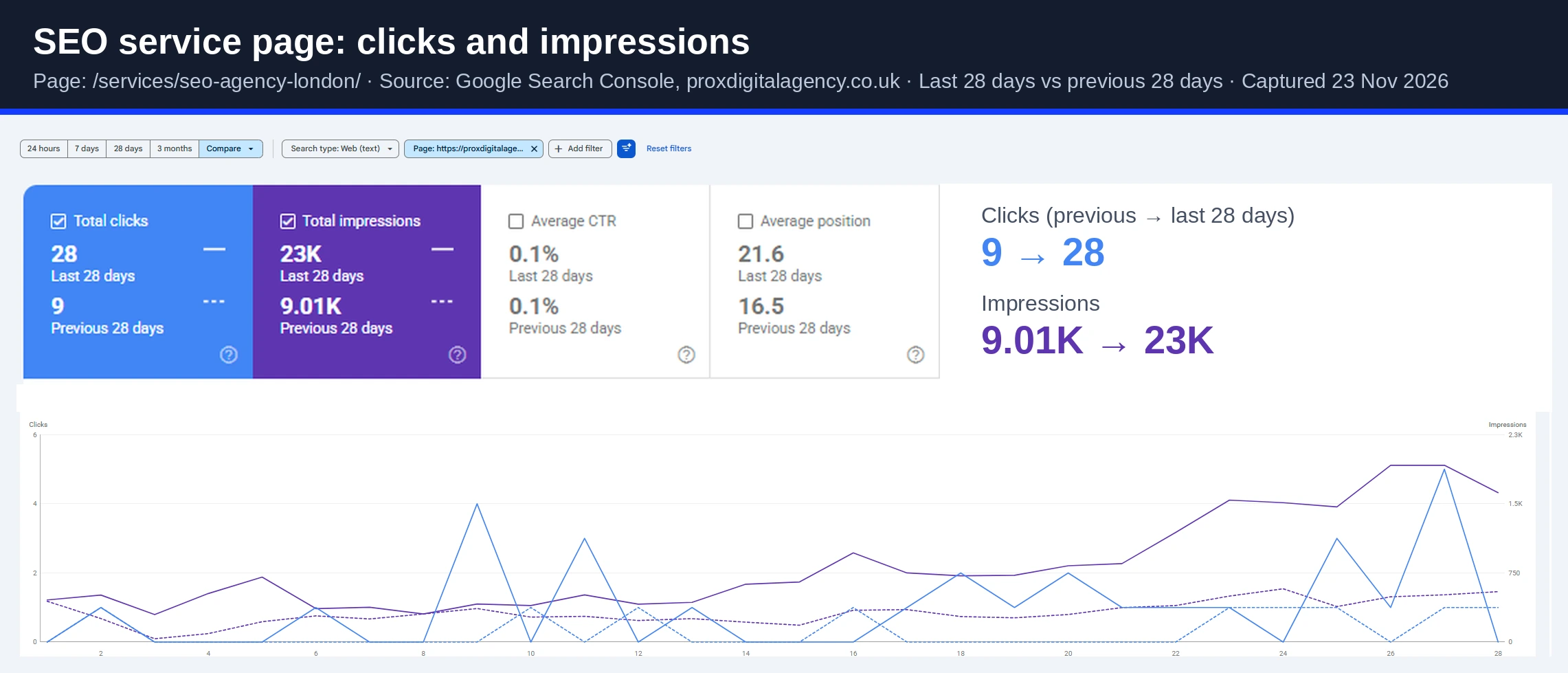
Impressions grew about two and a half times, and clicks tripled. Average position moved from 16.5 to 21.6 over the same period, which is normal when a page starts appearing for many more searches: Google is now testing it for a much wider set of queries, including harder ones further down the results.
The GEO Playbook: Finding the Questions People Actually Ask
SEO told us where we were close. GEO helped us find what people were really asking. The trick is a single line of regex, a pattern Search Console understands, applied to the same 28 days of data:
(\b\w+\b\s){7,}
What it does: it filters your queries down to the long ones, roughly eight words or more. Short searches are usually keywords (“seo agency uk”). Long ones are usually full questions in a person’s own words, such as “how do I get my business to show up in chatgpt answers”. That’s exactly the way people now talk to AI tools.
How to Use the Regex in Search Console
- In Search Console, open Performance and set the date range to the last 28 days.
- Add a Query filter, choose Custom (regex), select Matches regex and paste the pattern above.
- Sort by impressions, and look for queries where your page appears but gets few or no clicks.
- Open the matching page and answer each question properly: either as an FAQ entry, or by starting a section with the question itself and answering it in the first sentence.
- Request indexing again after the update.
- Check back over the following weeks, both in Search Console and by asking AI tools the same questions.
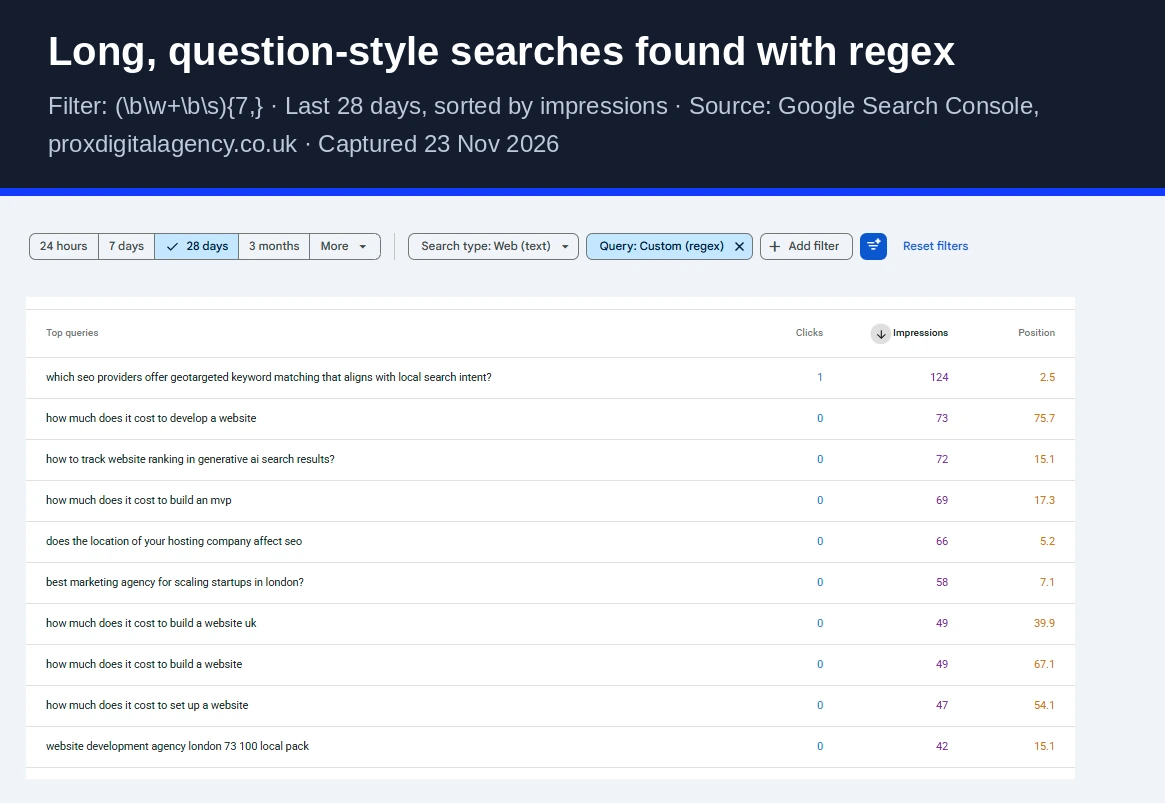
These are real questions from our own data. The top one, a question about SEO providers and local search intent, sits at an average position of 2.5, and it’s one we answered directly in an FAQ on our regional SEO intent guide.
The logic matches what recent research says about how AI tools pick sources. An analysis by Kevin Indig of around 1.2 million ChatGPT answers, reported by Search Engine Land in February 2026, found that 44% of citations came from the first third of a page, and that 78.4% of question-related citations came from headings. In other words, a direct answer near the top, under a heading that mirrors the question, is exactly what machines tend to lift.
What Happened on Our GEO Service Page
We applied the GEO playbook to our generative engine optimisation service page. Over the last 28 days, its average position improved from 17.6 to 13.4, impressions grew from 5.45K to 6.51K, and the page earned 28 clicks against none in the previous 28 days.
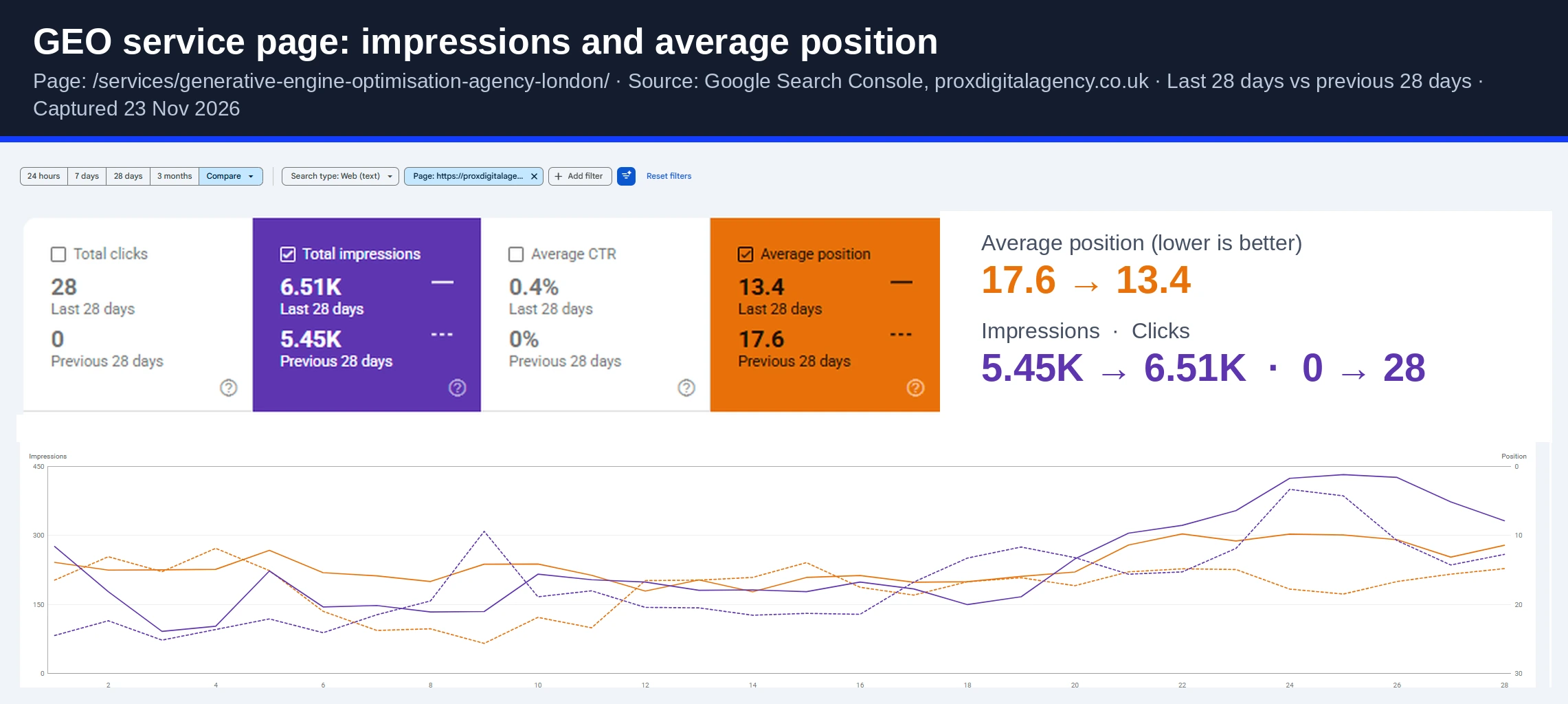
Across the last week of the period, the page averaged around position 11, at the edge of page one. As we updated pages this way, we also began to see our content appear in AI-generated answers and overviews.
The Results So Far
| Page | Period | Impressions | Clicks | Avg. position |
|---|---|---|---|---|
| SEO service page | Previous 28 days (28 Sep to 25 Oct 2026) | 9.01K | 9 | 16.5 |
| SEO service page | Last 28 days (26 Oct to 22 Nov 2026) | 23K | 28 | 21.6 |
| GEO service page | Previous 28 days (28 Sep to 25 Oct 2026) | 5.45K | 0 | 17.6 |
| GEO service page | Last 28 days (26 Oct to 22 Nov 2026) | 6.51K | 28 | 13.4 |
Source: Google Search Console for proxdigitalagency.co.uk, web search, captured 23 November 2026.
A Quick Word of Honesty
We’d rather you trust this than be dazzled by it.
- Results vary. Pages with very few impressions give little to learn from, and rankings move for many reasons at once.
- AI answers change with wording, location and timing, so look for patterns over time, not single screenshots.
- There’s no magic. Google says there are no additional technical requirements for its AI features. Pages need to be indexed and eligible to show in search with a snippet. What we’re doing is making our pages the clearest, most direct answer to a real question.
- Nothing here is a guarantee. It’s a method that works for us, tested on our own pages, and the evidence is above for you to judge.
Why GEO Matters in the Years Ahead
A few years ago, someone looking for a provider typed a keyword and scrolled. Today they ask a question and often read a summary first. That changes what brand visibility means:
- People ask about brands directly. An Ahrefs study published on 2 October 2026 found AI Overviews on 83% of US desktop branded searches on 29 September 2026, up from a 61.3% monthly average in July. It’s US desktop data, not a worldwide figure, but it shows the direction.
- Being named matters as much as being ranked. A page-one position doesn’t guarantee a place in the answer.
- Trust becomes the filter. AI tools prefer clear, consistent, well-evidenced sources, and they tend to favour brands that others mention too. Our guide to getting your brand mentioned in AI answers explains how to build those signals.
GEO isn’t a replacement for SEO. It’s the next layer: making sure that when people ask, your brand is part of the answer. The businesses that start building it now will have a head start that gets harder to catch up with.
What We Learned From Our SEO and GEO Strategy
- Your own data tells you what customers ask. You don’t need an expensive tool to find real questions. Search Console already holds them.
- Patience is a competitive advantage. Most people publish, panic and rewrite in a week. Waiting 28 days is the difference between reacting and learning.
- Answer first. The simplest change, putting the direct answer where both people and machines look first, was often the one that mattered most.
Try It Yourself This Week
You can run a lighter version in half an hour:
- Open Search Console and set the range to the last 28 days.
- Pick one important page and list its queries with high impressions and few clicks.
- Apply the regex filter to find the long, question-style searches.
- Add the best queries to your H1, first paragraph or FAQ, written naturally.
- Request indexing, then check again in a few weeks.
If you want to measure how often AI tools mention you as well, our round-up of AI rank tracking tools compares the options.
Frequently Asked Questions
What is the difference between SEO and GEO?
SEO (search engine optimisation) helps your pages rank in search results such as Google and Bing. GEO (generative engine optimisation) helps your brand get mentioned and cited in AI answers from tools such as ChatGPT, Gemini, Perplexity and Google AI Overviews. They share the same foundations, so the strongest strategy runs both together.
Why wait 28 days before changing a page?
A new or updated page needs time for Google to crawl it and for impressions and clicks to build up. Twenty-eight days gives you enough real Search Console data to see which searches the page appears for, instead of guessing.
What does the regex (\b\w+\b\s){7,} do in Search Console?
It filters the Performance report to queries with roughly eight or more words. Long queries are usually full questions written in natural language, which is how people now ask AI tools, so they show you exactly which questions your pages should answer.
Do I need special schema or markup to appear in AI Overviews?
No. Google says there are no additional technical requirements for its AI features: a page needs to be indexed and eligible to appear in search with a snippet. Clear, direct answers under headings that match real questions give it the best chance of being used.
Want Us to Run This for You?
If you’d like the same approach applied to your own pages, we do it every day. Our SEO agency and generative engine optimisation services combine technical foundations, content and AI search readiness across the UK, the USA and Australia. You can also see the method in action in our Aegotel B2B SEO case study.
Free SEO and GEO audit
Find the questions your customers are already asking
Book a free discovery call and we’ll run this 28-day method on your Search Console data, show you the searches you’re missing and where your brand should appear in AI answers.


 Muhammad Bilal, London
 7 mins
Image SEO: Alt Text, File Names and Formats That Help Pages Rank

Header Tags for SEO: How to Structure H1 to H6 (With Examples)
Title Tags and Meta Descriptions: How to Write Them for Higher Click-Through Rates

SEO Copywriting: How to Write Pages That Rank and Convert

On-Page SEO Checklist: 27 Checks to Run Before You Publish Any Page

On-Page SEO: The Complete Guide to Optimising Every Page for Google and AI Search (2026)

How to Get More Google Reviews (and Handle Negative Ones) Without Hurting Your Rankings

Local SEO for Law Firms: How UK Solicitors Can Win More Local Enquiries