Local Citations and NAP Consistency: How to Build, Audit and Clean Up Your Business Listings
Local citations are online mentions of a business’s name, address, phone number, or other identifying details. They commonly appear in business directories, mapping platforms, industry websites, and local listings, helping customers find accurate information about a business.
NAP consistency refers to keeping your business’s name, address and phone number accurate across these platforms.
For example, if a business in Manchester has changed its telephone number but several directories still display the old one, potential customers may struggle to get in touch.
Building and maintaining local citations is part of a wider local SEO strategy. It helps businesses manage their online information, support local discovery, and avoid problems caused by outdated or duplicate listings.
This guide explains what local citations are, why NAP consistency matters, how to build relevant citations, and how to find and correct inaccurate business listings.
What Are Local Citations in SEO?
Local citations are references to your business on third-party websites and online platforms. They help people discover your business and access details such as its location, contact information, website, and opening hours.
In practice, citations can appear on general business directories, industry-specific platforms, mapping services and local organisation websites.
For example, an independent restaurant in Birmingham might have business listings on Google Maps, Apple Maps, Yell and a regional restaurant directory.
As a result, each listing gives customers another way to find information about the restaurant.
Structured vs Unstructured Local Citations
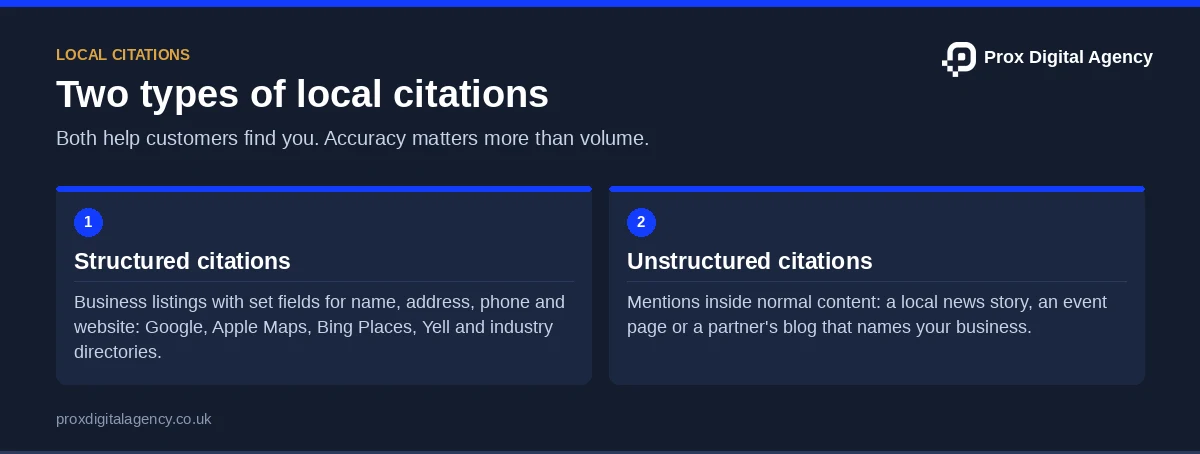
Local citations generally fall into two categories.
Structured Citations
Structured citations appear in a standardised business listing format, usually containing fields for your company name, address, phone number, and website.
Examples include:
- Google Business Profile
- Apple Maps business listings
- Bing Places for Business
- Yell
- Relevant industry directories
Unstructured Citations
Unstructured citations are business mentions appearing within regular website content rather than a dedicated listing.
For example, a local newspaper might mention a new café opening in Leeds and include its address within an article.
Similarly, a community organisation might reference a business that participated in a local event.
Both forms can help people discover a business, although their value and relevance depend on the platform and context.
What Is NAP Consistency and Why Does It Matter?
NAP stands for Name, Address, and Phone number.
NAP consistency means making sure these details accurately represent your business across its website, directories, and other relevant online platforms.
Consider a business with the following listings:
Illustrative example using fictional business information.
For example, the outdated phone number in Directory B could cause customers to contact the wrong number.
The shortened name in Directory A may not be a problem if it is a recognised variation of the same trading name, but it should be reviewed for consistency with the business’s actual branding.
NAP consistency doesn’t mean every platform must use identical formatting down to punctuation and abbreviations.
Instead, what matters is that your business can be accurately identified and customers receive correct information.
How NAP Consistency in Local Citations Supports Visibility
Accurate business details help maintain a reliable presence across local search and discovery platforms.
Google recommends complete and accurate business information because it helps the platform understand businesses and match them with relevant searches.
However, Google does not publish an exact ranking weight for directory citations or NAP consistency.
It would therefore be misleading to suggest that correcting a minor address abbreviation will automatically improve Google Maps rankings.
The practical benefits are clearer: customers can find the right location, contact the correct business and encounter consistent information across different platforms.
For an overview of the wider ranking process, see our complete guide to local SEO.
How Do Local Citations Influence Google Maps and Other Platforms?
Local citations contribute to the wider information available about a business online.
Business information can appear across mapping services, directories, and search platforms, helping customers access company details from different sources.
In short, their role is best understood through three areas.
Business Information Accuracy
When important listings contain correct details, customers are less likely to encounter outdated addresses, disconnected phone numbers or incorrect opening hours.
For businesses with physical premises, these details can directly affect visits and enquiries.
Local Business Discovery
Citations create additional opportunities for customers to find your business outside your website.
For instance, someone looking for an accountant might browse a relevant professional directory before visiting the firm’s website.
A restaurant customer may discover a business through a mapping application rather than traditional Google Search.
Not every listing needs to generate substantial website traffic to serve a useful purpose.
Business Relevance and Recognition
Mentions on relevant local or industry websites can help establish a business’s presence within its sector or community.
However, citations should not be treated as a guaranteed ranking shortcut.
Google identifies relevance, distance, and prominence as its main local ranking factors. Its published guidance does not establish a direct ranking benefit for obtaining a particular number of directory citations.
Businesses should therefore prioritise citation accuracy and relevance rather than chasing volume.
How to Build Local Citations Step by Step
Citation building involves identifying suitable platforms, creating or claiming listings, and adding accurate business information.
The process is usually more manageable when you establish your business details before submitting them anywhere.
Step 1: Prepare Your Official Business Information
Create a master record containing the information you’ll use across platforms.
Include:
- Official trading name
- Business address, where appropriate
- Main telephone number
- Website URL
- Business category
- Business description
- Opening hours
- Relevant service areas
- Business email address, where required
Next, check these details against your website and actual business operations.
Use the name your business is genuinely known by, rather than adding keywords to make it appear more relevant.
For service-area businesses, consider whether your address should be hidden on public listings. Follow each platform’s eligibility and privacy requirements.
Step 2: Claim Your Existing Business Listings
Before creating new listings, search for your business on major platforms.
An existing profile may already have been created through previously submitted information or other platform processes.
Where possible, claim the existing listing rather than immediately creating another.
For example, if your business already appears on Bing Maps, use Bing Places for Business to investigate the claiming process.
Otherwise, creating unnecessary duplicates can make ongoing management more difficult.
Step 3: Choose Relevant Sources for Your Local Citations
However, not every business directory deserves your time.
Prioritise established platforms that customers in your market might genuinely use.
For UK businesses, possible starting points include Google Business Profile, Apple Maps, Bing Places and Yell, subject to eligibility and the availability of suitable listing features.
In addition, industry-specific directories can be useful.
For example, a healthcare provider might consider appropriate professional directories, while a construction business could look for relevant trade associations.
Similarly, regional business organisations may offer additional listing opportunities.
Finally, evaluate each platform based on relevance, legitimacy and the usefulness of its information to customers.
Step 4: Complete Each Listing Accurately
Once you’ve selected a platform, provide the requested details using your master business record.
Also, use appropriate categories and include a clear description where supported.
Avoid keyword-stuffed business names and generic descriptions that don’t accurately represent your services.
If the platform supports photographs, upload relevant images that reflect the business.
Finally, some listings require verification or manual approval before becoming public.
Step 5: Keep a Citation Tracking Record
Then maintain a spreadsheet listing the platforms where your business appears.
A simple record might include:
This record makes future citation audits easier, especially when your business changes its details.
Not sure how many of your listings are wrong?
Send us your business name and phone number. We will check your key listings for wrong addresses, old numbers and duplicates, free.
Building Local Citations Manually vs Using Automated Tools
Businesses generally have two approaches to citation building and management: manual submissions and automated listing services.
Neither approach is universally better.
The right choice depends on the number of locations, available resources, and directories you need to manage.
Manual Citation Building
Manual citation building involves creating, claiming, and updating listings individually.
This gives you greater control over each platform and lets you review its specific requirements.
For this reason, it’s often practical for a small business with one location and a manageable number of important listings.
However, manual submissions can become time-consuming when a business appears across many platforms.
Automated Citation Management
Automated citation services can help distribute or manage business information across supported directories.
These tools may reduce repetitive work, particularly for businesses with several locations.
However, coverage varies by provider.
Not every platform is supported, and some services require an ongoing subscription to manage listings.
Before choosing a tool, review which directories it covers, how it handles existing listings, whether manual verification is still required, and what happens when a subscription ends.
Which Approach Should You Choose?
A combined approach may work well: use an automated solution for supported listings while handling important specialist directories manually.
How to Perform an Audit of Your Local Citations
A local citation audit identifies inaccurate, duplicated, missing, or outdated business information.
It’s particularly useful after a relocation, rebranding, phone number change, or business expansion.
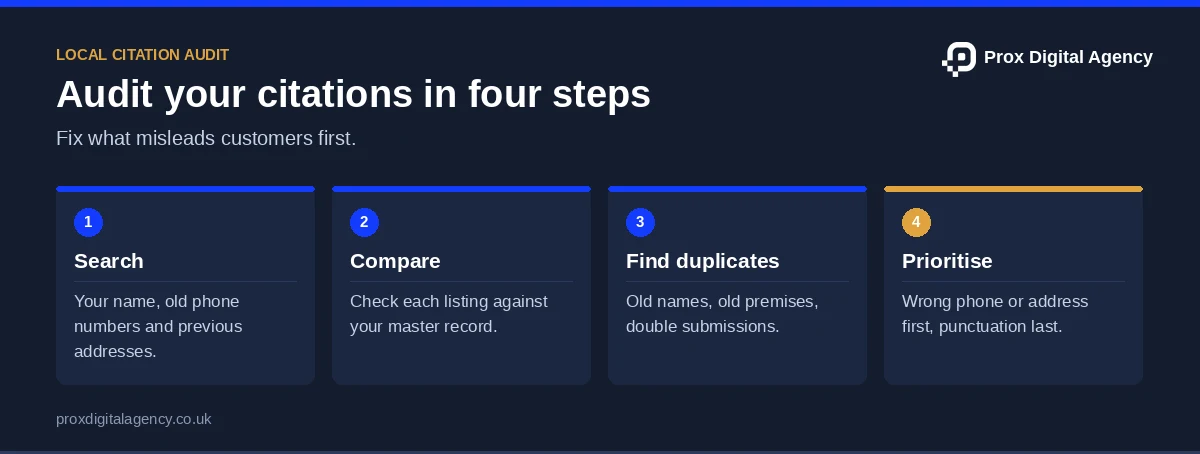
Step 1: Search for Your Existing Citations
Begin by searching for your business name, phone number, and address using different combinations.
Try searches such as:
- “Your Business Name”
- “Your Business Name” + “City”
- “Your Business Name” + “Phone Number”
- “Previous Business Name”
- “Old Business Phone Number”
These searches can reveal listings that may not appear when you search for your current trading name alone.
You can also review your existing citation tracking sheet or use a specialist citation audit tool.
Step 2: Compare Listings Against Your Master Record
Then check each relevant citation for incorrect information.
Look for outdated phone numbers, previous addresses, incorrect website links, old trading names, and unsuitable categories.
In particular, pay attention to platforms customers are likely to use.
An outdated phone number on a prominent mapping service may deserve attention before a minor formatting difference on a less relevant directory.
Step 3: Identify Duplicate Listings
Duplicate listings occur when the same business has multiple records on one platform without a valid reason.
This can happen after a relocation, rebrand or accidental resubmission.
For example, a salon might have one listing under its current name and another under an older business name, both pointing to the same premises.
Check whether the platform provides options to claim, merge, mark, or remove duplicates.
Don’t delete profiles without understanding whether they represent legitimate separate locations, departments or practitioners.
Step 4: Prioritise Corrections
Not all citation issues require the same urgency.
A simple prioritisation framework can help:
This approach keeps the audit focused on meaningful problems rather than cosmetic differences.
How to Fix Incorrect or Duplicate Local Citations
Once you’ve identified citation issues, the next step is correcting them at their source.
Claim and Edit Listings Where Possible
If you control a listing, sign in to the relevant platform and update the inaccurate fields.
After that, save any required changes and complete verification steps if requested.
Some platforms review edits before publishing them, so allow for processing time.
Request Corrections from Directory Owners
If you don’t control a listing, look for an ownership claim process, suggested-edit option or support contact.
Then provide the correct business information and any evidence requested by the platform.
After that, keep a record of your request and check whether the change appears publicly.
Handle Duplicates Carefully
Where duplicate listings exist, follow the platform’s specific process.
Some services support merging or marking duplicate records, while others require a support request.
Avoid creating a new profile simply because you can’t access an existing one.
Instead, investigate ownership recovery first.
Review Listings After Major Business Changes
A move, rebrand, or telephone number change should trigger a fresh review of important citations.
Update your own website and directly controlled profiles first, then work through other relevant platforms.
Keep the previous business information in your tracking sheet temporarily to help identify old listings.
The objective is to maintain accurate business records, not eliminate every historical reference to your company.
Mistakes to Avoid With Local Citations
Citation management is easier when businesses avoid several recurring problems.
Submitting to Every Available Directory
A large number of irrelevant listings may create unnecessary maintenance without providing useful customer value.
Using Inconsistent Trading Names
Adding service keywords or location terms to your business name can create confusion and may breach platform guidelines.
Ignoring Old Listings
Business relocations and rebrands can leave outdated records behind.
Creating Duplicate Profiles
In addition, duplicate submissions may complicate ownership and information management.
Expecting Guaranteed Rankings
Citations are one part of local SEO. Their presence does not guarantee a particular Google Maps position.
Forgetting Ongoing Maintenance
Business information can become inaccurate after operational changes, even when the original citation building was completed correctly.
A smaller portfolio of accurate, relevant listings is generally more manageable than a large collection of neglected citations.
How Often Should You Audit Local Citations?
There isn’t a universal schedule that suits every business.
A single-location retailer with stable contact details may need less frequent auditing than a multi-location company regularly opening branches.
As a practical starting point, consider reviewing priority listings every three to six months and whenever significant business information changes.
By contrast, businesses with multiple locations may benefit from more frequent checks and centralised tracking.
It’s also useful to investigate citation problems when customers report incorrect directions, disconnected phone numbers or outdated online information.
For a broader diagnostic process covering website issues, business information and local visibility, see our local SEO audit guide.
Beyond Google: Keeping Local Citations Consistent on Apple Maps and Bing
Although Google Business Profile is an important part of local visibility, customers also use other mapping and discovery platforms.
For example, Apple Maps and Bing Places provide additional opportunities to manage business information.
Each platform has its own listing and verification process, so information should be checked directly rather than assuming it will automatically match your Google profile.
This is particularly relevant when a business changes its location, opening hours or contact number.
Keeping your details accurate across important platforms makes it easier for customers to find reliable information, regardless of where they begin their search.
Our Apple Business Connect and Bing Places guide explains how to set up and manage these additional business profiles.
When to Get Professional Help With Local Citations
Citation work is simple in principle but slow in practice, especially after a move, a rebrand or when you run several branches. If you would rather hand it over, our local SEO services UK team can find, claim and correct your listings, then keep them accurate as your business changes.
Frequently Asked Questions About Local Citations
Are Local Citations Still Important for SEO in 2026?
Local citations remain useful for maintaining accurate business information and supporting discovery across relevant platforms.
However, Google doesn’t publish a specific ranking benefit for citation volume, so businesses should prioritise accuracy and relevance over collecting as many listings as possible.
How Many Local Citations Does a Business Need?
Ultimately, there is no fixed number.
The appropriate selection depends on your business type, location, and the platforms customers are likely to use.
First, start with important mapping services and credible industry or regional directories.
Do NAP Details Have to Match Exactly?
They should accurately represent the same business, but minor differences in formatting don’t necessarily create a meaningful problem.
An outdated telephone number or incorrect address is more important to correct than harmless punctuation differences.
Can I Build Local Citations Myself?
Yes. Small businesses can manually claim, create, and update relevant listings.
Citation management tools or professional assistance may be useful when the number of listings or locations becomes difficult to manage internally.
Can Incorrect Citations Hurt Google Maps Rankings?
Incorrect information can create confusion for customers and make online business details less reliable.
However, the direct ranking impact of an individual inconsistent citation isn’t publicly quantified by Google.
Correct significant inaccuracies because they affect business information and customer experience, not because a ranking increase is guaranteed.
Conclusion: Keeping Your Business Information Reliable
Local citations are most useful when they make your business easier to find and contact. An accurate listing on a relevant platform offers more practical value than a directory entry that simply adds to your citation count.
As your business develops, changes to your location, contact details, or services should be reflected across the platforms your customers use.
In short, treat citation management as part of maintaining your wider business presence rather than a one-time ranking exercise.
By focusing on accurate information, relevant listings, and regular reviews, you can establish a more dependable foundation for local discovery and customer enquiries.
Prox Digital Agency · Local SEO
Want your listings cleaned up for you?
We find, claim and correct your business listings across Google, Apple, Bing and trusted UK directories, then keep them accurate.

 Muhammad Bilal, London
 11 mins
Local SEO for Small Businesses: A Step-by-Step Plan for Your First 90 Days
What Is Local SEO? A Complete Guide to Ranking in Google Maps and Local Search (2026)

Prox Digital Agency Releases Free 2027 Website Checklist as Fewer Than Half of Mobile Sites Pass Google’s Speed Test

B2B SEO Case Study: How We Took Aegotel from Hacked and Invisible to Full Tracking

Prox Digital Agency Named Second in NeuralAdX Ltd’s “Best Google Gemini Optimisation Agency UK” Comparison

International SEO Keyword Research: How We Research New Markets (UK, US, UAE and Australia)
Keyword Mapping: How to Assign Keywords to Pages and Avoid Cannibalisation

Niche Keyword Research: How to Find Low-Competition Keywords Your Competitors Miss