Local SEO for Service-Area Businesses: How to Rank Without a Shop or Office
Local SEO for service area businesses helps companies appear in location-based searches even when they don’t have a customer-facing shop or office. Eligible businesses, such as plumbers, electricians, and mobile cleaners, can use a Google Business Profile with a hidden address and defined service areas.
But hiding your address doesn’t mean your business can rank equally well in every town you serve. Google still considers relevance, distance, and prominence when determining local results.
A successful approach combines accurate business information, relevant website content, genuine customer reviews, and clear service coverage.
This guide explains how to set up a service-area business profile, improve visibility for “near me” searches, and build local SEO without a public business address.
What Are Service Area Businesses?
A service-area business (SAB) provides services at customers’ locations rather than requiring them to visit a shop or office.
Common examples include:
- Plumbers and heating engineers
- Electricians
- Mobile car detailers
- Domestic and commercial cleaners
- Locksmiths
- Garden maintenance companies
- Mobile appliance repair services
For example, an electrician based in Birmingham may visit customers across Solihull, Sutton Coldfield and surrounding areas without operating a public office.
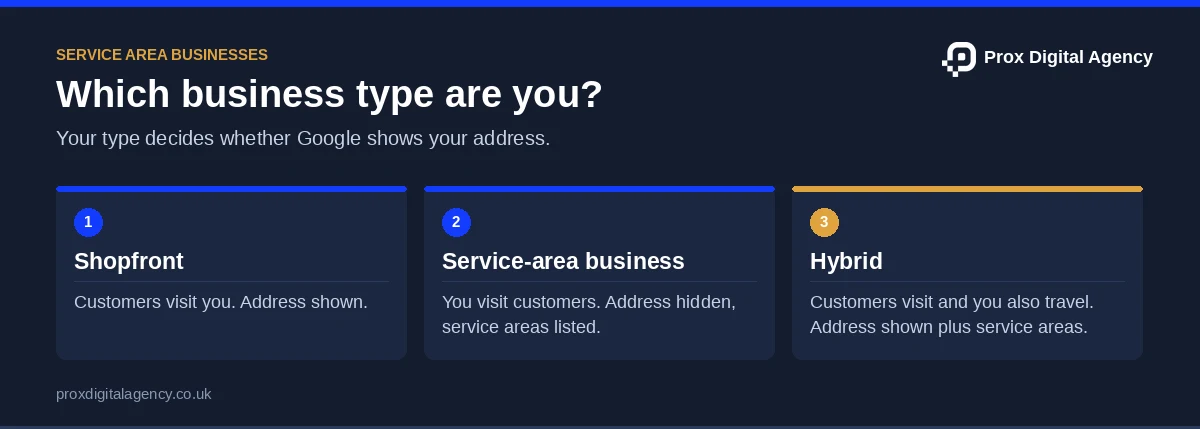
Google distinguishes between three business models:
A service-area business still needs a genuine operating base. Hiding the address doesn’t remove Google’s eligibility or verification requirements.
Can Service Area Businesses Rank on Google Maps Without a Shop?
Yes. Eligible service-area businesses can appear on Google Maps without displaying a physical address. Businesses such as mobile mechanics and plumbers can create a Google Business Profile and specify the areas they serve. However, selecting service areas doesn’t guarantee rankings in those locations.
How Google Ranks Service-Area Businesses
Google considers three main local ranking factors:
- Relevance: How closely your services match the search.
- Distance: How far your business is from the searcher’s location.
- Prominence: Your business’s reputation and online presence, including reviews and links.
Adding more towns to your profile won’t automatically improve visibility. Rankings still depend on these factors.
For a broader explanation of these factors, read our complete guide to local SEO.
How to Set Up a Google Business Profile for Service Area Businesses
Your Google Business Profile should accurately represent how your business operates, including your services, contact details, and areas covered.
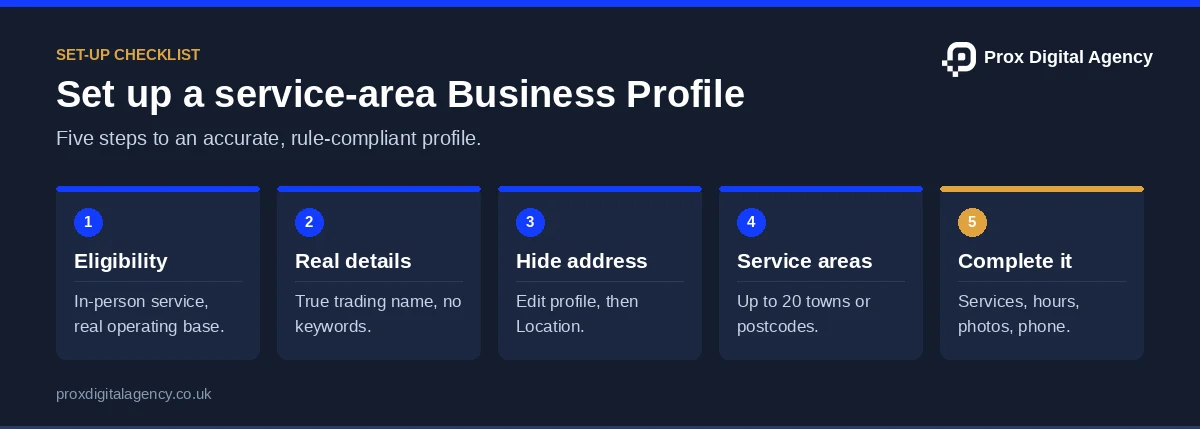
Step 1: Check Your Business Eligibility
Google Business Profiles are available to eligible businesses that interact with customers in person. Mobile plumbers, electricians and cleaners may qualify, while online-only businesses generally don’t.
Step 2: Enter Your Genuine Business Information
Use your actual trading name, accurate contact details, and relevant business categories. Avoid adding unnecessary keywords to your business name.
Step 3: Hide Your Business Address
If customers don’t visit your premises, hide your address through Edit Profile → Location. Google may still require your actual operating address for verification. Avoid using false addresses or ineligible virtual offices.
Step 4: Define Your Actual Service Areas
Add the cities or postcodes you genuinely serve. Google’s service area guidelines allow up to 20 service areas and say the overall area should generally stay within about two hours’ driving time of your base.
Step 5: Complete Your Business Profile
Add your services, telephone number, website, opening hours, and relevant photographs. Keep the information accurate so customers can understand your services and contact you easily.
For more detailed profile optimisation, use our Google Business Profile optimisation checklist.
How Does Google Verify Service Area Businesses?
Google may require businesses to complete verification before they can fully manage their business profile.
The available verification methods are determined by Google and may differ between businesses.
One method is video verification.
What Google May Require During Video Verification
For a service-area business, Google may request evidence showing:
- Operating location: Nearby street signs, landmarks, or other identifiable location information.
- Business activity: Professional tools, equipment, products, or relevant workspace.
- Business ownership or management: Evidence that you operate or represent the business, such as access to branded equipment or suitable business documentation.
For example, a mobile electrician might show relevant electrical tools, a branded work vehicle, and evidence connecting the business to its genuine operating location.
Google’s video process requires a continuous, unedited recording made through the Business Profile workflow.
Avoid showing sensitive personal information or other people’s faces.
If verification is unsuccessful, review Google’s feedback and follow the available instructions.
Verification confirms business eligibility and ownership; it doesn’t guarantee particular search rankings.
How to Improve Local SEO for Service Area Businesses
Once your business profile is accurate, the next step in local SEO for service area businesses is improving how your website and wider online presence support relevant local searches.
1. Optimise Your Main Service Pages
Your website should explain what services you offer and where you provide them.
For example, a plumbing company might have separate pages covering:
- Emergency plumbing
- Boiler repairs
- Bathroom installations
- Central heating maintenance
Each page should describe the service, explain relevant customer needs, and provide clear contact information.
Include genuine service coverage where it helps visitors determine whether you can assist them.
Avoid repeating the same location keywords unnecessarily.
2. Make Your Service Areas Clear
Customers shouldn’t have to guess whether your business covers their location.
A dedicated service-area section can explain your coverage in straightforward language.
For example:
“Our electrical services are available across Birmingham, Solihull and Sutton Coldfield, including domestic repairs, installations and planned maintenance.”
This provides practical information without creating several nearly identical webpages.
If you cover many towns, organise the information so customers can identify relevant areas quickly.
3. Maintain Accurate Business Listings
Your contact details should remain accurate across your website and relevant online directories.
For businesses with hidden addresses, don’t publish a private residential address on directories simply to create more citations.
Use platforms that support your operating model and follow their individual requirements.
Check your business name, telephone number, and website links regularly.
4. Build Genuine Customer Reviews
Reviews help potential customers assess your reliability, communication, and service quality.
Google also identifies review quantity and positive ratings as factors that can contribute to local prominence.
Ask customers for honest feedback after completing a service.
For example, an electrician could share a Google review link after finishing an installation and providing the relevant paperwork.
Avoid incentives, fake reviews or requesting only positive feedback.
Respond professionally to reviews, especially where customers raise concerns.
5. Earn Relevant Local Mentions
Local business associations, trade organisations, community initiatives and relevant publications can provide opportunities for business discovery.
An established plumbing company might be listed by a recognised trade association or mentioned by a local publication covering a community initiative.
Focus on credible, relevant opportunities rather than purchasing large numbers of unrelated backlinks.
The objective is to establish a genuine local presence that reflects your business’s activities.
Covering several towns from one base?
Tell us where you work. We will check your profile set-up, service areas and website pages, and show you where you are missing out, free.
Near Me SEO: How Service Area Businesses Rank Without a Shop
“Near me” searches indicate that someone is looking for a business relevant to their current location.
For example:
- Plumber near me
- Mobile car detailing near me
- Emergency locksmith near me
- Electrician near me
These searches often depend heavily on location.
Focus on Relevant Services and Geographic Coverage
You don’t need to repeatedly add “near me” to your website content.
Instead, describe your services clearly and provide accurate information about the areas you serve.
A page explaining emergency electrical repairs in Birmingham is more useful than one repeating “electrician near me” throughout its content.
Understand the Role of Proximity
Google considers distance when determining local results.
Even if you serve several towns, you may not appear equally prominently in searches performed across all of them.
Your selected service area does not override Google’s distance calculations.
Focus on improving relevance and business information while recognising the geographic limitations of local search.
Make Contact Easy on Mobile
Someone searching for an urgent service may want to contact a business quickly.
Your mobile website should provide accessible telephone numbers, straightforward enquiry options and clear availability information.
Avoid making visitors navigate multiple pages to confirm whether you cover their area.
These improvements support customer experience regardless of their direct effect on rankings.
The Role of Hyper-Local Content in Local SEO for Service Area Businesses
Hyper-local content addresses the needs of customers in specific neighbourhoods, towns or communities.
It can be useful when a business has genuine experience or information relevant to those areas.
For example, a roofing contractor working across Greater Manchester might publish content explaining common roof maintenance considerations for particular building types found in its service region.
A gardening company could share seasonal maintenance advice relevant to local growing conditions.
When Should You Create a Location-Specific Page?
A separate location page may be useful when you have enough meaningful information to support it.
This could include genuine service availability, completed projects, relevant local experience or practical details customers need.
Avoid creating pages that differ only by the town name.
For example, publishing 30 pages with the same cleaning service description and replacing “Leeds” with different nearby towns offers little unique value.
Don’t Confuse Service Areas With Branch Locations
Serving a town doesn’t mean you operate a physical branch there.
Your website should make that distinction clear.
If you offer mobile services in York but operate from Leeds, describe York as part of your service coverage rather than inventing a York office.
For businesses with genuine branches in several locations, our guide to local SEO for multiple locations explains the different approach required.
Local SEO Tips for Plumbers, Electricians and Other Service Area Businesses
Plumbers and electricians often serve customers across several neighbouring areas, making clear service information particularly important.
Prioritise Your Main Services
Focus on services customers actively request, such as emergency plumbing, boiler repairs, electrical inspections or consumer unit replacements, where relevant to your business.
Use separate pages when the service has enough distinct information to justify one.
Communicate Availability Accurately
If you offer emergency callouts, explain the hours and areas covered.
Don’t advertise a 24-hour service unless your business can genuinely provide it.
Customers should be able to understand whether your service is available before contacting you.
Show Relevant Experience
Genuine project photographs, qualifications, service explanations and customer feedback can help demonstrate experience.
For regulated work, ensure any certifications or registrations mentioned are current and accurately represented.
Avoid unsupported claims about being the best or highest-ranked provider in your area.
Make Enquiries Straightforward
Include a clear telephone number or enquiry form on important service pages.
If you charge callout fees or have coverage restrictions, explain them where appropriate.
Providing useful information can reduce unsuitable enquiries and help customers make informed decisions.
Common Mistakes in Local SEO for Service Area Businesses
Businesses without shopfronts should be particularly careful about how they represent their locations.
Displaying a Private Address Unnecessarily:
Service-area businesses that don’t receive customers at their operating address should hide it on Google Business Profile.
Using Virtual Offices:
Creating a profile at an ineligible virtual office can violate Google’s guidelines.
Creating Multiple Profiles for Nearby Towns:
Service coverage alone doesn’t justify separate business profiles for every area.
Selecting Unrealistic Service Areas:
Listing locations far beyond your actual operating capacity can misrepresent your business.
Publishing Duplicate City Pages:
Repeating the same content with different town names provides limited value to customers.
Expecting Guaranteed Map Pack Rankings:
Adding locations or updating profile information doesn’t guarantee a particular position.
Accurate representation and genuinely useful content should guide your approach.
How to Measure Local SEO for Service Area Businesses
Local SEO for service area businesses should be measured through relevant visibility and business enquiries rather than rankings alone.
Google Business Profile performance reporting can provide information about interactions such as calls, website clicks and search activity, depending on the available metrics.
Google Search Console can help you review which searches generate impressions and clicks for your website.
Useful measures include:
- Relevant organic search traffic
- Calls and qualified enquiries
- Completed bookings or service requests
- Performance of important service pages
- Customer enquiries from target service areas
Review these figures over time rather than drawing conclusions from individual search results.
A business may generate valuable enquiries without appearing in the same Map Pack position across every location it serves.
When Service Area Businesses Need a Local SEO Specialist
If you cover a wide area, compete with franchise networks or keep failing verification, it is worth getting specialist help. A local SEO specialist can set up your profile correctly, structure your service pages and track calls from each town you cover, without breaking Google’s rules.
Frequently Asked Questions About Local SEO for Service Area Businesses
Can I Rank on Google Maps With a Hidden Address?
Yes. Eligible service-area businesses can appear in local results while keeping their address hidden.
However, rankings still depend on relevance, distance and prominence, and visibility varies between searches.
Does Hiding My Business Address Hurt Local SEO?
Google doesn’t state that hiding an address creates an automatic ranking penalty for eligible service-area businesses.
You should follow the address display rules for your operating model rather than exposing a private address to influence rankings.
How Many Service Areas Can I Add to Google Business Profile?
Google currently allows up to 20 service areas, selected through supported geographic areas such as cities or postcodes.
Your coverage should accurately reflect where you operate.
Can I Have More Than One Google Business Profile?
A service-area business generally has one profile for its operating location.
Separate profiles may be appropriate when a business has genuinely distinct locations with separate staff and service areas that meet Google’s eligibility requirements.
Creating extra profiles simply to target more towns isn’t permitted.
Do I Need a Website for Service-Area SEO?
A website isn’t always required to maintain an eligible Google Business Profile.
However, it gives customers more information about your services, coverage, experience, and contact options while creating opportunities for organic search visibility.
Conclusion: Local SEO Without a Shopfront for Service Area Businesses
A physical shopfront isn’t necessary for every business to establish a useful local search presence. What matters is accurately representing how your business operates and making relevant information accessible to potential customers.
For service area businesses, local SEO means being clear about the services provided, the locations genuinely covered, and how customers can get in touch.
As your service coverage changes, keep your online information aligned with your actual operations.
A reliable local presence should help customers understand where you work, what you offer, and whether your services meet their needs.
Prox Digital Agency · Local SEO
Want more calls from the towns you cover?
We help plumbers, electricians and mobile services get found across their genuine service area with the right profile, pages and reviews.

 Muhammad Bilal, London
 10 mins
Local Link Building: 12 Ways to Earn Links From Your Community, Press and Partners
Beyond Google: How to Set Up Apple Business Connect and Bing Places for Local Visibility

The Complete Guide to Hiring a Web Development Agency in the UK (2027)
Local SEO for Multiple Locations: How to Rank Every Branch Without Duplicate Content
Local Citations and NAP Consistency: How to Build, Audit and Clean Up Your Business Listings
Local SEO for Small Businesses: A Step-by-Step Plan for Your First 90 Days
What Is Local SEO? A Complete Guide to Ranking in Google Maps and Local Search (2026)

 Fahad Khan, London
Prox Digital Agency Releases Free 2027 Website Checklist as Fewer Than Half of Mobile Sites Pass Google’s Speed Test