The Complete Guide to Hiring a Web Development Agency in the UK (2027)
Your website is often the first thing a customer sees. It builds trust, drives sales and supports every marketing channel you run. That is why the decision about who builds it matters so much.
A good partner saves you time and money. A poor one causes delays, pushes the project over budget and delivers a site that does not work properly. So before you hire a web development agency in the UK, you need a clear, repeatable process that matches your requirements to realistic market prices.
This guide gives you that process. It covers what agencies do, 2027 costs and timelines, a six-step hiring framework, a proposal scorecard, contract clauses, red flags, UK legal requirements and the questions to ask before you sign.
Quick answer: how to hire a web development agency in the UK
- Write a one-page brief: goals, pages, features, budget and deadline.
- Set a realistic budget with a 10–15% reserve.
- Shortlist 3–5 agencies and test their live client sites.
- Compare itemised proposals using a weighted scorecard.
- Agree milestone payments instead of paying everything upfront.
- Sign a contract that assigns you the code, content and domain.
Typical 2027 UK budgets: £1,500–£8,000 for a brochure site, £3,000–£30,000+ for e-commerce and £15,000+ for custom platforms. Want a figure for your project? Try our website cost calculator.
What Does a Web Development Agency Do?
A web development agency plans, designs, builds and maintains websites and web applications for businesses. Most combine several specialist skills under one roof, so you are not managing separate designers, developers and SEO consultants yourself.
Some UK agencies cover every service above, while others specialise in one or two, such as Shopify stores or bespoke web apps. As a result, knowing what you actually need narrows your shortlist quickly. If you are unsure whether you need a template platform or a bespoke build, our guide to custom website development vs CMS platforms explains the trade-offs.
Agency, Freelancer or In-House Team?
Before you hire a web development agency, decide which type of partner fits your project. Each option has a place.
For most growing UK businesses, an agency offers the best balance of skills, accountability and continuity, especially when the website is a key source of leads or sales.
UK Web Development Costs and Timelines in 2027
Web development prices in the UK vary widely depending on complexity, scale and the type of provider. Use the ranges below as a starting point for your budget before you hire a web development agency.
Ongoing maintenance typically adds £50 to £300 a month for most small and mid-sized sites, and more for large or e-commerce platforms. These figures are estimates: your final quote depends on your exact requirements and the agency’s pricing. For a full breakdown of design, hosting, content and running costs, see our guide to how much a website costs in the UK. Replacing an existing site instead? Here is a detailed breakdown of how much a website redesign costs in the UK in 2027.
What Affects the Price?
- The number of pages and unique templates.
- How much custom design is involved.
- Custom features and third-party integrations.
- E-commerce scale, such as product count and payment options.
- Accessibility and security requirements.
- Data and content migration from an old site.
- How quickly you need it delivered.
- The agency’s size, seniority and location.
In short, a clear brief reduces last-minute surprises and makes quotes much easier to compare like for like.
How to Hire a Web Development Agency in the UK: 6 Steps
Follow these steps in order. Each one removes a common source of risk before you commit any money.
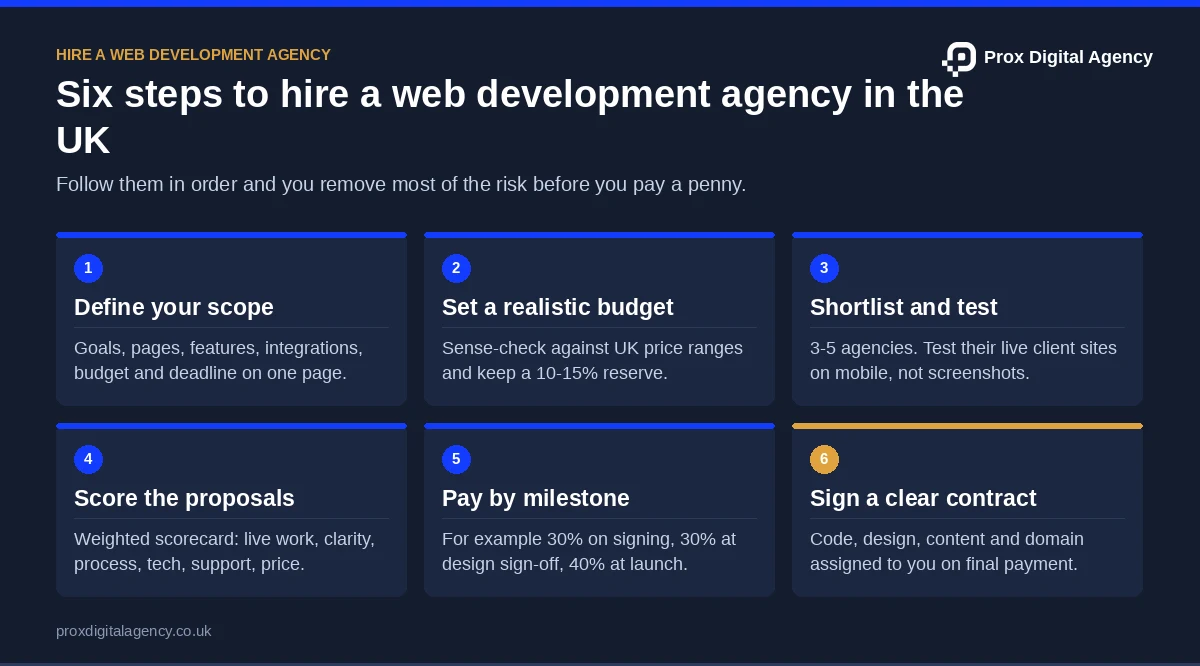
Step 1: Define Your Scope and Goals
Before you hire a web development agency, outline your requirements. Start with the type of project:
- A marketing website that promotes your services and generates enquiries.
- A custom web application for customers or staff, such as a booking or employee management system.
- An e-commerce store to sell products online.
Then write down your goals. Do you need more leads, higher online sales, a better user experience or all of these? A one-page brief should cover your goals, target audience, must-have pages and features, integrations, budget range and deadline. Goals help an agency recommend the right solution rather than simply quoting for what you asked for. If you are replacing a site that is not converting, start by understanding why your London business website is losing customers, so your brief fixes the real problems.
Step 2: Set a Realistic Budget
A budget defines your maximum spend and stops the project drifting. Use the cost table above to sense-check your figure, and keep a reserve of 10–15% for unexpected changes. If your budget and your wish list do not match, prioritise the features that drive revenue and plan a second phase for the rest.
Step 3: Shortlist Agencies and Test Their Live Work
Next, build a shortlist of three to five UK agencies from these sources:
- Google and local search results for the type of site you need.
- Review platforms such as Clutch and Google reviews.
- Industry directories, awards and recommendations from businesses you trust.
Next, look at their deployed client work, not just portfolio screenshots. Visit the live sites and test them yourself:
- Check loading speed on mobile and desktop with Google’s PageSpeed Insights.
- Test mobile responsiveness on your own phone.
- Click through menus, forms and checkout pages.
- Confirm the company is active and its details match on Companies House.
If the live sites feel slow or broken, remove that agency from your list. What you see is likely what you will get.
Step 4: Compare Proposals With a Scorecard
Request written proposals from your shortlist and compare them side by side.
To stop the cheapest or slickest pitch winning by default, score each agency out of five against weighted criteria:
In other words, the cheapest quote is rarely the best value. Focus on clarity, evidence and fit.
Want a second opinion on the proposals you have received?
Send us your brief or the quotes you are comparing. We will tell you honestly what looks right, what is missing and what a fair price for the scope would be.
Get a free proposal reviewSee our web development services →
Step 5: Agree Milestone Payments
Above all, avoid paying 100% upfront. A staged payment structure keeps both sides motivated and protects your cash flow. A common example:
Larger projects often split development into extra milestones, but the principle is the same: every payment should follow a visible piece of progress.
Step 6: Sign a Clear Contract
Never hire a web development agency without a written contract. It protects your investment and should cover:
- The full scope of work and deliverables.
- The timeline and key milestones.
- Payment terms.
- Ownership of the code, design and content, with copyright assigned to you on final payment.
- Handover of domain, hosting and analytics logins.
- Revision rounds and how change requests are priced.
- Confidentiality and data protection terms.
- Support terms after launch.
- Cancellation and dispute procedures.
Ownership, in particular, deserves special attention. Under UK copyright law, the person who writes code or creates a design usually owns it unless the rights are assigned in writing, so paying for a website does not automatically make it yours. If you are unsure about any clause, ask a solicitor to review the contract. It is a small cost compared with a failed project.
How a Web Development Agency Works: The Process
Most UK agencies follow a similar workflow. Knowing the stages before you hire a web development agency helps you plan your own time and spot a team that is cutting corners.
Each phase should end with your written approval, and you should never let an agency skip sign-offs. For a realistic view of how long each stage takes, read how long it takes to design a website.
What a Good Web Development Agency Proposal Should Include
A good proposal is specific enough that two different developers could read it and build roughly the same product. Look for:
- A written list of pages and features, and what is out of scope.
- The technology chosen, and why it suits you.
- A timeline broken into stages.
- A fixed or capped price, and what would change it.
- How you will review progress.
- What happens after launch.
- For replacement sites, a plan for redirects that protects your search rankings.
On the other hand, be wary of proposals that are mostly about the agency’s awards. If a custom build is recommended, the proposal should explain why an off-the-shelf platform would not do the job. To judge whether the proposed technology will still serve you in a few years, compare it with the web development trends for 2027 that actually matter.
Red Flags When Hiring a Web Development Agency
Some warning signs should make you pause. Others should make you walk away.
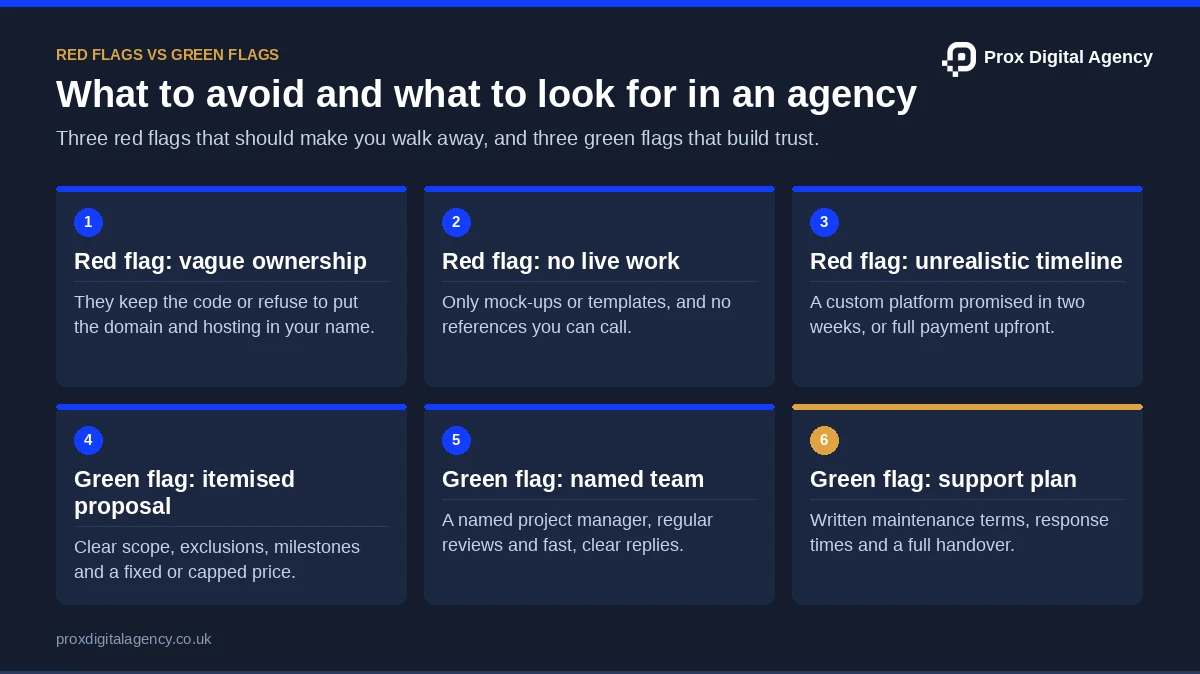
Vague Ownership Terms
If an agency claims permanent ownership of your core codebase, or refuses to register the domain and hosting in your name, walk away. You should be able to move your site to another provider at any time.
No Proven Case Studies
Be cautious of agencies that only show mock-ups or templates. You want live, functioning client sites and, ideally, references you can call. Real results prove real ability.
Unrealistic Timelines
For example, a custom enterprise platform cannot be built in two weeks. If an agency promises this, corners are being cut, and security, testing and architecture will suffer.
Other Warning Signs
- A price far below every other quote.
- Pressure to sign quickly.
- Slow or unclear replies during the sales stage.
- No written proposal or contract.
- A request for full payment upfront.
- No named project manager.
- No plan for testing or post-launch support.
- A refusal to share client references.
Trust your instincts. If something feels off during the sales process, it rarely improves once the project starts.
Questions to Ask a Web Development Agency Before You Hire Them
Use these questions in your final meetings before you hire a web development agency. The answers will tell you more than any pitch deck.
Then take notes on every answer and score them against your scorecard. This is your final decision-making stage.
UK Legal and Compliance Checklist for Your New Website
UK businesses must follow certain rules online, and a good agency will help you meet them. When you hire a web development agency, ask how they handle each point below.
- UK GDPR and the Data Protection Act 2018: collect and store personal data lawfully, securely and only for clear purposes. The ICO’s UK GDPR guidance is the official reference.
- Cookies (PECR): the Data (Use and Access) Act 2025 relaxed consent for some low-risk cookies, such as certain analytics, but you must still tell users what you set and let them opt out, and advertising cookies still need consent. Follow the ICO’s guidance on cookies and similar technologies.
- Accessibility: build to WCAG 2.2 level AA so disabled users can use your site. It also helps you meet your duties under the Equality Act 2010.
- E-commerce rules: show clear prices, delivery terms and returns policies, and include all mandatory fees in the price shown upfront, as required since April 2025 under the Digital Markets, Competition and Consumers Act. The CMA’s guidance explains what is allowed.
- Privacy policy and terms: publish clear, up-to-date documents.
- Copyright and licences: make sure every image, font and plugin is properly licensed.
Do not leave compliance to chance. Fines, chargebacks and lost trust cost far more than getting it right during the build.
Why SEO Should Be Part of the Build
However, a beautiful site is not enough. It also has to be found. SEO should start during development, not after launch, because fixing structural problems later costs more. Ask your agency to include:
- A clean, crawlable site structure.
- Fast loading and good Core Web Vitals.
- A mobile-first design.
- Logical headings, page titles and meta descriptions.
- Structured data, as explained in our schema markup guide.
- A full redirect plan from old pages.
- Compressed, properly sized images.
- An XML sitemap and robots.txt set-up.
- Local SEO elements, such as consistent business details and a link to your Google Business Profile.
Google’s own SEO Starter Guide is a useful benchmark for what a well-built site should do. If you are replacing an existing website, follow our SEO website migration checklist so you keep the rankings you have already earned, and consider a technical SEO audit before launch.
After Launch: Support and Maintenance
Even so, a website still needs care after it goes live. Software updates, security patches and backups are essential. Typical maintenance covers:
- Core, plugin and theme updates.
- Daily or weekly backups.
- Security monitoring.
- Uptime checks.
- Speed and performance reviews.
- Small content changes.
- Bug fixes.
Maintenance typically costs £50 to £300 a month for most small and mid-sized sites, and more for large or e-commerce platforms. When you hire a web development agency, agree these terms in writing before you sign the build contract, because that is when you have the most leverage. You should also be able to take your code, database and content elsewhere without obstruction if you stop paying for support. Our guide to website security best practices explains what good protection looks like.
Planning a launch for 2027? Our free 2027 Website Checklist covers the speed, AI-readiness and conversion checks to run before you go live.
Hire a Web Development Agency You Can Trust
A website is not a one-off purchase. It is a business asset that should earn its keep for years, and the agency you choose decides how well it performs.
In short, use this guide as your filter. Write a clear brief. Test live work. Question ownership terms. Tie every payment to progress. These habits protect your budget and your timeline, and they separate reliable partners from the ones that put your business at risk.
When you hire a web development agency in the UK, look for honesty before polish: clear answers, fair pricing and a plan for after launch. That is how we work at Prox Digital Agency. As a UK web development agency, we build fast, secure, SEO-ready websites that you fully own, with clear pricing, realistic timelines and support that continues after launch. You can see the results in our case studies.
Prox Digital Agency · Web Development
Ready to start your website project?
Tell us what you need to build. We will scope it, give you a clear, itemised quote and a realistic timeline, with no obligation.
Frequently Asked Questions
How do I hire a web development agency in the UK?
Write a short brief with your goals, pages, features and budget, then shortlist three to five UK agencies with live work similar to your project. Compare itemised proposals, check references and company details, agree milestone payments, and sign a contract that gives you ownership of the code, content and domain.
How much does it cost to hire a web development agency in the UK?
Most brochure websites cost £1,500 to £8,000, B2B lead generation sites £8,000 to £25,000 and e-commerce stores £3,000 to £30,000+. Custom web platforms usually start around £15,000 and enterprise builds around £50,000. Ongoing maintenance typically adds £50 to £300 a month for most small and mid-sized sites.
How long does a web development agency take to build a website?
A brochure site usually takes 4 to 8 weeks, an e-commerce store 8 to 14 weeks, a custom platform 16 to 30 weeks and an enterprise build 24 to 40 weeks. Most delays come from late content, slow feedback and scope changes rather than the build itself.
Should I hire a freelancer or a web development agency?
A freelancer can suit a small, simple site with a tight budget. An agency is usually the safer choice when you need design, development, SEO, testing and support from one accountable team, or when the project is business-critical and cannot depend on one person.
Should I choose a London agency or a regional one?
Both can deliver excellent work. London agencies tend to charge towards the top of the market, while regional teams are often cheaper. Experience with projects like yours, live portfolio quality and clear communication matter far more than the postcode.
Who owns the website code and domain after launch?
You should. Under UK law the developer usually owns the copyright in code they write unless it is assigned to you in writing, so your contract should transfer the code, design and content to you on final payment. The domain, hosting and analytics accounts should be registered in your company’s name from day one.
What should a web development agency contract include?
The scope and deliverables, timeline and milestones, payment terms, ownership and IP assignment, handover of logins, revision rounds and change-request pricing, data protection terms, post-launch support and how either side can end the agreement.
Do I need a monthly maintenance plan?
In most cases, yes. Websites need regular software updates, backups, security monitoring and small fixes. A maintenance plan typically costs £50 to £300 a month for most small and mid-sized sites, and more for large or e-commerce platforms, and it is far cheaper than repairing a hacked or broken site.

 Muhammad Bilal, London
 11 mins
Local SEO for Multiple Locations: How to Rank Every Branch Without Duplicate Content

Local Citations and NAP Consistency: How to Build, Audit and Clean Up Your Business Listings

Local SEO for Small Businesses: A Step-by-Step Plan for Your First 90 Days

What Is Local SEO? A Complete Guide to Ranking in Google Maps and Local Search (2026)

Prox Digital Agency Releases Free 2027 Website Checklist as Fewer Than Half of Mobile Sites Pass Google’s Speed Test
B2B SEO Case Study: How We Took Aegotel from Hacked and Invisible to Full Tracking
Prox Digital Agency Named Second in NeuralAdX Ltd’s “Best Google Gemini Optimisation Agency UK” Comparison

International SEO Keyword Research: How We Research New Markets (UK, US, UAE and Australia)