Local Link Building: 12 Ways to Earn Links From Your Community, Press and Partners
Local link building is the process of earning backlinks from relevant businesses, organisations, publications and websites connected to your area. These links can support your website’s authority, increase referral traffic and contribute to local search visibility.
But how can a small business earn quality local backlinks without buying links or spending heavily on outreach?
The most practical approach is to build genuine relationships, share useful information, and participate in activities worth mentioning.
This guide covers 12 local link building strategies, including community partnerships, local PR, sponsorships and budget-friendly opportunities for UK businesses.
What Is Local Link Building?
Local link building involves acquiring links from external websites that have a relevant geographic, industry, or community connection to your business.
For example, a Bristol-based bakery might receive a backlink from a regional food publication, while a Birmingham accounting firm could earn a mention from a local business association.
These links help people discover your website through other trusted sources.
Unlike broader link building, which may focus on industry publications regardless of location, local link building places greater emphasis on geographic relevance.
How Does Local Link Building Affect SEO?
Google considers information such as links from other websites when assessing local prominence, one of its main local ranking factors alongside relevance and distance.
However, a backlink doesn’t guarantee a higher Google Maps ranking.
The value of a link depends on factors such as its relevance, context, and the website providing it.
A genuine mention from a recognised local organisation may be more useful to customers than numerous links from unrelated directories.
For a broader explanation of local ranking factors, see our complete guide to local SEO.
What Makes a Good Link in Local Link Building?
Not every backlink offers the same value.
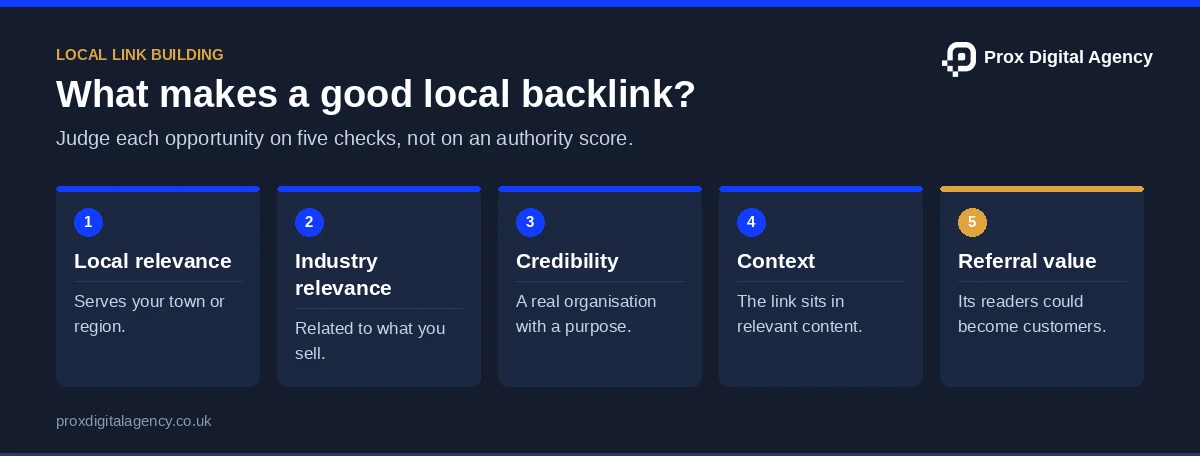
Before pursuing a link opportunity, consider whether the website is relevant to your business and whether its visitors could reasonably benefit from discovering your services.
Useful characteristics include:
- Local Relevance: The website serves your town, city, or region.
- Industry Relevance: Its content relates to your products or services.
- Credibility: The organisation has a legitimate purpose and identifiable presence.
- Context: The link appears naturally within relevant information.
- Referral Potential: Its audience may genuinely be interested in your business.
Avoid judging links solely by third-party SEO authority scores. These metrics can help with research but aren’t Google’s published ranking scores.
12 Practical Local Link Building Strategies
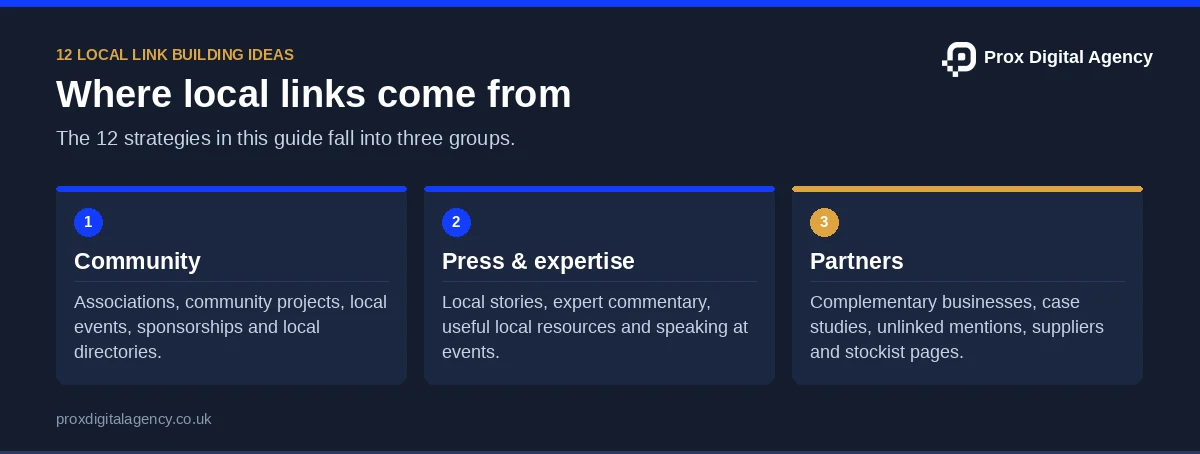
The following methods focus on earning links through legitimate business activities, useful content, and relevant local relationships.
1. Join Relevant Local Business Associations
Local chambers of commerce, business networks and professional associations can provide opportunities to connect with other organisations.
Some maintain member directories or business profiles that include website links.
For example, a Sheffield-based consultancy might join an appropriate regional business network and appear in its member directory.
Before joining, review the membership benefits, fees and listing requirements.
Practical Tip: Prioritise associations that offer networking, professional support or genuine customer exposure rather than joining solely for a backlink.
2. Build Relationships With Complementary Businesses
Businesses offering related but non-competing services may have opportunities to collaborate.
For example, a wedding photographer could work with local venues, florists, or event planners.
These relationships might lead to joint projects, supplier recommendations, or relevant website mentions.
A venue could feature photographs from a real wedding and credit the photographer with a link to their portfolio.
The mention should reflect an actual professional relationship rather than an arrangement created purely to exchange links.
3. Contribute to Local Community Organisations
Community involvement can create opportunities for relevant recognition.
Businesses may support local initiatives, volunteer programmes, charities or neighbourhood improvement projects.
For example, a gardening company could contribute expertise to a community planting project.
If the organisers publish information about the activity, they may choose to mention participating businesses.
The priority should be the community contribution itself, not securing a link.
Avoid requiring organisations to provide backlinks as a condition of participation.
4. Sponsor Relevant Local Events
Local sponsorships can help businesses reach audiences within their target area.
Opportunities might include community festivals, charity events, educational programmes or sports activities.
For example, an independent retailer could sponsor a local community event where its products are relevant.
However, sponsorship links require careful handling.
Google recommends using rel=”sponsored” for paid placements, with rel=”nofollow” also accepted.
Sponsorship should therefore be considered primarily for its branding, audience, and community benefits rather than as a way to purchase ranking influence.
5. Share Useful Stories With Local Publications
Local PR involves providing journalists and regional publications with information that may interest their readers.
Suitable stories could include a genuine business expansion, community initiative, original local research, or noteworthy industry development.
For example, a regional construction business might share findings from a survey about common property maintenance concerns.
A publication may cover the story and reference the business.
However, editorial coverage and backlinks are never guaranteed.
Keep pitches relevant, factual, and concise.
For more detailed outreach methods, see our guide to digital PR for SEO.
6. Provide Expert Commentary to Local Journalists
Journalists sometimes need knowledgeable contributors to explain specialist topics.
A local accountant might comment on practical bookkeeping challenges facing small businesses, while a building surveyor could explain common property maintenance issues.
Relevant commentary can establish professional credibility and may result in an editorial mention or backlink.
Start by identifying journalists and publications covering your industry or region.
Offer specific expertise rather than sending generic promotional messages.
If your contribution is published without a link, it may still have value through brand exposure and professional recognition.
7. Create Useful Local Resources
Original resources can give other websites a reason to reference your content.
For example, a business could publish a practical guide to local commercial property requirements, relevant public resources, or seasonal maintenance considerations.
The resource should address a genuine information need.
Avoid copying existing guides or presenting unverified statistics as original research.
Where appropriate, use official sources and clearly explain how any data was collected.
Once published, share the resource with relevant organisations that may find it useful.
A helpful guide can continue attracting relevant references beyond its initial promotion.
8. Contribute to Local Industry Events
Workshops, exhibitions and professional events provide opportunities to demonstrate expertise.
A digital consultant might deliver a session on website accessibility, while a qualified tradesperson could contribute to a relevant training event.
Event organisers sometimes publish speaker biographies, presentation summaries, or resource pages with links.
Choose events that match your experience and business audience.
You shouldn’t expect every speaking opportunity to produce a backlink, but it can support wider professional relationships and visibility.
9. Share Genuine Customer Case Studies
Case studies can demonstrate the work you’ve completed while creating opportunities for relevant mentions.
For example, an office refurbishment company might publish a project overview covering the client’s requirements, completed work and practical outcomes.
With the customer’s permission, the project may also be featured on the client’s website or by participating suppliers.
Make sure any performance claims are supported by evidence.
Avoid requiring clients to publish backlinks or using case studies primarily as a vehicle for exchanging links.
10. Find Relevant Local Directories
Established local and industry directories can help customers discover businesses.
Useful examples may include legitimate regional business directories, professional associations, and relevant trade listings.
Before submitting your information, assess whether the platform is credible and whether customers actually use it.
Complete listings accurately and avoid duplicate records.
A smaller selection of appropriate directories is generally more manageable than hundreds of unrelated submissions.
Remember that directory listings also support business information accuracy, so check names, addresses, and telephone numbers carefully.
11. Look for Unlinked Business Mentions
An unlinked mention occurs when another website references your business without linking to your website.
For example, a local publication might mention your company’s participation in an event but omit a website link.
Search for your business name and review relevant mentions.
Where a link would genuinely help readers find more information, you can politely ask the publisher to consider adding one.
Don’t demand changes or contact publishers repeatedly.
Some publications have editorial policies that restrict external links, and they aren’t obliged to include one.
12. Reconnect With Suppliers and Existing Partners
Existing professional relationships can provide relevant opportunities.
A supplier might maintain a directory of authorised stockists, approved installers or local service partners.
For example, a retailer could qualify for inclusion in a manufacturer’s official stockist directory.
Similarly, a service business might appear in an appropriate partner directory.
Check whether your business meets the listing criteria and whether the information would help prospective customers.
Avoid artificial reciprocal linking arrangements created only to influence search rankings.
Want a list of local link opportunities near you?
Tell us your town and industry. We will find associations, publications and partners that could link to you, free.
Local Link Building on a Limited Budget
Local link building doesn’t always require paid campaigns or specialist software.
Small businesses can begin by identifying opportunities within relationships and activities they already have.
Start with Existing Connections
Review your suppliers, professional memberships, business partners and community activities.
You may already qualify for relevant listings or have completed projects worth documenting.
These opportunities are often easier to investigate than approaching unfamiliar websites.
Choose Two or Three Activities to Prioritise
Rather than attempting all 12 methods simultaneously, select those most appropriate for your business.
For example, a local tradesperson might prioritise trade associations, supplier directories and genuine project case studies.
A consultancy may benefit more from expert commentary, industry events and original educational resources.
Set a Manageable Outreach Routine
Dedicate a small amount of time each month to researching opportunities and contacting relevant organisations.
Keep outreach personalised and explain why the information would benefit their audience.
Avoid purchasing large prospect lists or sending repetitive messages to unrelated websites. If you would rather have it done for you, a local SEO agency can run local PR and outreach alongside your profile and citation work.
Local Link Building Mistakes to Avoid
Poor link-building practices can create risks without delivering meaningful business value.
Buying Links to Influence Rankings: Google considers paid links that pass ranking credit a form of link spam.
Excessive Link Exchanges: Arrangements made primarily to manipulate rankings can violate Google’s policies.
Submitting to Irrelevant Directories: Low-quality directory links may provide little customer value.
Using Keyword-Heavy Anchor Text: Repeated, unnatural commercial phrases can be associated with manipulative linking practices.
Publishing Low-Value Guest Articles: Articles written primarily to insert backlinks offer limited value to readers.
Expecting Guaranteed Ranking Improvements: Even relevant backlinks don’t guarantee a particular search position.
Google’s guidance allows legitimate advertising and sponsorship links when they’re appropriately qualified. The distinction is whether links are intended to manipulate ranking signals.
If you also need links from outside your area, our link building agency team runs wider outreach campaigns.
How to Measure Local Link Building Results
Link building should be evaluated through both website performance and business outcomes.
Start by recording newly acquired links, their sources, and the pages they reference.
Google Search Console provides information about some websites linking to your domain, although its links report isn’t a complete inventory of every backlink.
Third-party tools can provide additional estimates, but their data and scoring methods vary.
Useful measures include:
- New backlinks from relevant websites
- Referral visits from those websites
- Relevant organic search visibility
- Enquiries or conversions from referral traffic
- Relationships and opportunities created through outreach
Review results over time.
A single relevant link may introduce customers to your business, while another may provide little direct traffic.
Neither result should be judged solely by the linking website’s authority score.
Frequently Asked Questions About Local Link Building
What Is the Best Local Link Building Strategy?
There isn’t one strategy that suits every business. Relevant business associations, local publications, professional partnerships, and useful resources can all provide opportunities. Choose methods that fit your industry and target customers.
How Many Local Backlinks Do I Need?
Google doesn’t specify an ideal number of local backlinks. Focus on earning relevant, legitimate links rather than reaching an arbitrary target.
Can Local Backlinks Improve Google Maps Rankings?
Links can contribute to local prominence, which Google identifies as a local ranking factor. However, rankings also depend on relevance, distance, and other signals, so improvement isn’t guaranteed.
Is Local Link Building Free?
Many activities can be carried out without paying for link placements, although research, content creation, and outreach require time. Memberships, events, and sponsorships may involve costs.
Are Sponsorship Links Good for Local SEO?
Sponsorships can support community relationships, referral traffic, and brand visibility. Paid or sponsored links should be appropriately qualified and shouldn’t be purchased to manipulate search rankings.
How Do I Approach Local Websites for Backlinks?
Start by identifying relevant local websites, publications, or organisations that may benefit from your content. Send a personalised email explaining how your resource adds value to their audience, with a brief description and link. Keep your outreach professional and avoid pressuring website owners to include a backlink.
Conclusion: Building Local Authority Through Genuine Connections
Local link building works best when it reflects the relationships, expertise, and contributions a business develops within its community.
Rather than treating every website mention as an SEO transaction, focus on opportunities that make your business useful to local audiences.
A credible recommendation, relevant resource, or professional partnership can provide value beyond a backlink.
The aim is to establish a business presence that other organisations have genuine reasons to recognise, reference, and recommend.
Prox Digital Agency · Local SEO
Want help earning links that move local rankings?
We plan and run local PR, partnerships and outreach that earn genuine local backlinks, alongside the rest of your local SEO.

 Muhammad Bilal, London
 11 mins
Beyond Google: How to Set Up Apple Business Connect and Bing Places for Local Visibility
Local SEO for Service-Area Businesses: How to Rank Without a Shop or Office

The Complete Guide to Hiring a Web Development Agency in the UK (2027)
Local SEO for Multiple Locations: How to Rank Every Branch Without Duplicate Content
Local Citations and NAP Consistency: How to Build, Audit and Clean Up Your Business Listings
Local SEO for Small Businesses: A Step-by-Step Plan for Your First 90 Days
What Is Local SEO? A Complete Guide to Ranking in Google Maps and Local Search (2026)
 Fahad Khan, London
Prox Digital Agency Releases Free 2027 Website Checklist as Fewer Than Half of Mobile Sites Pass Google’s Speed Test