How Much Does Generative Engine Optimisation (GEO) Cost in the UK in 2026?
Short answer: most UK businesses pay between £2,000 and £5,000 per month for a genuine generative engine optimisation (GEO) retainer. Entry-level programmes start at around £800 to £2,000 per month, competitive B2B and multi-market programmes run £5,000 to £10,000, and enterprise work can pass £20,000 per month. Most agencies also charge a one-off audit or onboarding fee of roughly £1,500 to £5,000.
That is a wide range, and it is wide for a reason. This guide explains what drives the price of GEO, what you should get at each budget level, the costs that rarely appear on a proposal, and how to tell real GEO from ordinary SEO with a new label on it.
If you are new to the discipline, start with our explainer on what GEO is and how it works, then come back here to plan your budget.
GEO Cost in the UK at a Glance
These are typical monthly retainer ranges for UK agencies in 2026, based on published agency pricing across the market.
| Tier | Typical monthly cost | Best suited to |
|---|---|---|
| Starter | £800 – £2,000 | Local and small businesses in low-competition categories |
| Foundation | £2,000 – £5,000 | SMEs and growing brands wanting consistent AI visibility |
| Authority | £5,000 – £10,000 | Competitive B2B categories, multiple services or markets |
| Enterprise | £10,000 – £20,000+ | Large brands, several countries or languages, heavy digital PR |
| One-off audit / onboarding | £1,500 – £5,000 | A baseline of where you stand in AI answers before any retainer |
One useful rule of thumb: anything sold as “full GEO” for well under £1,500 a month is usually standard SEO with AI terminology added. That is not always a bad thing, but you should know which one you are buying.
Why GEO Pricing Varies So Much
A GEO quote is really a price for closing the gap between how AI platforms describe your category today and how you want them to describe it. The bigger that gap, the more work it takes. These are the factors that move the price most.
1. How visible you already are
If ChatGPT, Perplexity, Gemini and Google’s AI Overviews already mention your brand for some of your core questions, the work is about strengthening and widening that presence. If they never mention you, the programme has to build recognition from scratch, which takes longer and costs more. Our AI invisibility checklist is a quick way to gauge where you start.
2. How competitive your category is
AI answers usually name only a handful of providers. In a crowded category such as legal services, fintech or SaaS, you are competing with brands that have years of reviews, press coverage and comparison-site listings behind them. Winning a place in those answers takes more content, more third-party mentions and more time.
3. Third-party mentions and digital PR
This is often the biggest single cost driver. AI platforms lean heavily on what other sources say about you: industry publications, review platforms, directories, “best of” lists and community discussion. Your own website is only part of the picture. Programmes that include active digital PR and outreach cost more, but they also tend to move AI visibility furthest. See how to get your brand mentioned in AI answers for why this matters.
4. Content volume and depth
AI systems favour clear, well-structured pages that answer specific questions directly. Most brands need new content (comparisons, pricing pages, detailed FAQs, original data) as well as restructuring what they already have. The number of pages involved has a direct effect on cost.
5. Technical foundations
Schema markup, crawler access for AI bots, page speed, clean site architecture and files such as llms.txt all affect whether AI systems can read and trust your site. A site with a sound technical base needs less remedial work. One with years of accumulated issues needs more.
6. Platforms, markets and languages
Tracking and optimising for one platform in one country is a very different scope from covering five AI platforms across the UK, Europe and the US. Each extra market or language adds research, content and monitoring. Our comparison of the major AI search engines shows how differently each one sources its answers.
What You Should Get at Each Budget Level
Starter (£800 – £2,000 per month)
Expect an initial AI visibility check across a small set of priority questions, technical fixes for AI crawlability and schema, restructuring of your key service pages into answer-first formats, a small amount of new FAQ or comparison content, and basic monthly reporting. This suits a local business, or one in a niche where few competitors are doing GEO yet.
Foundation (£2,000 – £5,000 per month)
This is where most SMEs land. On top of the starter work, you should see a tracked set of commercial prompts measured every month, a regular content programme built around the questions buyers actually ask AI tools, entity and brand consistency work across the web, some digital PR or listings outreach, and reporting that connects AI visibility with traffic and enquiries.
Authority (£5,000 – £10,000 per month)
For competitive B2B categories or brands with several service lines. Expect larger prompt sets tracked across multiple AI platforms, sustained digital PR to earn coverage in the sources AI systems cite, original research or data assets that others reference, competitor share-of-voice analysis, and closer integration with your SEO and content teams.
Enterprise (£10,000 – £20,000+ per month)
Multi-market or multi-language programmes, dedicated strategists, large-scale content and PR operations, custom dashboards and board-level reporting, and ongoing work on how AI systems describe your brand, products and leadership.
Common GEO Pricing Models
Monthly retainer
The most common model. GEO is ongoing: AI platforms update their models and sources constantly, and competitors do not stand still. A retainer covers continuous monitoring, content and outreach. Most agencies ask for a minimum commitment, because meaningful change in AI answers rarely happens within a few weeks.
One-off audit
A fixed-fee assessment of how AI platforms currently describe you and your competitors, plus a prioritised action plan. This is a sensible first step if you want to understand the opportunity before committing to a retainer, or if you have an in-house team who can carry out the recommendations.
Project or sprint
A defined piece of work over a fixed period, such as rebuilding your service pages for AI answers, a technical GEO clean-up, or launching a new comparison and pricing content hub.
Combined SEO and GEO retainer
Increasingly common, and usually the best value. GEO and SEO share most of the same foundations, so running them together avoids paying twice for technical work, content and outreach. More on this below.
GEO vs SEO Cost: Do You Need Both?
For most businesses, yes, and the good news is that they overlap heavily. Many AI answers draw on pages that already rank well in traditional search, so strong SEO makes GEO cheaper and more effective. GEO then adds the pieces classic SEO tends to miss: answer-first content, tracking visibility inside AI responses, entity consistency, and earning mentions in the sources AI systems rely on.
If you are comparing budgets, our guide to how much SEO costs in the UK covers the SEO side in detail, and our SEO vs GEO guide explains where the two disciplines differ.
Hidden Costs to Plan For
- AI visibility tracking tools. Measuring your presence in AI answers needs specialist software. Some agencies include this; others pass the cost on. Our round-up of the best AI rank tracking tools covers the main options.
- Content production. Check whether the retainer includes writing, or only strategy and briefs.
- Development time. Technical fixes such as schema or crawler settings may need your developer, especially on custom-built sites.
- Digital PR placements. Earned coverage takes time and effort. Some agencies also pass on costs such as paid directory listings. Ask what is included.
- Your team’s time. Good GEO needs input from people who know your business: case studies, expert quotes, product detail and approvals.
Red Flags When Comparing GEO Quotes
- Guaranteed placement in ChatGPT or AI Overviews. No agency controls what AI platforms say. Any guarantee of specific AI answers should end the conversation.
- No baseline. If an agency cannot show you how AI platforms describe you today, it cannot show you progress later.
- No prompt tracking. Reporting only on Google rankings and traffic is SEO reporting. GEO reporting should show which AI questions mention you, how often, and how that compares with competitors.
- Very low “full GEO” pricing. As above, well under £1,500 a month usually means rebranded SEO.
- Tactics aimed at manipulating AI. Hidden text, mass-produced low-quality pages or fake reviews can damage your brand’s credibility with both search engines and AI systems.
How to Measure the Return on GEO
Before you sign anything, agree how success will be measured. Useful measures include:
- AI citations and mentions across a fixed set of commercial questions, tracked monthly
- AI share of voice compared with your main competitors
- Referral traffic from AI platforms such as chatgpt.com, perplexity.ai and gemini.google.com, visible in Google Analytics 4
- Branded search growth, since people who see you in an AI answer often search for you by name afterwards
- Enquiries and leads from AI-referred visitors, which is the measure that matters most
The tools in our guide to the best GEO tools can help you track the first two.
Questions to Ask Before You Hire a GEO Agency
- Can you show me how AI platforms describe my brand and competitors today?
- Which prompts and platforms will you track, and how often?
- What is included in the fee: strategy, content, technical work, PR, tools?
- How does this work alongside our existing SEO?
- What results have you achieved for businesses like ours, and how were they measured?
- What is the minimum term, and what happens if we stop?
How Prox Prices GEO
We do not sell fixed GEO packages, because two businesses at the same budget can need completely different work. Every engagement starts with an assessment of how AI platforms currently describe your brand and your competitors. From that, we build a programme sized to the opportunity, with clear measures agreed up front. It can run on its own or alongside SEO.
If you want to know what GEO would cost for your business, talk to our generative engine optimisation agency or book a free strategy call. We will show you where you stand in AI answers today and what it would take to change that.
Frequently Asked Questions
How much does GEO cost per month in the UK?
Most UK businesses pay £2,000 to £5,000 per month for a genuine GEO retainer. Entry-level programmes start at around £800 to £2,000, and competitive or multi-market programmes range from £5,000 to more than £20,000 per month.
Is GEO more expensive than SEO?
Not necessarily. GEO and SEO share most of their foundations, and combined programmes are often better value than buying them separately. GEO can cost more where it involves significant digital PR, because earning mentions in the sources AI platforms trust takes sustained effort.
Can small businesses afford GEO?
Yes. Small and local businesses in less competitive categories can see results from a focused programme at the lower end of the range, especially if their SEO is already in good shape. A one-off audit is a lower-risk way to start.
Is there a one-off GEO option?
Yes. Many agencies offer a fixed-fee GEO audit, typically £1,500 to £5,000, which shows how AI platforms currently describe you and gives you a prioritised plan. You can then run the work in-house or move on to a retainer.
How long does GEO take to show results?
Technical and on-page improvements can influence AI answers relatively quickly, but meaningful, lasting change usually takes several months, particularly where it depends on earning third-party coverage. That is why most GEO work runs as an ongoing retainer rather than a short project.
Can anyone guarantee my business will appear in ChatGPT?
No. AI platforms decide what they include in their answers, and no agency controls that. A credible GEO agency will improve the signals those platforms rely on and measure the change, but it will not guarantee specific placements.

 Maryam Basit, London
  8 mins
Google Business Profile Optimisation: The 2026 Checklist

Digital PR for SEO: How to Earn Links Journalists Actually Want

E-E-A-T in 2026: How to Prove Experience, Expertise, Authority and Trust
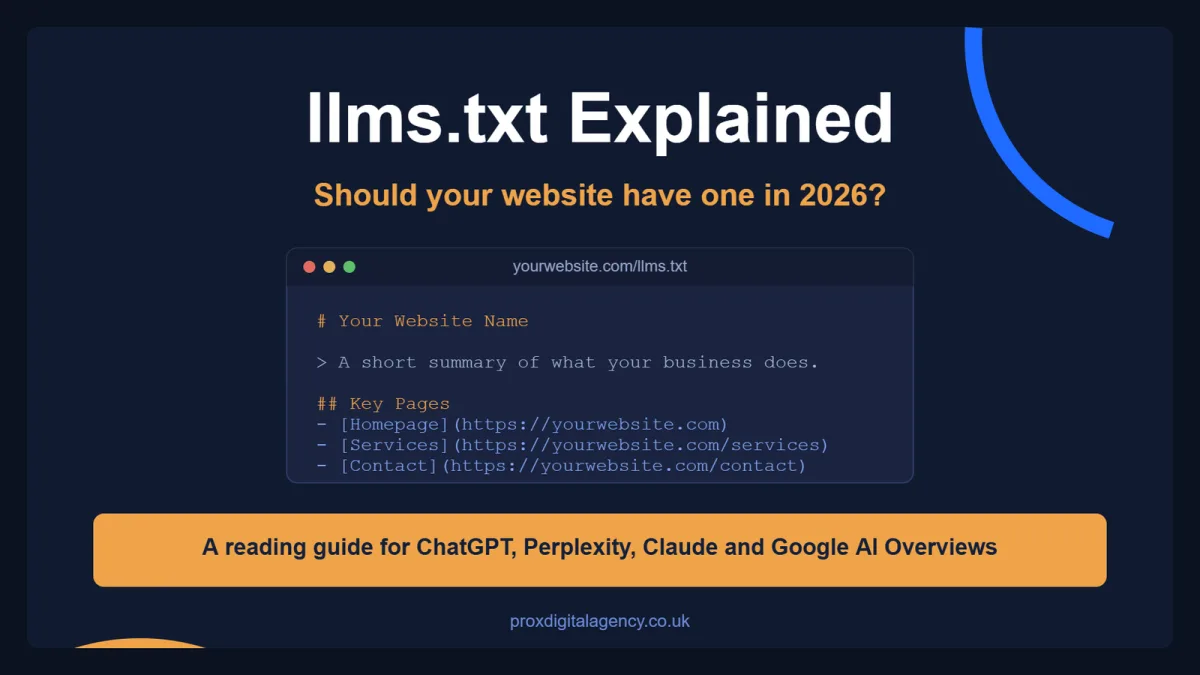
llms.txt Explained: Should Your Website Have One in 2026?
Perplexity Optimisation: How to Become a Cited Source

Prox Digital Agency Expands Its Generative Engine Optimisation Practice for Global Businesses

How to Choose a Professional SEO Company: 10 Questions to Ask

9 Web Design Mistakes That Quietly Kill Conversions