Local SEO for Small Businesses: A Step-by-Step Plan for Your First 90 Days
Local SEO for small businesses involves improving your visibility in location-based searches on Google Search and Google Maps. It helps nearby customers find your business when they’re looking for the products or services you provide.
Small business owners don’t need a large marketing budget to get started. The priorities are setting up an accurate Google Business Profile, improving your website’s local relevance, managing customer reviews, and keeping your business information consistent across online platforms.
A structured 90-day plan can help you complete these activities in a manageable order without trying to address everything at once.
This guide explains why local SEO matters for small businesses and provides a step-by-step plan for your first three months, including practical local SEO tips for independent shops, freelancers and businesses with fewer than ten employees.
Why Is Local SEO Important for Small Businesses?
Local SEO helps small businesses become more visible to customers searching within their service area.
For example, someone searching for “barber shop in Leeds” is likely looking for a business they can visit nearby. Similarly, a search for “accountant for small businesses in Bristol” indicates interest in a service connected to a particular location.
Appearing in relevant local search results creates an opportunity for these businesses to receive enquiries, appointments and visits.
It Helps You Reach Relevant Local Customers
Small businesses often serve a defined geographic area. A neighbourhood café might depend on nearby residents and workers, while a local electrician may cover several surrounding towns.
Local SEO helps businesses focus on searches connected to those locations.
Rather than competing for broad keywords against businesses nationwide, you can concentrate on services and locations relevant to your customers.
It Supports Visibility on Google Maps
Google Maps is an important discovery platform for businesses with physical locations and eligible service-area businesses.
An accurate Google Business Profile can display your contact information, operating hours, services, and customer reviews.
This gives potential customers useful information when they’re comparing businesses.
It Can Complement a Limited Marketing Budget
Unlike paid advertising, organic local search visibility doesn’t require payment for every website click.
However, local SEO still requires time, consistent maintenance and, in some cases, investment in website improvements or professional support.
For a small business with limited resources, prioritising foundational activities can be more practical than attempting multiple marketing campaigns simultaneously.
To understand the underlying ranking principles, read our complete guide to what local SEO is.
Your First 90 Days of Local SEO for Small Businesses
A 90-day local SEO plan helps small business owners organise their work into three stages.
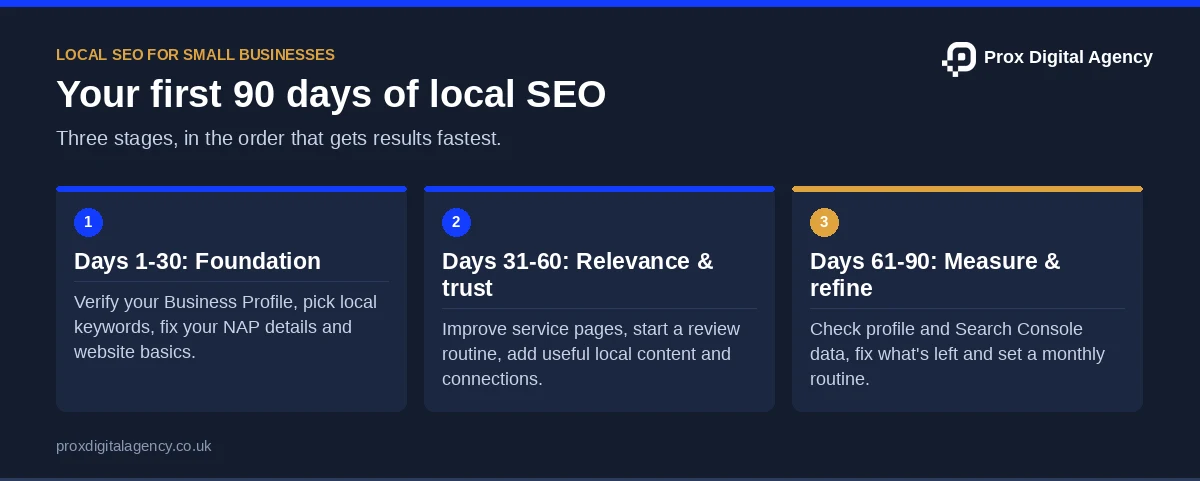
The objective is to establish accurate business information during the first month, improve website relevance and credibility during the second, and evaluate progress during the third.
These stages are implementation milestones, not guaranteed ranking timelines.
Google’s local results depend on relevance, distance, and prominence, alongside the competitive conditions surrounding each search.
A new business may need longer than 90 days to establish consistent visibility, especially in competitive locations.
Days 1–30: Build Your Local SEO Foundation
The first month focuses on establishing accurate business information, identifying relevant keywords and ensuring your website meets basic local SEO requirements.
Week 1: Set Up and Verify Your Google Business Profile
Claim or create an eligible Google Business Profile and complete the required verification. Ensure your business name, category, address or service area, opening hours, contact details and services are accurate. Add genuine photographs and avoid unnecessary keywords in your business name.
For detailed guidance, work through our Google Business Profile optimisation checklist.
Week 2: Identify Your Most Relevant Local Keywords
Research how customers search for your services in your area. For example, an accountant in Nottingham might target “small business accountant Nottingham” or “bookkeeping services Nottingham”.
Use Google Search suggestions, competitor websites and Search Console to identify relevant terms. Group keywords by service and assign them to appropriate pages rather than targeting everything on your homepage.
Our local keyword research guide shows how to find the regional terms your customers use.
Week 3: Check Your Business Information Across the Web
Review your business name, address and phone number (NAP) across Google Business Profile, your website and relevant directories. Correct outdated details, broken website links and duplicate listings that could confuse customers.
Our local citations and NAP consistency guide explains the auditing process.
Week 4: Review Your Website’s Local SEO Basics
Check that your website clearly explains your services, locations and contact options. Review page titles, headings, mobile usability and whether important pages can be indexed by Google. If you are unsure what a small business site needs, start with these essential website features for UK small businesses.
Set up Google Search Console to monitor search performance and identify indexing issues. Prioritise necessary fixes rather than redesigning your website unnecessarily.
Days 31–60: Improve Local Relevance and Build Trust
The second month focuses on improving service pages, collecting genuine reviews, publishing useful local content and developing relevant business connections.
Week 5: Improve Your Main Service Pages
Ensure each important service page explains what you offer, who it’s for, which areas you cover and how customers can enquire. Include relevant experience and clear contact options.
Create separate pages for distinct services where useful, but avoid near-identical pages targeting different towns.
Week 6: Improve Your Customer Review Process
Ask customers for honest Google reviews after completing a service or purchase. Share a direct review link and respond professionally to positive and negative feedback.
Avoid incentives, fake reviews or selectively requesting positive feedback.
Our guide on how to get more Google reviews and handle negative feedback covers this in detail.
Week 7: Add Useful Local Content Where Needed
Create content that answers genuine customer questions or demonstrates relevant local experience. For example, a gardening business could publish seasonal maintenance advice, while an accountant might explain common bookkeeping requirements.
Focus on useful information rather than producing articles solely to target location keywords.
Week 8: Develop Relevant Local Business Connections
Build relationships with local associations, suppliers, community organisations and industry publications. Genuine collaborations, events and expert contributions can create opportunities for relevant mentions and backlinks.
Avoid purchasing unrelated links or participating in link schemes.
Days 61–90: Measure Performance and Refine Your Approach
The final month focuses on evaluating search performance, addressing remaining issues and establishing a manageable ongoing SEO routine.
Week 9: Review Your Google Business Profile Performance
Check available Business Profile metrics, including searches, calls, website clicks and direction requests. Use these insights to understand customer interactions and identify areas for improvement.
Remember that clicks and direction requests don’t necessarily represent completed enquiries or visits.
Week 10: Review Website Search Performance
Use Google Search Console to review impressions, clicks and relevant search queries. Identify important pages receiving visibility but limited engagement.
Improve unclear page titles, content or calls to action where needed, and assess performance over a meaningful period.
Week 11: Address Remaining Issues
Prioritise unresolved problems affecting local visibility or customer experience. These may include outdated business listings, broken contact links, unclear service information or mobile usability issues.
Focus on corrections that offer practical value rather than making unnecessary changes.
Week 12: Create Your Ongoing Local SEO Routine
Establish a monthly routine for checking business information, responding to reviews, monitoring search performance and updating relevant website content.
Compare progress against your initial baseline and identify the next priorities. The first 90 days should establish a reliable foundation and not be treated as a guaranteed ranking deadline.
Want a 90-day local SEO plan built for your business?
Tell us what you sell and where. We will map out the first 90 days for you, in priority order, free.
Budget-Friendly Local SEO Tips for Small Businesses
Small business owners don’t need to invest in every SEO tool or service immediately.
If resources are limited, begin with activities that improve core business accuracy and customer experience.
Prioritise Free Google Tools
Google Business Profile and Google Search Console are available without a subscription fee.
Google Analytics can also help you understand how visitors use your website, provided it’s implemented appropriately.
These tools offer useful starting information before you consider paid SEO software.
Focus on Your Most Important Services
If your business offers several services, prioritise those most relevant to your customers and business objectives.
A sole trader may achieve more by improving three useful service pages than by producing twenty short articles with overlapping information.
Quality and relevance should guide the workload.
Use Your Existing Business Knowledge
Customer questions, common service issues, and real project experience can provide useful content ideas.
You already understand many of the concerns your customers have.
Turn that knowledge into clear website content instead of relying on generic articles.
Decide When External Support Is Worthwhile
Some small business owners can manage foundational local SEO themselves.
Others may need assistance with technical problems, website improvements, competitive research or limited internal capacity.
Before outsourcing, identify which tasks you need help with and what outcomes you expect.
For a more detailed breakdown of potential expenditure, see our UK local SEO pricing guide.
Local SEO Checklist for a Small Shop with Fewer than 10 Employees
For a small retail business, the most useful starting tasks are those that help customers find the shop, understand its products, and visit during the correct operating hours.
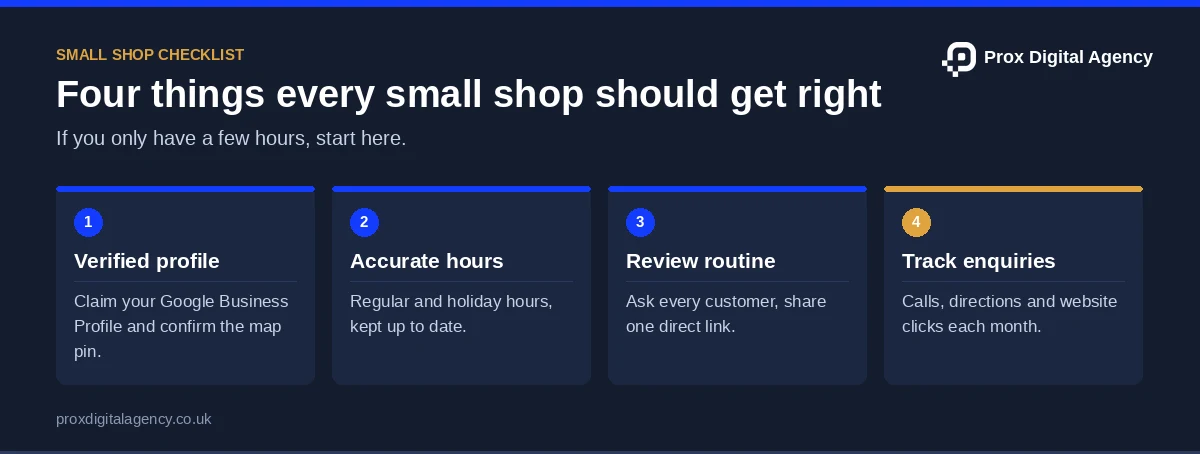
Use this checklist as a practical reference:
- Claim and verify your eligible Google Business Profile.
- Confirm that your shop address and map location are accurate.
- Add regular and special opening hours.
- Choose relevant business categories.
- Upload genuine photographs of the premises and products.
- Check that your website is mobile-friendly.
- Make your telephone number and contact information easy to find.
- Review important business directory listings.
- Establish a process for requesting genuine customer reviews.
- Monitor local search visibility and customer interactions.
For example, a small clothing shop in Cardiff may place greater emphasis on accurate opening hours, directions, product information and store photographs than on producing frequent blog posts.
The most useful priorities depend on how customers interact with the business.
Local SEO for Freelancers and Solo Small Businesses
Solo entrepreneurs often have even tighter time and budget constraints than small retail teams.
A self-employed photographer, tutor, or consultant may have to manage marketing alongside client work and administration.
For these businesses, the first step is to determine whether their operating model qualifies for a Google Business Profile.
Google’s guidelines for representing your business make eligibility depend on how the business interacts with customers. An online-only business isn’t automatically eligible simply because it serves people within a city.
If you’re eligible, ensure that your profile accurately reflects your operating model and location.
Then focus on a website that clearly describes your services, experience, service area, and enquiry process.
You can also improve local relevance through useful portfolio examples, genuine testimonials displayed with appropriate permission, and relevant business associations.
For freelancers, consistency is usually more manageable than attempting an ambitious publishing schedule.
Common Local SEO Mistakes Small Businesses Should Avoid
Several mistakes can reduce the effectiveness of an otherwise sensible local SEO strategy.
Using an Inaccurate Business Address
A virtual address or location where your business doesn’t genuinely operate may violate Google Business Profile requirements.
Adding Keywords to Your Business Name
Your profile should reflect your real-world trading name, not a collection of services and locations.
Creating Duplicate Location Pages
Repeating the same content across multiple town pages provides limited value to customers.
Ignoring Negative Reviews
An unanswered complaint can leave potential customers without context about how your business handles problems.
Expecting Immediate Rankings
Local search visibility depends on several factors, and improvements don’t follow a guaranteed timetable.
Measuring Rankings Without Business Outcomes
Website clicks and search positions matter less if they aren’t helping the business achieve meaningful goals.
Avoiding these issues can make your ongoing SEO work more reliable.
When Should a Small Business Consider Professional Local SEO Services?
Professional support may be useful when a business has limited time, technical website issues, inconsistent local visibility, or plans to expand into new areas.
For example, a small company managing several service categories may need help prioritising keyword research, service-page improvements and performance tracking.
At Prox Digital Agency, we help businesses approach local search through coordinated website optimisation, relevant content and performance measurement.
If your business needs help developing or implementing its strategy, explore our local SEO services for small businesses.
Frequently Asked Questions About Local SEO for Small Businesses
Can a Small Business Do Local SEO Without Hiring an Agency?
Yes. Many basic tasks, including maintaining your Google Business Profile, updating contact information, and requesting genuine reviews, can be handled internally.
Professional support becomes more relevant when technical or competitive challenges exceed the business’s available resources.
How Long Does Local SEO Take for a Small Business?
There is no fixed timeframe. Accurate listing updates may become visible relatively quickly, while improvements in competitive local rankings can take longer.
Your starting position, location, competition, and quality of implementation all affect progress.
What Is the Most Important First Step in Local SEO?
For an eligible business, reviewing and verifying its Google Business Profile is a sensible first step.
However, website quality, accurate business information and relevant services also matter. No single task guarantees strong rankings.
Can Local SEO Work for a Business Without a Physical Shop?
Yes, depending on the business model.
Eligible service-area businesses may maintain a Google Business Profile while hiding their address, provided they meet Google’s requirements.
Businesses operating exclusively online may not qualify for a Business Profile but can still improve their website’s search visibility.
Conclusion: Local SEO for Small Businesses Over 90 Days and Beyond
Local SEO is an ongoing process, and for small businesses, consistency matters more than trying to do everything at once. A clear strategy helps you focus on improvements that make your business easier to find and give potential customers the information they need.
The first 90 days provide a starting point, but lasting progress comes from keeping your business information accurate, understanding how customers search, and adapting your approach as your business grows.
The goal is not simply to rank higher on Google but to build a reliable local presence that helps the right customers find and choose your business.
Prox Digital Agency · Local SEO
Short on time to do this yourself?
We help small businesses with Google Business Profile set-up, reviews, local pages and tracking, at a pace and budget that suits you.

 Muhammad Bilal, London
 13 mins
Local Citations and NAP Consistency: How to Build, Audit and Clean Up Your Business Listings
What Is Local SEO? A Complete Guide to Ranking in Google Maps and Local Search (2026)

Prox Digital Agency Releases Free 2027 Website Checklist as Fewer Than Half of Mobile Sites Pass Google’s Speed Test
B2B SEO Case Study: How We Took Aegotel from Hacked and Invisible to Full Tracking

Prox Digital Agency Named Second in NeuralAdX Ltd’s “Best Google Gemini Optimisation Agency UK” Comparison

International SEO Keyword Research: How We Research New Markets (UK, US, UAE and Australia)
Keyword Mapping: How to Assign Keywords to Pages and Avoid Cannibalisation

Niche Keyword Research: How to Find Low-Competition Keywords Your Competitors Miss