Digital PR for SEO: How to Earn Links Journalists Actually Want
Digital PR for SEO isn’t about mass-emailing journalists, it’s about earning links that improve rankings. For local businesses in 2026, competition for visibility is high, and credible editorial coverage matters more than ever. But how do you get journalists to notice you?
Prox Digital Agency compiled this guide to show you how to pair newsworthy storytelling with local data and expert commentary. You’ll learn what journalists want, how to pitch without spamming, and how SEO PR builds authority, supports local search growth, and gets your business cited in AI answers.
Let us walk you through every step, from spotting opportunities to crafting pitches and turning digital PR into a reliable SEO channel.
Why Digital PR Is the Most Reliable Link-Building Method in 2026
Google is improving at detecting link manipulation. It can easily detect paid links, PBNs, and low-quality guest posts that carry real SEO risk. On the other hand, digital PR avoids these tactics and earns editorial links for link building strategies.
Digital PR is currently the most reliable method for link building and here is why:
- Journalists consider links to trusted sources rather than paid coverage.
- Digital PR can easily earn backlinks from authoritative websites that are difficult to pitch through other ways.
- Your one strong digital PR can earn several backlinks from multiple publications.
- Even if you don’t get a backlink, this coverage can increase your brand visibility and mentions among your potential audience.
So, instead of getting hundreds of low-value or paid links, focus on earning fewer but better links from real publications and journalists. This is the best digital PR strategy for 2026 you can opt for.
What Journalists Actually Want From Digital PR
Journalists do not look for favours. What impresses them is a story that is relevant, useful, and ready to use. Understand that, and journalist link building becomes a lot easier.
Let’s look at a clear picture:
If you can give a journalist a usable quote in under two hours, you’re already ahead of most PR teams.
The SEO-PR Convergence: How Earned Links Drive Rankings and AI Citations
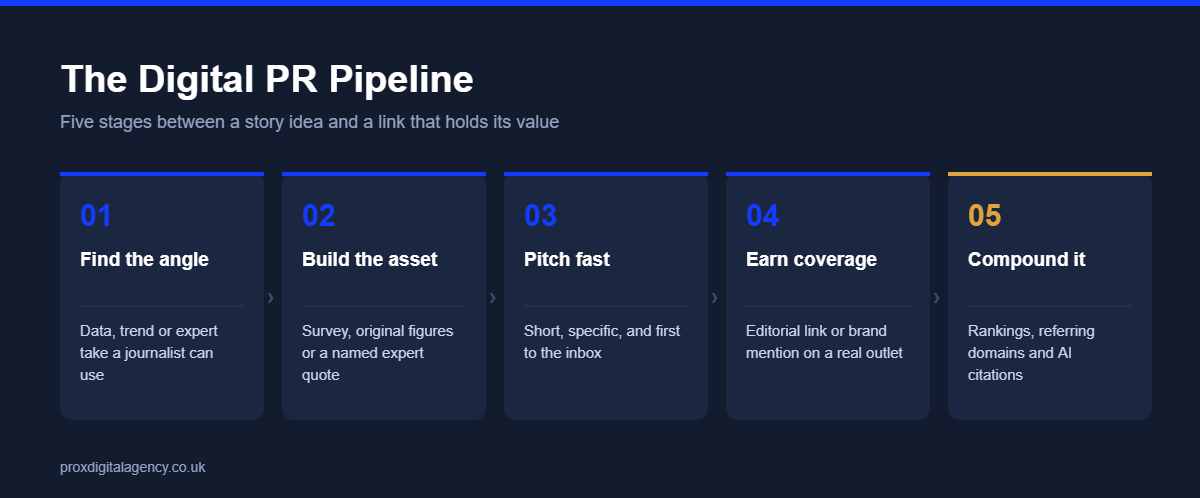
SEO and PR were once treated as separate functions, but that approach is no longer sustainable. SEO PR is now one discipline, because the same coverage that earns a backlink now also earns visibility in Google’s AI Overviews and other AI-generated answers.
So, what’s changed? Search visibility. That now depends on more than rankings alone.
- Search engines increasingly pull from trusted, cited sources for AI-generated answers.
- Brand mentions as SEO signals matter even without a link, since they help build topical authority. Community platforms like Reddit work the same way.
- AI citations: digital PR is becoming its own goal. Being quoted by a major outlet raises the odds your brand gets surfaced in AI-generated summaries too.
A good SEO PR strategy doesn’t just chase links. It chases credibility, and credibility gets rewarded across search and AI platforms. That overlap is why SEO and GEO are converging rather than competing.
Reactive vs. Proactive Digital PR: Which Works Best for Local Businesses?
Proactive PR helps you build opportunities over time, while reactive PR lets you respond quickly to relevant news and journalist requests. Both approaches work. but they suit different budgets and goals.
Here’s a quick breakdown of why each suits different goals:
A local IT company responding to a journalist’s request about preventing phishing attacks is a realistic reactive PR opportunity. Creating original research on phishing trends and pitching it to publications is a more proactive approach that can generate coverage over time.
Once you’ve landed a few reactive wins, proactive campaigns get easier to pitch. Editors are more likely to take a call from a source they’ve quoted before, which is exactly what most digital PR campaigns are built on over time.
Finding PR Opportunities Worth Pitching to Journalists
Good opportunities come from watching what journalists are already asking for. So, avoiding guesswork here is helpful.
You can follow the suggestions below and look for those PR opportunities:
- Visit journalist request platforms like Qwoted, ResponseSource, and X threads tagged #journorequest.
- Review trending topics in Google Trends and industry news sites. They show what’s getting high coverage currently.
- Look for data gaps. If nobody’s published fresh numbers on a topic in your industry, that’s your catch.
- Check local news cycles. Regional papers need local voices for national stories. This is where link building for local business really pays off.
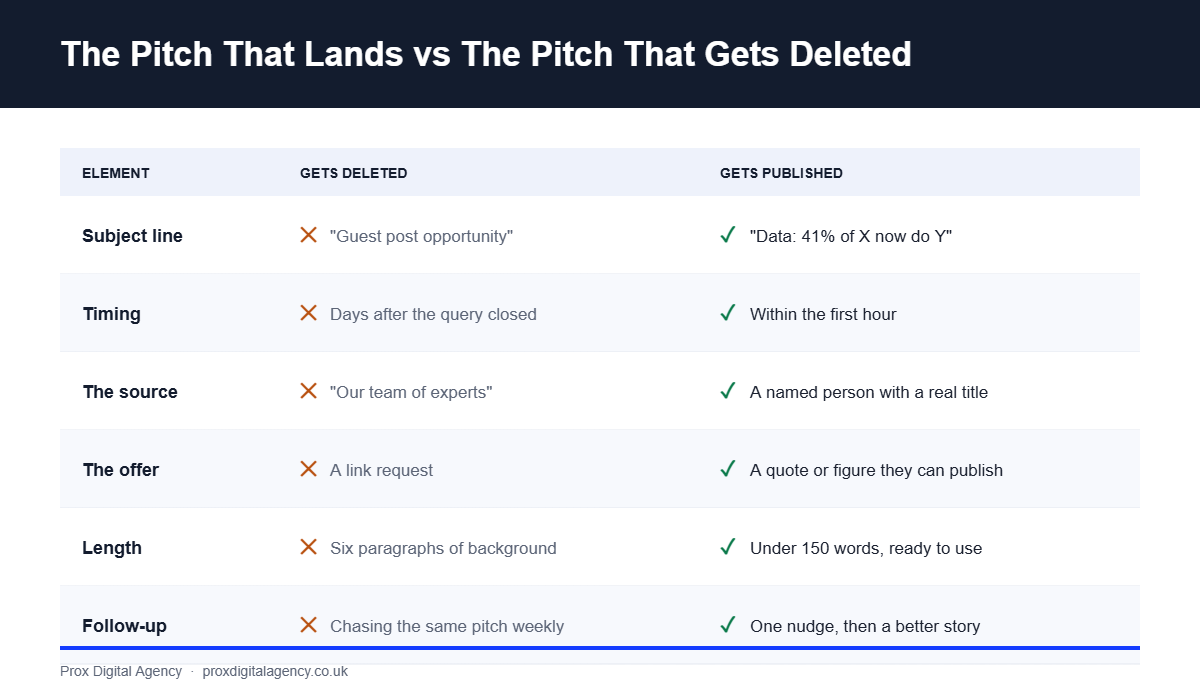
How to Pitch Journalists Without Spamming
The relevance and length of your pitch are key to successful pitching without spamming. Below, we have shared the do’s and don’ts when pitching digital PR to journalists.
What you should do:
- Keep it under 150 words.
- Lead with the story angle, not your company.
- Include one clear quote, ready to use.
- Offer to be available for a quick call.
What you should not do:
- Send the same pitch to fifty journalists at once.
- Attach a press release as a PDF with no summary.
- Follow up more than once without new information.
A Basic Reactive Pitch Template
You can utilise this template for your next digital PR pitch to journalists.
Subject: Quote for [topic] – available now
Hi [Name],
Saw your request on [platform]. I’m [name], [title] at [company], and I work on [relevant area].
Here’s a quote you can use:
“[Quote, 2-3 sentences, specific and useful]”
Happy to jump on a call if you need more details. Let me know.
[Name], [Phone number]
This kind of link-building outreach respects the journalist’s time. That’s what can help you get replies, and it’s one of the simplest link-building strategies any business can adopt without a big budget.
Measuring the Impact of Digital PR on Local SEO and Domain Authority
Digital PR results take longer to show up than paid ads, but they last longer too.
Track these to measure your PR impact:
- Referring domains: New unique sites linking to you, not total link count.
- Domain authority movement: Check monthly, not weekly. It moves slowly.
- Branded search volume: Coverage often increases people searching your brand name directly.
- Local pack rankings: For local business digital PR, watch Google Maps visibility alongside organic rankings.
- Referral traffic: Some journalist-driven links send real visitors, not just SEO value.
Don’t judge a campaign on one metric alone. A single piece of coverage might not move rankings overnight, but a consistent digital PR strategy that lands coverage every month compounds over time.
Common Mistakes Businesses Make with Link Building Outreach
Even well-intentioned campaigns can fall into the same traps. Avoid these common mistakes, and you’ll have a better chance of earning links that journalists actually want.
- Pitching too broadly. Sending one generic pitch to every journalist on a list rarely works.
- Ignoring smaller publications. A niche trade site link often carries more relevance than a low-value mention on a huge site.
- No follow-through. Agreeing to give expert commentary for SEO purposes, then being slow to respond, damages relationships fast.
- Treating it as a one-off. A single successful pitch doesn’t replace an ongoing strategy.
- Skipping the data. Data-led link building tends to outperform opinion pieces, because journalists trust numbers over claims.
Make Digital PR a Reliable Link-Building Channel With Prox
Digital PR isn’t a shortcut. It’s the most sustainable way to build links that hold up, both in search rankings and in the AI-driven results shaping how people find businesses now. The brands winning at this treat it as an ongoing relationship with journalists, not a one-off campaign.
That’s where Prox comes in. Digital PR sits inside our wider SEO service and feeds our GEO work, so coverage is put to work in both places. We handle the outreach, the data, and the follow-up that most in-house teams don’t have time for, so you get editorial coverage without chasing it yourself. If you want digital PR for SEO that earns links journalists actually want, Prox can build and run that pipeline for you. Contact us and book your free strategic call now!
Prox Digital Agency
No time to chase journalists?
We find the angles, build the data and run the outreach, so you get editorial coverage and the links that come with it. Tell us your goal and we will map the first campaign free.
FAQs
What does Digital PR for SEO mean?
Digital PR for SEO means using newsworthy stories, expert insights, and media coverage to earn quality backlinks and improve search visibility.
What’s the difference between digital PR and traditional link building?
Traditional link building often means directly asking for a link. Digital PR means earning coverage through a story, quote, or piece of data that a journalist wants to publish anyway.
Is HARO still worth using for link building?
Yes, but know which HARO you are using. Cision shut the original down in December 2024; Featured.com bought the brand and relaunched it as a free query email in April 2025, and that version is active. Run it alongside regional platforms such as ResponseSource in the UK, plus Qwoted and Source of Sources. Response speed matters more than which platform you choose. Journalists tend to go with whoever replies first with something usable.
How long does digital PR take to show SEO results?
Most businesses start seeing referring domain growth within one to three months of consistent outreach, which lines up with how long SEO takes to work more broadly. Ranking improvements usually follow a few months after that, depending on competition and existing domain strength.
Do brand mentions without links still help SEO?
Yes, brand mentions without links can still provide indirect SEO value by increasing brand awareness, visibility, and credibility, but they do not carry the same direct link value as a backlink.


 Maryam Basit, London
  0 mins
E-E-A-T in 2026: How to Prove Experience, Expertise, Authority and Trust
llms.txt Explained: Should Your Website Have One in 2026?
Perplexity Optimisation: How to Become a Cited Source

Prox Digital Agency Expands Its Generative Engine Optimisation Practice for Global Businesses
How to Choose a Professional SEO Company: 10 Questions to Ask

9 Web Design Mistakes That Quietly Kill Conversions

Prox Digital Agency CEO Ali Zafar Azad Discusses Digital Transformation on Xraised

What Does an SEO Agency Actually Do? (2026)