Niche Keyword Research: How to Find Low-Competition Keywords Your Competitors Miss
Generic keyword guides tell you to chase volume. That might work for Amazon, but for everyone else it is a slow path to page four. Niche keyword research flips the approach.
Instead of chasing volume, you target the specific phrases your potential customers actually type. The search numbers might look small, but the results look very different.
At Prox Digital Agency, we use this exact approach to help UK businesses earn rankings without waiting months. Here is how it works.
Niche Keyword Research vs High-Volume Keywords
High-volume and trending keywords attract heavy competition, because big brands dominate them. They have more links, more authority and more resources. You can still compete for them, but it usually takes a long time and a large budget.
By contrast, niche keyword research targets queries where the competition is weak. As a result, you win on relevance and intent rather than authority, which is a much faster route to traffic.
How Specific Search Intent Changes Conversions
Specific searches come from people who are actively looking for particular products or services. Usually, they know what they want and have a problem that needs solving now.
For example, someone in Leeds searches for “waterproof hiking boots women’s size 6”. That is a highly specific search, so the person is likely much closer to buying. In general, long-tail queries convert at higher rates than broad ones. They may bring less traffic, but the visitors are often more valuable.
Why “Low Competition” Depends on Your Site’s Authority
A keyword that works for one site can fail for another, because difficulty is relative. So, a new domain should target the lowest difficulty bands, while an established site can aim higher.
What Makes a Niche Keyword Worth Targeting?
Low search volume does not automatically make a term a good opportunity. Before you create content around it, check its relevance, search intent, competition and potential to bring valuable traffic.
Niche vs Broad vs Trending Keywords
In short, niche keywords build your foundation, while trending keywords add short-term spikes. You can use both, but it is best to begin with niche terms.
The Qualification Checklist
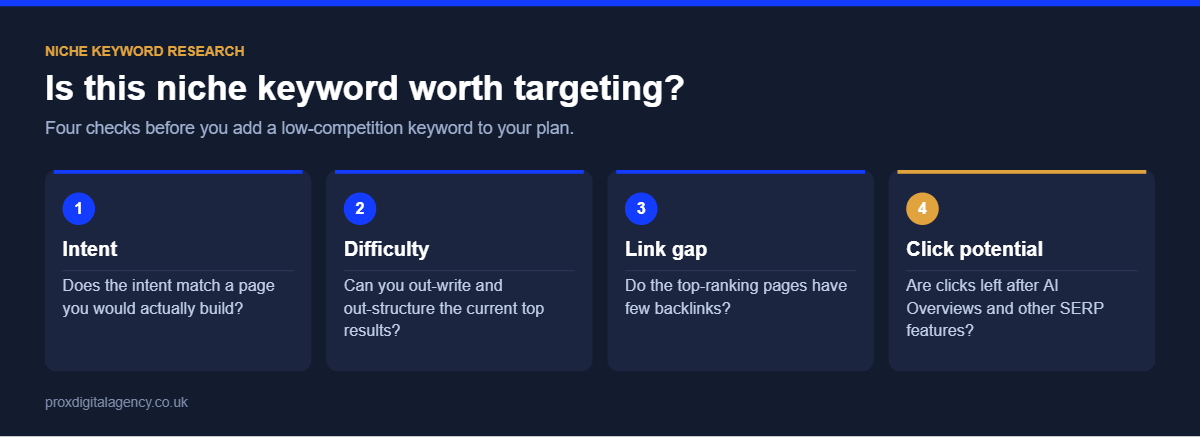
Before you target a keyword, answer four questions on intent, difficulty, link gap and click potential:
- Does the intent match a page you would actually build?
- Can you out-write and out-structure the current top results?
- Do the top pages have few backlinks?
- Are there clicks left after AI Overviews and other SERP features?
If the answers are yes, add the keyword to your strategy.
How to Find Niche Keywords Your Competitors Overlook
Finding niche market keywords takes a different approach. In particular, you start with your audience, not your tools.
Start Niche Keyword Research With Your Customers
Your customers rarely use technical terms. Instead, they use the words they would naturally use to describe a problem. For example:
- An SEO specialist says “technical site audit”.
- A business owner says “why is my website not showing up on Google”.
Both queries mean the same thing. However, only one reflects how your potential customer actually searches. You can find this real language in these places:
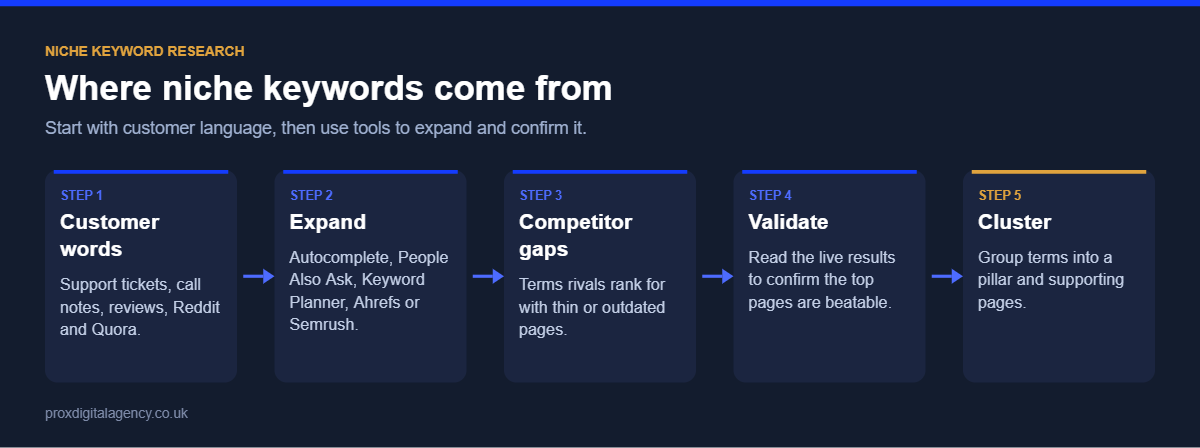
- Support tickets and sales call notes
- Customer reviews on G2, Trustpilot or Amazon
- Reddit and Quora threads
- Google Search Console queries
Write down 15 to 20 phrases. These are your seeds.
Turn Seed Keywords Into More Niche Keyword Research Ideas
Next, feed your seeds into keyword tools. Google Keyword Planner gives volume ranges, while Ahrefs and Semrush add difficulty scores and SERP data. Then use two free sources:
- Google itself: type a seed into the search bar and note the autocomplete suggestions. Then scroll to “People Also Ask” and open each question to reveal more. Keep going until you have 5 to 10 real questions, because these reflect how your customers actually search.
- Search Console: the performance report shows queries where you rank in positions 8 to 25. Google already half-trusts these pages, so small improvements can push them to page one.
Look for Gaps in Competitor Rankings
Your competitors have already proved there is demand. Now you just need to find what they missed. Run their domains through Ahrefs or Semrush and filter by keyword difficulty and position. Then look for terms where they rank with thin, outdated or generic content.
Those are your openings. For a full method, read our competitor keyword analysis guide.
Validate Niche Keyword Research Against the Live SERP
Tools give you data, but the search results page gives you the truth. So, open the top 10 results for your keyword in an incognito window and check:
- Who ranks: big brands or small blogs?
- How good their content is: thin, outdated or off-topic?
- If each page type fully matches the query.
- Whether AI Overviews or shopping results take most of the clicks.
If the top results leave room for improvement, the keyword may be worth targeting. On the other hand, if they are highly relevant and hard to beat, look for another opportunity.
Map and Prioritise the Results of Your Niche Keyword Research
Finding keywords is half the job, and mapping them to pages is the other half. Sort by intent before volume, because a keyword’s value depends on more than its search numbers. For example, a transactional term with 50 searches may deliver better results than an informational one with 5,000.
Build Topic Clusters Instead of Orphan Posts
A topic cluster is a group of related pages linked together. One pillar page covers the broad topic, while supporting pages go deeper. As a result, a well-structured cluster helps Google understand how your pages relate, and it strengthens your internal linking.
If you need help building clusters, our keyword research specialists can map them for you.
Want a list of low-competition keywords you can rank for?
Tell us your niche and your website. We will find the specific, high-intent phrases your competitors have missed and check which ones your site can realistically win, free.
Get a free niche keyword reviewSee our keyword research services →
How to Build Pages From Your Niche Keyword Research
Finding the right keyword is only the beginning. Next, you need a page that matches the search and adds real value.
Cover the Topic Better Than the Top Results
Read the top 10 pages and note what they cover. Then cover it better. For instance, answer the “People Also Ask” questions, add subtopics they missed and include original data, a template or a sharper opinion. The more closely your content answers the query, the more useful it is to the searcher.
Optimise for AI Overviews and Answer Engines
AI Overviews now appear on many queries. They can take clicks, but they also create chances to be cited. To improve your chances:
- Write a direct 30 to 40 word answer under each H2, then explain in more detail.
- Include specific numbers, name the tools and add real examples.
- Add FAQ schema markup.
- Use question-based headings that match “People Also Ask” queries.
Specific, well-structured content gets cited far more often than generic content. If you target the UK market, our step-by-step guide on how to do keyword research for UK businesses shows how to match local search behaviour.
Focus Your Niche Keyword Research to Grow Traffic
Niche keyword research is not a lesser version of “real” keyword research. In fact, it is the version that works for sites that are not Wikipedia or Amazon.
Most searches are long-tail, and many long-tail keywords face less competition than broad terms. Moreover, long-tail searches often convert at higher rates.
So, start with one topic cluster. Find your seeds, qualify them and build a keyword map. Then create the first page for your highest-intent keyword and measure what happens over 90 days. After that, expand what works.
Looking for keywords your competitors have missed? Speak to the Prox Digital Agency SEO team about a targeted keyword strategy for your UK business.
Prox Digital Agency
Rank for the searches your competitors overlook
We find the niche keywords your customers actually type, qualify each one on intent, difficulty and click potential, and map them into topic clusters your site can win. Start with a free niche keyword review.
Frequently Asked Questions
What is niche keyword research?
Niche keyword research is the process of finding specific, low-competition search phrases that target a narrow audience. These keywords often have lower search volume but stronger intent. As a result, they are usually easier to rank for and attract more qualified traffic than broad terms.
How do I find low-competition keywords?
Start with customer language from support tickets, reviews and forums. Then expand it with autocomplete and “People Also Ask”, and check keyword difficulty in Ahrefs or Semrush. Finally, read the live search results to confirm the top pages are beatable.
What keyword difficulty should a new site target?
There is no universal number. However, a new site should usually aim for the lowest difficulty bands, often KD 0 to 30, while an established domain can go higher. Always judge difficulty against your own site’s authority.
Are low-volume keywords worth targeting?
Yes, if the searchers are the right people. Tools often underestimate niche volume. More importantly, those searchers are often qualified prospects with specific needs.
How do I find niche keywords for free?
Use Google Autocomplete, “People Also Ask”, Google Search Console and manual competitor searches to find ideas. In addition, free versions of keyword tools let you check search volume, competition and related terms.
How do I do keyword research for a niche market?
First, find the words your target audience uses to describe their needs, products or problems. Then expand those ideas with Google Autocomplete, “People Also Ask”, Search Console and keyword tools. Finally, check intent, competition and relevance before you choose which terms to target.


 Prox Digital Agency, London
 5 mins
Prox Digital Agency Named Second in NeuralAdX Ltd’s “Best Google Gemini Optimisation Agency UK” Comparison

International SEO Keyword Research: How We Research New Markets (UK, US, UAE and Australia)

Keyword Mapping: How to Assign Keywords to Pages and Avoid Cannibalisation

Keyword Research for PPC: How to Find Google Ads Keywords That Convert

Competitor Keyword Analysis: How to Find and Win the Keywords Your Rivals Rank For

How to Do Keyword Research: A Step-by-Step Guide for UK Businesses (2026)

Headless SEO: How to Rank a Headless CMS or API-Driven Website

Faceted Navigation SEO: Stop Filters Wasting Crawl Budget on Your Ecommerce Site