International SEO Keyword Research: How We Research New Markets (UK, US, UAE and Australia)
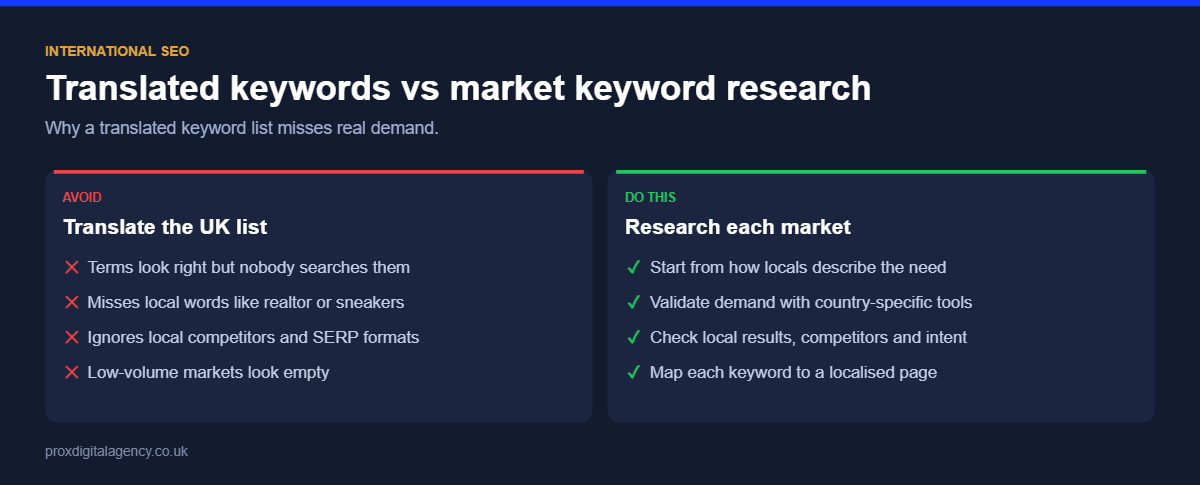
A keyword list that works in the UK may not work in other markets. That is why relying on direct translation is the most common international SEO keyword research mistake. It produces terms that look correct but that nobody actually searches for.
At Prox Digital Agency, we research each market from scratch. We study how people in that country really search, including their language, words and intent. At the same time, we study the rivals in that market. A good plan must reflect those differences.
The four stages below show how we do international SEO keyword research for a new market, such as the US, the UAE or Australia.
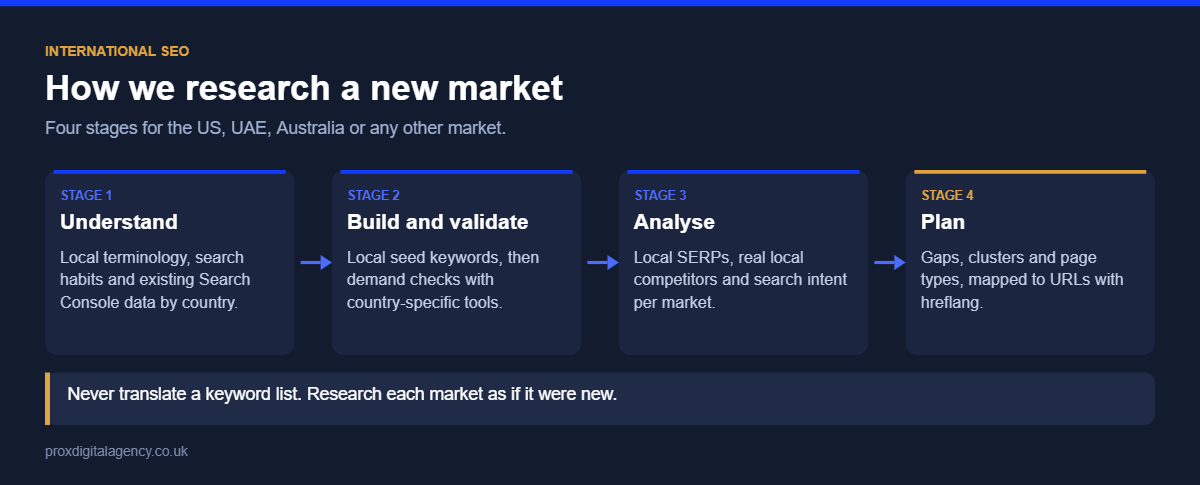
Step 1: Understand the Market Before International Keyword Research
First, learn how the target audience searches. This means spotting local terms and search habits. It also means checking any rankings or impression data you already have in that country.
Language and Terminology
Countries that share a language still use different words. In fact, the terms people type into Google are shaped by local usage:
For example, a UK business that targets the US with “estate agent” may miss much of the demand.
Existing Visibility in Search Console
Next, open Google Search Console and filter the performance report by country. Then look for:
- Queries that already generate impressions abroad
- Pages that attract international clicks
- Countries with rising impressions but low clicks
These signals show where Google already sees relevance. As a result, they make strong starting points.
Step 2: Build and Validate International Keyword Research Seeds
With the market understood, you can build a seed list and test it against real demand.
Build Local Seed Keywords
Seed keywords are the basic phrases you start with. Build them from your products, services and topics, and from what your customers look for. Then adapt them to local usage.
For instance, imagine an accountancy firm expanding into a new market. A seed keyword like “tax return” is not enough. Local users may search for quite different terms. At this point, multilingual keyword research is vital, since local words can carry different meanings and intent. So, expand your seed list using:
- Keyword research tools set to the target country
- Google’s related searches and autocomplete
- Local brand names and industry terms
- Competitor websites in the target market
Validate Demand in the Target Market
Not every translated term has demand. Therefore, test each term before you go further. Set your keyword tool to the right country and language, and then compare search volumes across the variations.
Google Trends also helps you compare regional terms such as “holiday” and “vacation”. However, treat low-volume data carefully in smaller markets. There, low or zero volume may reflect limited tool data rather than a lack of demand. So, confirm it with the search results, related searches and competitor traffic.
Step 3: Analyse Local SERPs, Competitors and Search Intent
This stage shows what Google considers relevant in each market, and it often changes your plan.
Analyse the Local SERP
Search as a local user would. Use the right country version of Google and the local language. A VPN or a location setting helps here. Then review:
- Which pages rank, and what type they are
- SERP features such as maps, shopping results and “People Also Ask”
- Related searches
- Content formats, such as guides, comparison pages or category pages
- AI-generated answers and the sources they cite
In short, the search results tell you what users expect. For example, if the top results are all product pages, a blog post will struggle to compete.
Identify Real Local Competitors
Your UK rivals may not be your rivals abroad. Often, local firms lead the target market. So, find out who actually ranks for your main terms. Then compare the keywords they rank for, their key landing pages, the content they have that you lack and the topics they cover poorly. Any gaps are openings for you. Our competitor keyword analysis guide walks through the full gap-analysis method.
Determine Search Intent
Classify every keyword by intent:
Intent can differ between markets. For instance, the same keyword may return guides in one country and service pages in another. So, always check the live results before you choose a page type.
Support International SEO Keyword Research With Hreflang
The technical setup matters just as much, because good international SEO keyword research is wasted if Google shows the wrong page. Correct hreflang tags help search engines show the right language or regional page to each visitor. Without them, the wrong page can appear in the wrong country. Our hreflang tags guide shows how to set them up for the UK, US, UAE and Australia, and Google’s guide to managing multi-regional sites covers the URL options.
Planning to win customers in a new country?
Tell us the market you want to enter. We will check how people there actually search for your services, what demand exists and who you are up against, free.
Get a free market keyword reviewSee our keyword research services →
Step 4: Turn International SEO Keyword Research Into a Strategy
Insights only matter when they lead to action. So, in this stage your international SEO keyword research becomes a plan. Follow this workflow:
- Identify gaps: find keywords and topics where competitors rank and you do not.
- Group by intent: cluster related keywords that serve the same need.
- Map to pages: assign each cluster to an existing page or a new one.
- Choose page types: decide what the market needs.
Depending on the market, you may need localised service pages, product or category pages, dedicated landing pages or informational guides. These are not random choices. Instead, they come directly from your keyword and market research. Our international SEO service covers this full process, from market research to page mapping and technical setup.
For comparison, our guide on how to do keyword research for UK businesses shows how the same principles apply in the UK.
Rank Your Targets by Value
Choose your first targets with care. A keyword with high volume but weak intent may not be worth the effort. Score each opportunity against these factors:
Overall, relevance and intent beat raw volume. For example, a keyword with 500 monthly searches and clear commercial intent often outperforms one with 5,000 informational searches.
Account for AI Search and Changing Search Behaviour
Search is changing. AI Overviews and AI tools now shape what people see, and users may read an AI summary before they click. To support your visibility:
- Write clear, useful content in the local language.
- Structure pages with logical headings.
- Answer common questions directly.
- Use local examples, terms and references.
After launch, keep checking your rankings, Search Console data, rival moves and user behaviour. In other words, international SEO keyword research does not end at launch. Rather, your approach should evolve as search trends change in each market.
Start Your International SEO Keyword Research With Prox
To win in a new market, you need more than translated pages. You need the terms local people use, proof of real demand, a clear view of your rivals and an understanding of what users want.
Through international SEO keyword research, Prox Digital Agency helps companies find keyword opportunities based on real local search behaviour. We study rivals in each market to spot gaps, and then build a plan for each market around real demand and intent. The result is more visibility, better traffic and a stronger position in every market you enter.
Prox Digital Agency
Enter new markets with keywords people actually search
We research every market from scratch: local terminology, real demand, local competitors and search intent, then map each keyword to the right page and set up hreflang correctly. Start with a free market keyword review.
Frequently Asked Questions
Why is international SEO keyword research essential?
International SEO keyword research shows how people search in each market, including their terminology, demand and intent. Without it, you risk targeting terms nobody uses and missing valuable traffic and enquiries.
How is international keyword research different from regular keyword research?
Standard keyword research focuses on a single market. International research, by contrast, must account for language, culture, local terminology, competitors and differences in search results between countries.
Will translating keywords work for international SEO?
No. Direct translation often misses how local people actually search. Instead, research and localise keywords for each market, because search terms, intent, competitors and results differ by country and language.
How do I find keywords for a new international market?
Start with Search Console data filtered by country, which can reveal useful terms. Then build local seed terms, expand them with keyword tools and competitor research, and finally validate demand in the target market.
How should I handle low search volume in smaller markets?
Low or zero volume in smaller markets may reflect limited tool data rather than a lack of demand. So, check the search results, related searches and competitor visibility before you rule out a keyword, and prioritise relevance and intent over volume alone.


 Prox Digital Agency, London
 5 mins
Prox Digital Agency Named Second in NeuralAdX Ltd’s “Best Google Gemini Optimisation Agency UK” Comparison

Keyword Mapping: How to Assign Keywords to Pages and Avoid Cannibalisation

Niche Keyword Research: How to Find Low-Competition Keywords Your Competitors Miss

Keyword Research for PPC: How to Find Google Ads Keywords That Convert

Competitor Keyword Analysis: How to Find and Win the Keywords Your Rivals Rank For

How to Do Keyword Research: A Step-by-Step Guide for UK Businesses (2026)

Headless SEO: How to Rank a Headless CMS or API-Driven Website

Faceted Navigation SEO: Stop Filters Wasting Crawl Budget on Your Ecommerce Site