Do not treat Perplexity like Google. It does not work by simply ranking pages. It combines information from multiple sources and then provides answers, with inline citations for each source. If you want your brand to appear in those citations, you need to understand the mechanism behind source selection.
This guide simply breaks down how Perplexity picks sources, how to make a page citable, and how to build a Generative Engine Optimization strategy that actually works in 2026. Let’s get started!
How Perplexity Picks Its Sources?
Think of Perplexity as an answer engine. When a user asks a query, the system reads relevant content from its index and live webpages. It then retrieves an answer summary with proper citations.
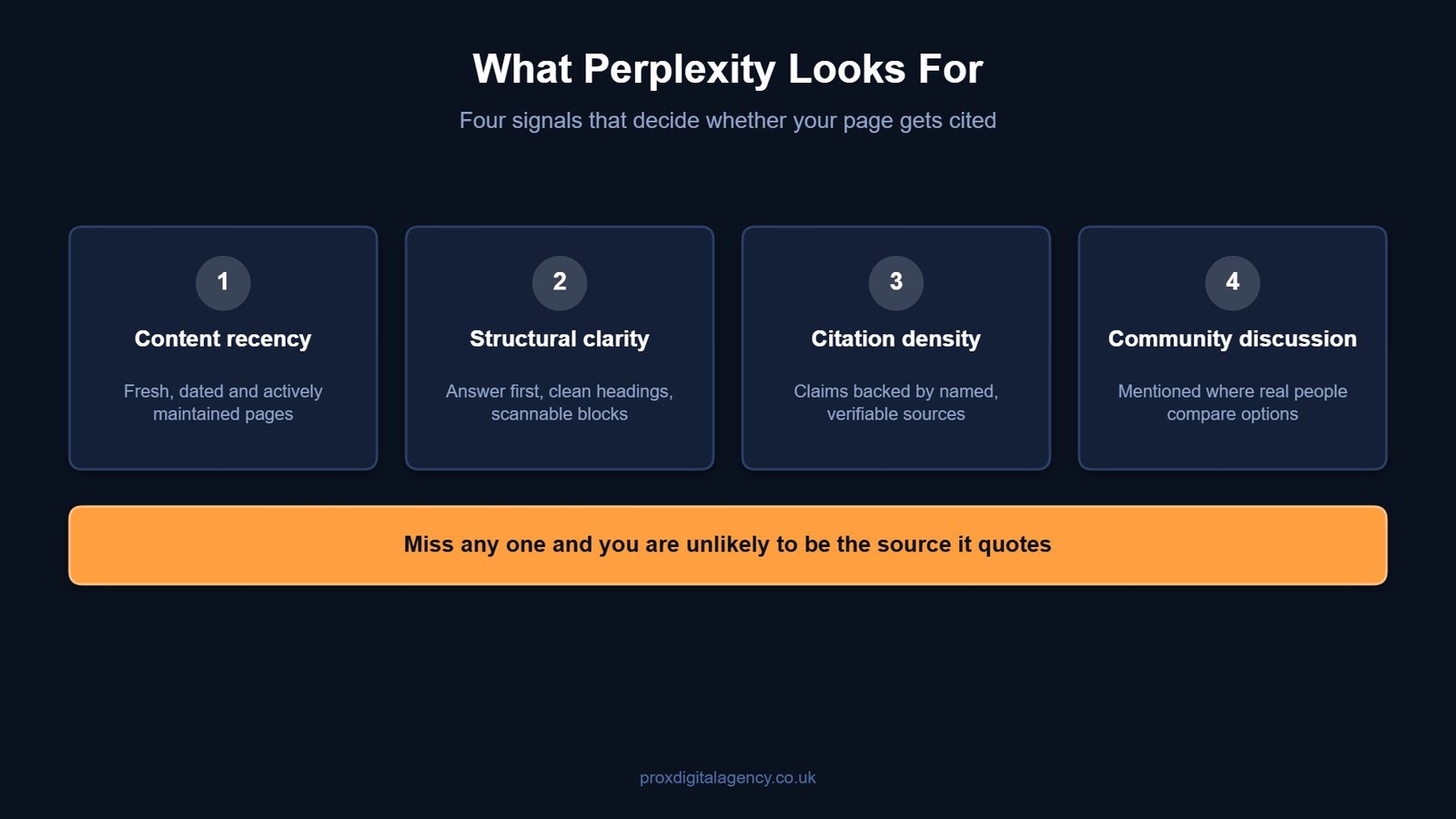
This picking process is not as simple as it sounds. It follows a pattern based on four key signals.

- Recency
- Clarity
- Density
- Community Discussion
Signal 1: Content Recency
Perplexity’s top priority is fresh and updated content. If a user inquires about AI tools, SEO changes, or digital marketing trends, the answer engine will prioritise pages published or refresh within the last 6 to 12 months or even less.
A page from 2022 may still rank on Google, but Perplexity will likely not cite it if newer sources exist. This means evergreen content alone is not enough. You need to publish consistently and update existing content regularly.
Signal 2: Structural Clarity
Perplexity extracts answers from pages that are easy to parse. This includes pages with
- Clear H1 and H2 hierarchy
- Short paragraphs
- Direct answers placed early in the content
- Bullet points and tables
- No cluttered layouts or
- Zero intrusive pop-ups
The engine does not reward clever writing. It rewards clarity. If a page is difficult to extract information from, Perplexity will move to the next source.
Signal 3: Citation Density
One of the easiest yet trickiest ways to get cited by Perplexity is to earn links from authoritative domains. This is similar to traditional backlinks, but with a twist. Perplexity looks at the citation context to understand how other pages reference your content.
If multiple sources quote your statistic, link to your research, or name your brand as the origin of a concept, Perplexity treats your page as a primary source. This is why original data and proprietary frameworks are so valuable.
Signal 4: Community Discussion
Perplexity crawls forums, Reddit threads, and community platforms. These spaces act as validation layers. If users discuss a topic and reference a specific source, that source gains authority in Perplexity’s model.
This is a fundamental shift from Google. Google treats forums as content. Perplexity treats them as signals. A well-placed mention in a high-engagement Reddit thread can be more valuable than a backlink from a low-authority blog.
How Perplexity is Different from Google and ChatGPT
Perplexity Optimisation sits apart from both traditional SEO and ChatGPT-style LLM brand mentions. You cannot treat them as the same thing. Let’s see things individually.
Perplexity vs Google
| Factor | Perplexity | Google |
|---|
| Core output | List of links | Synthesised answer with citations |
| Ranking Signal | Backlinks, content depth, user behaviour | Recency, extractability, citation consensus |
| User Intent | Navigational, informational, transactional | Informational, comparative, research-focused |
| Click-through | Secondary metric (citation is the win) | Primary metric |
| Content Format | Long-form, comprehensive guides | Answer-first paragraphs, data blocks |
Google wants to keep users on Google. Perplexity wants to answer the query and send users to the source if they want more. This changes the goal of optimisation.
Perplexity does not want you to fight for position one. It wants you to earn a place among the three to five cited sources.
Perplexity vs ChatGPT
| Factor | Perplexity | ChatGPT |
|---|
| Core output | Synthesised answer with live citations | Conversational answer from memory or browsing |
| Ranking Signal | Retrieval relevance, recency, citation density | Training data presence, LLM brand mentions |
| User Intent | Research-focused, fact-checking, comparative | Explanatory, creative, task-based |
| Click-through | Secondary metric (citation is the win) | Not a primary metric |
| Content Format | Answer-first paragraphs, extractable data blocks | Long-form responses, conversational flow |
ChatGPT relies on training data and web browsing (when enabled). Perplexity is a retrieval-augmented generation (RAG) system. It always retrieves live information before generating an answer.
This is why AI search visibility is more measurable with Perplexity. You can also check our guide AI Search Engines Compared to get a better understanding of different AI generated engines and how they work.
You can test it. You can query a topic and see whether your brand appears. With ChatGPT, the response is harder to predict because it depends on the model version and context window.
The 7 Things That Make a Page Citable
Citation is not an accident. It is a result of specific structural and strategic choices. Here are the seven factors that make a page more likely to be cited by Perplexity.
Answer-First Structure: Answer Before Explanation
Perplexity prefers pages that answer the question immediately. /burrying content under ten paragraphs of context is useless. State direct answer in the first 50 to 100 words, then explain.
This is called the “Answer-First Approach” content structure. It works for both human readers and AI extraction.
Original Data and Statistics: Be the Primary Source
Pages with unique numbers are gold. If you conduct original research, publish survey results, or analyse proprietary data, Perplexity has a reason to cite you.
You cannot fake this. You must create data that does not exist elsewhere. This is part of building topical authority for machine learning.
Concise Definitions: Say It in One Sentence
Perplexity often extracts definitions from pages that explain a concept clearly in one or two sentences. Providing a concise definition near the top of your page can increase the likelihood of your content being quoted directly.
For example: “Perplexity optimisation means structuring content in a way that increases the likelihood of Perplexity citing it as a source.”
Schema Markup: Tell AI What Your Content Means
Structured data and schema for AI parsing is no longer optional. Use FAQPage, Article, Organisation, and Speakable schema where relevant. This helps Perplexity understand the structure of your content and extract the right elements.
High-Authority Citations: Get Cited by Credible Sources
Your page needs to be referenced elsewhere. This is one of the Digital PR strategies for AI visibility. When industry publications, research aggregators, and high-authority blogs reference your content, Perplexity treats it as a credibility signal.
A single link from a .edu or .gov domain often carries more weight than dozens of links from low-authority sites.
Entity Consistency: Help AI Connect the Dots
Perplexity uses Entity SEO for AI engines to understand who you are and what you cover. Your brand name, author names, and key topics should be consistent across your website, social profiles, and third-party platforms.
Create an “About” page that works as your portfolio. Link to your authors’ LinkedIn profiles. Use consistent naming conventions everywhere.
Crawlability for AI Bots: Let Perplexity Access Your Site
Do not block PerplexityBot. Review your robots.txt file and ensure the crawler can access your pages without restriction. The same applies to GPTBot, ClaudeBot, and Google-Extended.
Blocking these bots is a common mistake. Brands often block AI crawlers to protect content, then wonder why they are invisible in AI search results.
The Role of Reddit and Forums
Perplexity treats community platforms as contextual data sources. Reddit threads, Quora answers, and niche forums provide real-world perspectives that traditional web pages often lack.
Reddit and forums matter because
- They contain natural language questions and answers
- They reflect genuine user sentiment
- They are frequently updated
- They provide consensus signals
When Perplexity receives a query, it may pull from a Reddit thread where users discuss the exact problem. If your brand or content is mentioned in that thread, you gain indirect visibility.
How to Check Whether Perplexity Cites You Today
You cannot improve what you cannot measure. Here is a simple process to audit your current AI search visibility.
Step 1: Run Direct Queries
Open Perplexity and search for:
“What is [your topic]?”
“Best [your category] in 2026”
“[Your brand name] review”
“[Your brand name] statistics”
Note if Perplexity picking up your brand in the answer or the citations.
Step 2: Check Referral Traffic
Go to Google Analytics. Look for referral traffic from perplexity.ai. Perplexity referrals are often recorded as direct or uncategorised traffic, so tagging your links with UTM parameters is essential for accurate tracking.
Step 3: Check Content’s Extractability
Pick one of your existing blog. Paste the URL into Perplexity and give command to “summarise this page in three bullet points.”
If the summary is accurate and includes your key points, you are on the right track and your page is extractable. If the summary is vague or misses the core answer, rebuild your structure.
Step 4: Monitor Brand Mentions
Use monitoring tools such as Google Alerts, Brand24, or Mention and track your brand conversations. Prioritise Reddit, Quora, and industry forums because Perplexity treats these discussions as authority signals.
How to Build a Citable Content Strategy
Once you understand the Perplexity citation mechanism, the next step is its implementation. here is how you can do it.
- Create a citation asset – content built for AI referencing: clear answer, original data, concise definition, quotable framework.
- Refresh content regularly – update key pages every 90 days to signal freshness.
- Optimise for zero-click searches – brand visibility matters more than clicks; a citation is a win.
- Build semantic depth – cover the full concept cluster so Perplexity sees your site as comprehensive.
Ready for Perplexity Optimisation?
Perplexity Optimisation is still new in the trends. Most brands have not adapted. That gap is your opportunity.
Its citation mechanism is clear. Perplexity favours recent, well-structured, heavily-cited pages backed by community validation. Brands that publish original data and build forum presence will dominate AI search. But that is not your problem to solve. Prox is here to handle it for you.
Prox Digital Agency helps businesses become cited sources. We specialise in Generative Engine Optimization (GEO), citable content creation, and AI search visibility measurement across Perplexity, ChatGPT, and Gemini.
The brands that get cited are not always the biggest. They are the clearest and most data-rich. Contact our expert team and build for the mechanism starting today.
FAQ
What is Perplexity Optimisation and why does it matter in 2026?
Perplexity Optimization is the practice of structuring content to increase the likelihood of being cited as a source in Perplexity AI’s generated answers. It matters because Perplexity is rapidly becoming a primary research tool for professionals, and citation drives both brand visibility and referral traffic.
Is Perplexity AI better than ChatGPT?
Both are for different purposes. Perplexity AI is better for real-time, citation-backed research, while ChatGPT is stronger for creative writing, brainstorming, and conversational depth.
How do I get my brand cited by Perplexity?
To get cited by Perplexity, publish original research, earn citations from high-authority domains, and maintain an active presence in community discussions so the AI recognises your brand as a trusted source.
What type of content do AI search engines prefer to cite?
AI search engines prefer content with original research, unique statistics, quotable definitions, and an answer-first structure that state the core answer in the first 50 to 100 words.
Does social media presence influence AI search results?
Yes. Positive mentions on Reddit, LinkedIn, and X act as validation signals—Perplexity crawls these platforms to measure trust, and brands with active community presence are more likely to be cited.


 US
US UK
UK +44 (7) 43 8304 605