AI search optimisation has quietly become standard practice for UK agencies, not an experiment on the side.
One marketer claims SEO is dead. Another says ChatGPT will replace Google. Meanwhile, agencies everywhere promise they can make brands appear inside AI-generated answers overnight. The reality looks far less dramatic.
AI search has definitely changed how people discover businesses. But traditional SEO has not disappeared. UK digital agencies now treat AI search as an extra layer of visibility rather than a replacement for SEO.
The biggest change comes from user behavior. People no longer search the way they used to. Instead of typing:
“best accounting software UK”
Users increasingly ask complete questions such as:
“What is the best accounting software for a small business in the UK?”
Instead of searching:
“best mobile app agency London”
They ask:
“Which UK agency actually builds scalable mobile apps?”
That small behavioral shift changes everything because businesses now compete to become the answer.
Search Evolved Faster Than Most Brands
For years, SEO followed a familiar playbook. Businesses found keywords, published blogs, built backlinks and tried to climb Google’s rankings. That process still matters, but user expectations evolved much faster than many companies expected.
Today, people often get answers before they even click websites. Google AI Overviews summarise results instantly. ChatGPT recommends companies and tools conversationally. Platforms like Perplexity cite sources and answer questions in seconds.
This means businesses now face a different challenge. If AI systems recommend competitors before users even reach search results, your visibility problem starts much earlier than traditional rankings.
That reality pushed many UK digital agencies to rethink how search works, a shift we map out in full in our guide to generative engine optimisation, especially for industries where trust directly affects buying decisions.
This matters most for sectors such as:
- SaaS businesses
- Fintech companies
- Ecommerce brands
- Healthcare providers
- Legal firms
- B2B service companies
In these industries, people rarely buy immediately. They research first. If AI fails to mention your brand during that research phase, customers may never even know you exist.
UK Agencies Stopped Optimising Only for Google
Smart UK agencies no longer think only about rankings. Instead, they think about search experiences.
That means agencies now ask different questions when building digital strategies:
- Can ChatGPT clearly understand what this company does?
- Does Google AI trust this brand enough to mention it?
- Does messaging stay consistent across every platform?
- Would AI confidently recommend this business?
These questions sound obvious, yet many companies struggle badly.
Their website says one thing. Their LinkedIn says something else. Their Clutch profile feels outdated. Even their service pages sound completely disconnected from their actual positioning.
Humans sometimes overlook inconsistency. AI usually does not. If your messaging feels confusing or contradictory, recommendation confidence drops. And when AI lacks confidence, brands quietly disappear from the conversation.
Content Finally Stopped Pretending to Sound Clever
For years, businesses filled websites with robotic content designed purely for rankings. You have probably seen this type of writing before. Long paragraphs full of buzzwords, complicated language and corporate jargon that sounds intelligent but explains very little.
Something like this:
“We leverage cutting-edge digital transformation methodologies to maximise scalable innovation.”
It sounds impressive. But nobody actually talks like that.
Interestingly, AI search now rewards the opposite approach. Many UK agencies simplify content instead of overcomplicating it. They remove unnecessary jargon and focus on clear explanations that both people and machines can understand.
Instead of saying:
“We leverage advanced software development frameworks.”
Agencies now write:
“We build software that grows with your business.”
Simple language works better because AI systems prefer content they can understand, summarise, and confidently recommend.
Humans prefer that too. After years of robotic SEO content, the internet finally rewards brands that sound human again.
Answer-First Content Quietly Became the Strategy
Traditional SEO focused heavily on keywords. AI search focuses more on answers.
That shift changed how UK agencies plan content. Instead of publishing giant articles that broadly cover topics, many agencies now create focused content that solves very specific questions.
For example, instead of writing:
“Everything About Cybersecurity”
They create targeted content like:
- How much does cybersecurity cost in the UK?
- Which cybersecurity solution works best for startups?
- What security risks affect ecommerce brands?
Why does this approach work?
Because AI tools prefer precise information. The easier your content answers a specific question, the easier it becomes for AI systems to reference your business.
Think about it this way.
- Search engines ranked pages.
- AI recommends expertise.
- And expertise always feels specific.
PR Suddenly Became Important Again
Many UK digital agencies now care about something marketers ignored for years.
Brand mentions. Not just backlinks. Not just rankings. Real mentions across trusted websites. AI systems build trust through repeated signals. If respected publications consistently mention your company, AI gains confidence in your authority.
That explains why agencies increasingly invest in:
- Digital PR
- Founder personal branding
- Guest posts
- Podcasts and interviews
- Industry commentary
- Thought leadership content
A company mentioned across respected platforms feels more trustworthy than a company nobody talks about online.
This shift explains why many agencies now push CEOs to become visible online. Visibility no longer starts and ends with rankings. It starts with recognition. And AI pays attention to brands people already trust.
SEO Did Not Disappear
It simply evolved. Despite dramatic headlines online, UK agencies are not replacing SEO. They are rebuilding it for a world where AI influences buying decisions long before people click websites. If the distinction still feels blurry, our SEO vs GEO comparison guide breaks down exactly where one ends and the other begins.
Technical SEO still matters. Fast websites still matter. Strong content, backlinks and good user experience still matter. But agencies now add another layer on top: AI search optimisation.
The goal feels surprisingly simple. Make it incredibly easy for both humans and AI systems to understand who you are, what you do and why someone should trust your business. Because in 2026, clarity often beats complexity.
Build Trust or Disappear From AI Answers
Many UK agencies now treat brand authority as the foundation of AI search optimisation, and it starts with the practical steps covered in how to get your brand mentioned in AI-generated answers. Traditional SEO focused heavily on rankings and keywords. AI search changes the game. Platforms like Google AI Overviews, ChatGPT and Perplexity prefer sources they trust.
This shift pushes agencies to think beyond rankings. They now ask a more important question:
“Would an AI trust this brand enough to mention it?”
That changes everything.
Instead of publishing endless low-value blogs, agencies invest in:
- Expert-led content
- Founder visibility and thought leadership
- High-authority mentions
- Consistent brand positioning
- First-party research and insights
The logic feels simple. AI systems summarise information from trusted sources. If your brand never appears in those trusted ecosystems, you become invisible. That is why UK agencies increasingly combine Search Engine Optimisation SEO, PR, content marketing and personal branding into one strategy.
Why Founder Visibility Matters More Than Ever
Many UK digital agencies now help founders build authority because AI systems often prefer recognisable experts over faceless brands. You might already notice this happening.
Search anything related to SaaS growth, AI, marketing or finance and the same names repeatedly appear across blogs, podcasts, LinkedIn, interviews and research reports. That repetition matters. When AI repeatedly finds a founder or business mentioned across trusted websites, it gains confidence in that entity.

Agencies now help founders build this visibility through:
- Guest posting on trusted publications
- Podcast appearances
- LinkedIn thought leadership
- Expert commentary
- Original industry reports
- Digital PR campaigns
This approach creates something powerful:
Search visibility + brand recall + AI trust signals.
Many businesses still chase backlinks alone. Smarter agencies build recognisable digital entities.
Content Clusters Are Replacing Random Blogs
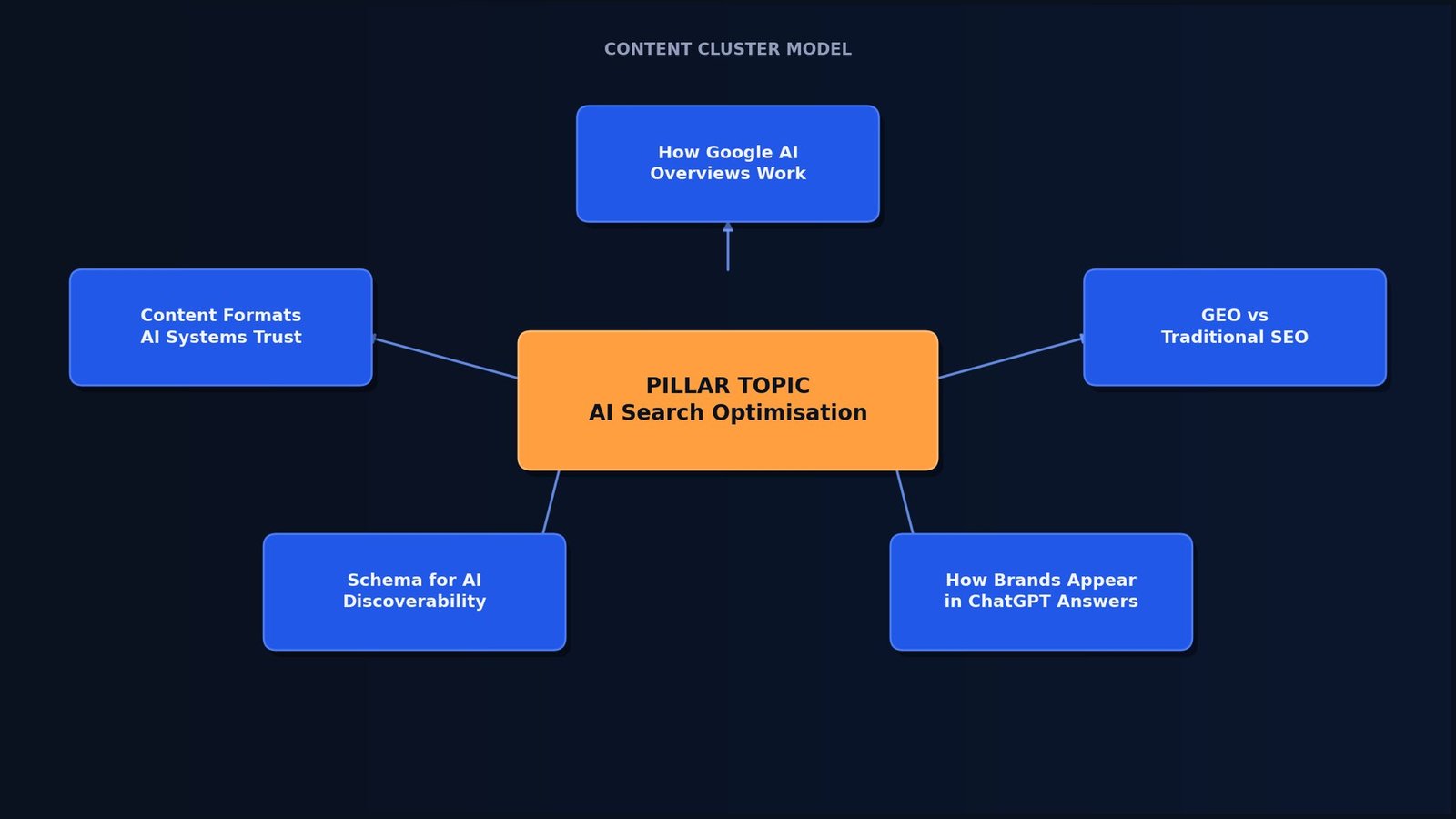
Publishing random articles no longer works. UK agencies increasingly build topic ecosystems instead of isolated blog posts.
Here is how they think:
Instead of writing:
- What is AI SEO?
- Best SEO tips for 2026
- Why SEO matters
They build content around one strong pillar topic.
For example:
Pillar topic: AI Search Optimisation
Supporting content:
- How Google AI Overviews work
- GEO vs traditional SEO
- How brands appear in ChatGPT answers
- Schema for AI discoverability
- Content formats AI systems trust
Every article supports the bigger authority theme.
This approach improves:
- Semantic relevance
- Internal linking
- User experience
- Topical authority
- AI discoverability
Search engines understand expertise better. AI models also understand context more clearly. Instead of scattered content, agencies build connected knowledge hubs.
Technical SEO Still Matters More Than People Think
Some businesses assume AI search kills technical SEO. That assumption creates expensive mistakes. UK agencies still prioritise technical foundations because AI systems cannot trust what they struggle to access.
Most agencies focus heavily on:
- Crawlability
If search engines cannot crawl pages properly, AI systems struggle to surface that information.
Agencies audit:
- Robots.txt issues
- Broken links
- JavaScript rendering problems
- Orphan pages
- Structured data
Schema markup continues to matter.
Agencies implement:
- FAQ schema
- Article schema
- Author schema
- Product schema
- Organisation schema
Structured information helps machines understand meaning faster.
- Site speed
Google data repeatedly shows that slow experiences hurt engagement.
A slow website damages:
- User trust
- Conversions
- Crawl efficiency
Many agencies optimise:
- Core Web Vitals
- Image compression
- Server response times
- Mobile performance
AI search may evolve quickly, but technical clarity still drives discoverability.
The Rise of Answer-First Content
One major shift defines AI search optimisation: Agencies increasingly write for answers. Traditional SEO often chased pageviews. AI search rewards clarity.
That means UK agencies now structure content differently. Instead of burying answers deep inside fluff, they prioritise:
- Direct answers early
- Clear subheadings
- Scannable formatting
- Lists and definitions
- Expert explanations
For example:
Long introduction → keyword stuffing → answer appears after 700 words.
Question → direct answer → context → examples → expert explanation.
Why? Because AI tools extract concise, trusted information. The easier your content becomes to summarise, the higher the chance AI references it.
Data Beats Opinions Every Single Time
Many top UK agencies increasingly publish original research. Why? Because AI systems prefer citing unique insights instead of recycled opinions. This lines up with Princeton and Georgia Tech’s original GEO research, which found that adding statistics, quotations and cited sources can boost visibility in AI-generated answers by up to 40%, the largest gain of any technique tested.
Strong examples include:
- Annual industry reports
- Customer surveys
- Market trend analysis
- Internal benchmark studies
- Case-study performance data
Imagine these two headlines:
- ‘SEO Trends in 2026’
- ‘We Analysed 10,000 Search Queries: Here’s What Changed in AI Search’
The second immediately feels stronger. It gives journalists, search engines and AI systems something unique to reference. Original data creates authority faster than generic blogging.
What Businesses Should Do Right Now
Most companies do not need to panic. But they do need to adapt. If your entire SEO strategy still revolves around rankings only, you risk falling behind.
Start with these steps:
- Audit your brand visibility
- Build topic authority, not random traffic
- Structure content for answers
- Invest in founder visibility
- Strengthen technical SEO
- Add schema markup
- Publish original insights whenever possible
The businesses winning AI search will not necessarily create the most content. They will create the most trusted content.
Frequently Asked Questions About AI Search Optimisation
What is the difference between SEO and GEO?
SEO (search engine optimisation) focuses on ranking web pages in traditional search results like Google. GEO (generative engine optimisation) focuses on getting a brand cited, quoted or recommended inside AI-generated answers from tools like Google AI Overviews, ChatGPT and Perplexity. The two overlap heavily but the desired outcome differs: a ranking position versus a mention inside a synthesised answer.
Does technical SEO still matter in 2026?
Yes. Site speed, crawlability, structured data and clean information architecture still matter because AI systems rely on the same underlying web infrastructure to find and understand content. Technical SEO is the foundation GEO is built on, not a separate discipline it replaces.
What actually improves a brand’s chances of being mentioned by AI?
Original data, direct quotations and cited sources make the biggest difference. Princeton and Georgia Tech’s GEO research found that adding statistics, quotations and citations can boost visibility in AI-generated answers by up to 40%, more than any other single technique tested.
Should businesses stop investing in traditional SEO?
No. Traditional SEO still drives the organic traffic, rankings and crawlable content that AI systems draw from in the first place. The businesses seeing the best results treat GEO as an additional layer on top of solid SEO fundamentals, not a replacement for them.
How does schema markup help with AI visibility?
Schema markup gives search engines and AI systems explicit, structured signals about what a page contains — its topic, author, questions answered and key facts — rather than leaving them to infer it from unstructured text. That structure makes content easier for AI systems to parse, trust and reuse accurately in generated answers.
Why does founder visibility matter for AI search?
AI systems tend to favour recognisable, repeatedly-cited experts over anonymous brand voices. When a founder is consistently mentioned across trusted sources — interviews, podcasts, LinkedIn, industry reports — AI systems build a stronger association between that person and their subject area, which increases the odds of the brand being surfaced in relevant answers.
The Future Belongs to Brands AI Remembers
Search no longer works the way it did five years ago. UK digital agencies already recognise this shift. They no longer optimise only for blue links. They optimise for visibility inside conversations, summaries, recommendations and AI-generated answers.
Brands that build trust, authority and structured expertise will win. Brands that rely on outdated SEO shortcuts may slowly disappear from discovery.
At Prox Digital Agency, we help businesses build future-ready digital strategies that combine SEO, AI search optimisation, content authority and technical growth systems so your brand stays discoverable in the age of AI.


 US
US UK
UK +44 (7) 43 8304 605