Lead generation web copy is the difference between a website that gets visited and one that gets booked.
This is the reality for many UK businesses in 2026. The problem usually isn’t visibility. It isn’t design either. More often than not, it is the words. Your website copy determines whether visitors stay or leave within seconds. It decides whether someone trusts your business enough to book a consultation or continues comparing competitors. Every headline, sentence and call-to-action either builds momentum or creates friction.
Modern buyers are also behaving differently. AI search tools, Google’s AI Overviews and ChatGPT allow people to research companies long before speaking to a salesperson. By the time someone reaches your website, they have already formed expectations. They are not looking for clever marketing language. They are looking for evidence that your business understands their challenges better than anyone else.
That means web copy has become one of the highest-return investments a business can make. Good design attracts attention. Exceptional copy converts attention into revenue.
What Is Lead Generation Web Copy?
Lead generation web copy is written with one clear objective: encouraging the right visitor to take the next step. That next step could be booking a discovery call, requesting a quotation, downloading a guide, subscribing to a newsletter or arranging a product demonstration.
Unlike traditional copywriting, lead generation copy doesn’t simply explain what a business does. It removes uncertainty. It answers objections before they arise. It creates confidence by demonstrating expertise rather than simply claiming it.
Think of your website as your highest-performing salesperson. A great salesperson doesn’t overwhelm prospects with information. Instead, they ask the right questions, understand problems, explain solutions clearly and guide conversations naturally towards a decision. Your website should achieve exactly the same outcome.
Why Most Business Websites Fail to Generate Leads
Many companies assume visitors are leaving because prices are too high or competitors offer better services. In reality, visitors often leave because the website gives them no compelling reason to continue. The majority of websites still focus almost entirely on themselves.
You’ll often find headlines such as:
- ‘We are an award-winning agency.’
- ‘Delivering excellence since 2014.’
- ‘Your trusted digital solutions provider.’
While these statements may be true, they answer the wrong question. Visitors are silently asking:
‘Can you solve my problem?’
If the homepage fails to answer that within a few seconds, attention disappears. Research from Nielsen Norman Group consistently shows that users scan before they read, taking in signals of relevance first and details second. Every unnecessary sentence increases cognitive effort, making visitors more likely to leave. Winning copy removes that effort.
The Psychology Behind High-Converting Copy
People rarely buy services because of features alone. They buy outcomes. A company searching for a new website is rarely excited about responsive layouts or modern code frameworks. What they actually want is more enquiries, stronger credibility, higher conversion rates and faster business growth.
Successful web copy shifts the conversation from features to transformation. Instead of saying your agency builds responsive websites, explain how those websites reduce bounce rates, improve customer trust and generate more qualified enquiries.
Every paragraph should answer one simple question:
‘Why should this matter to the reader?’
When copy continually connects business services to business outcomes, conversion rates improve naturally because readers begin imagining success rather than evaluating specifications.
Start With Your Customer, Not Your Company
Many websites introduce the business before introducing the customer’s problem. That order should almost always be reversed. The opening section of every important landing page should demonstrate complete understanding of the visitor’s situation.
- Perhaps they’re frustrated by declining enquiries.
- Perhaps their website feels outdated.
- Perhaps competitors appear higher in AI search results.
- Perhaps marketing activities generate traffic without producing quality leads.
When readers recognise their own frustrations in your copy, something important happens. They feel understood. Trust begins long before your business introduces itself.
Only after establishing empathy should your copy explain how your solution removes those challenges. The visitor becomes the hero. Your business becomes the guide.

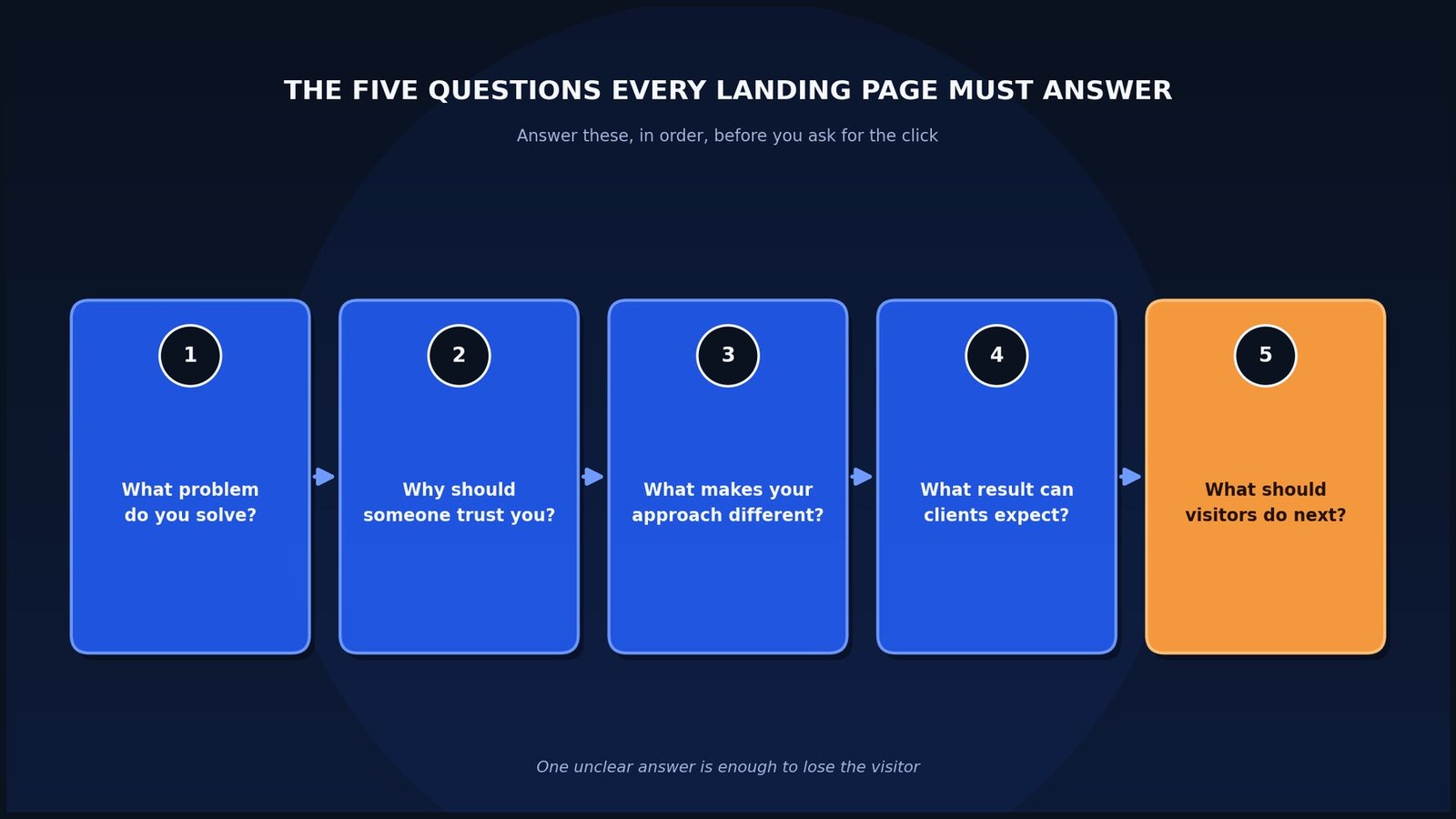
The Five Questions Every Landing Page Must Answer
Before asking anyone to complete a contact form, your copy should quietly answer several important questions. Every high-converting page should communicate:
- What problem do you solve?
- Why should someone trust you?
- What makes your approach different?
- What result can clients realistically expect?
- What should visitors do next?
If even one of these questions remains unclear, hesitation increases. Hesitation is the silent killer of conversions. Visitors rarely complain. They simply leave.

Clarity Always Beats Cleverness
Many businesses try to sound sophisticated. Unfortunately, sophisticated language often creates confusion. Compare these examples.
‘Our integrated digital ecosystem accelerates scalable organisational transformation.’
Now compare it with:
‘We help growing businesses generate more leads through better websites, SEO and AI visibility.’
The second version is easier to understand because it speaks the customer’s language rather than internal business jargon.
This principle applies throughout your website. Choose everyday language over corporate vocabulary. Write naturally. Explain complex ideas simply. The easier your copy is to understand, the easier it becomes for people to trust your business. And trust remains the foundation of every successful lead generation strategy.
Headlines That Stop Visitors From Leaving
The headline is the most valuable sentence on your website. Before anyone reads your service descriptions, testimonials or pricing, they read your headline. If it fails to capture attention, the rest of the page rarely gets a chance.
Many businesses waste this opportunity with generic statements like ‘Welcome to Our Website’ or ‘Professional Digital Solutions’. These phrases could belong to almost any company. They communicate nothing memorable and offer no reason to continue reading. A stronger headline immediately promises value.
Instead of talking about your business, talk about the visitor’s outcome. Explain the problem you solve and the result people can expect. Visitors should know within a few seconds whether they have found the right solution.
A simple framework works well:
Problem + Solution + Outcome
For example:
‘Generate more qualified leads with a website built for conversions, instead of just compliments.’
That headline speaks directly to business owners who want measurable growth rather than attractive design alone. The best headlines reduce uncertainty. They reassure visitors that they’re in the right place before they have even started reading the rest of the page.
Every Page Needs One Clear Next Step
One of the biggest conversion mistakes is asking visitors to do too much. Some websites offer six different buttons, multiple contact forms, newsletter subscriptions, downloadable guides, chatbot pop-ups and social media links all competing for attention. Instead of increasing engagement, this creates decision fatigue.
High-converting websites usually have one primary goal for each page. If the page exists to generate consultations, every section should gradually move visitors towards booking that consultation. Your calls-to-action should also explain the value of clicking.
Compare these examples.
Weak CTA
‘Submit’
Better CTA
‘Book Your Free Strategy Call’
The second version removes uncertainty and explains exactly what happens next. Good CTAs reduce perceived risk by making the next step feel simple, helpful and worthwhile. For the underlying formulas behind CTAs like this, see our breakdown of the psychology of the CTA.
Trust Converts Better Than Persuasion
Visitors are naturally sceptical. They’ve seen exaggerated promises before. They’ve read claims about being ‘industry leaders’ and ‘award-winning experts’ countless times. Trust is no longer built through self-promotion. It is built through evidence. Rather than telling visitors you’re experienced, demonstrate it through proof.
Effective trust signals include:
- Client success stories
- Verified reviews
- Industry certifications
- Case studies with measurable results
- Recognisable client logos
- Media mentions
- Awards and partnerships
These elements quietly answer an important question every buyer asks:
‘Can I trust this company?’
The stronger your proof, the less persuasion your copy requires.
Write For Humans First, AI Second
Search behaviour has changed dramatically over the past two years. People now ask ChatGPT, Google AI Overviews and voice assistants complete questions instead of typing short keywords. That means your copy should sound like natural conversation. Instead of forcing exact-match keywords into every paragraph, answer genuine customer questions clearly and directly.
Imagine a business owner asking:
‘How can I generate more enquiries from my website?’
Your content should answer that question exactly as a consultant would during a meeting. Natural language improves readability, increases trust and gives AI search engines clearer context about your expertise.
Ironically, writing more naturally often improves SEO because modern search algorithms increasingly reward relevance, clarity and topical authority rather than keyword repetition. The future belongs to websites that educate before they sell.
Remove Friction Wherever Possible
Every additional obstacle reduces conversions. Sometimes the problem isn’t the offer. It’s the effort required to accept it. Ask yourself how many unnecessary barriers exist on your website.
- Perhaps your contact form asks for twelve fields instead of four.
- Perhaps pricing is completely hidden.
- Perhaps visitors must navigate through several pages before finding basic information.
Every extra click increases the chance of abandonment. Simplify wherever possible. Small improvements often produce surprisingly large gains. Look for opportunities to:
- Shorten enquiry forms.
- Reduce unnecessary navigation.
- Make pricing expectations clearer.
- Improve page speed.
- Add answers to common objections before visitors ask them.
The easier your website feels to use, the more likely people are to complete their journey. If auditing every page yourself feels like a lot to take on, our digital marketing team can rebuild the messaging and conversion strategy alongside you rather than leaving you to guess.
Measure What Actually Matters
Many businesses celebrate increasing website traffic while ignoring the only metric that truly matters. Conversions. Ten thousand visitors mean very little if nobody makes contact. Instead of focusing solely on page views, monitor the numbers that influence revenue.
Track metrics such as:
- Contact form submissions
- Discovery call bookings
- Landing page conversion rates
- Average engagement time
- Scroll depth
- Lead quality
- Cost per qualified enquiry
These insights reveal whether your copy is genuinely persuading visitors or simply attracting attention. Great copywriting is never based on assumptions. It evolves through testing, measurement and continuous improvement. Even changing a headline, restructuring a page or rewriting a call-to-action can significantly increase conversion rates over time.
The Future Of Lead Generation Copy
Lead generation is changing. AI search engines increasingly summarise information before visitors even click through to websites. Buyers conduct extensive research independently before speaking with sales teams. Trust now develops across multiple digital touchpoints rather than during a single website visit, which is why copy can’t be treated in isolation from the rest of your marketing — see our digital marketing guide for UK businesses for how it fits alongside SEO, paid search and content strategy.
This means web copy has a much larger role than simply filling empty spaces on a page.
- It must educate.
- It must reassure.
- It must demonstrate expertise.
- It must position your brand as the obvious choice before competitors even enter the conversation.
Businesses that continue writing purely for search engines will struggle. Businesses that write for people, while making their expertise easy for AI systems to understand, will continue attracting qualified leads as search evolves.
The principles remain timeless.
- Understand your audience.
- Communicate clearly.
- Build trust.
- Guide action naturally.
Everything else supports those foundations.
Frequently Asked Questions About Lead Generation Web Copy
How long do visitors actually spend reading a web page before deciding to leave?
Not long, and most of that time is spent scanning rather than reading. Nielsen Norman Group’s research found that 79% of users scan any new page rather than reading it word for word, and on average people only read 20 to 28% of the words on a page during a visit. That is why headlines, subheadings and the first line of each section carry most of the weight.
What makes a call-to-action convert better than a generic one?
Specificity and clarity. A CTA like ‘Submit’ describes an action with no value attached to it, while ‘Book Your Free Strategy Call’ tells the visitor exactly what happens next and what it costs them. The stronger version reduces perceived risk by making the outcome feel simple and worthwhile rather than vague.
Should website copy be written for humans or for AI search engines like ChatGPT?
Humans first. Writing in natural, direct language that answers real customer questions tends to perform better with AI search tools too, because those systems reward clarity, relevance and topical authority over keyword repetition. Copy written purely to satisfy search algorithms usually reads awkwardly and converts worse for actual visitors.
Does shortening a contact form actually increase leads?
Often, though not automatically. HubSpot’s analysis of tens of thousands of contact forms found that conversion rates rose by nearly half when the number of fields dropped from four to three. That said, other studies have found the opposite in specific cases, so form length matters less than whether every remaining field is genuinely necessary for that stage of the enquiry.
What is the actual difference between traditional copywriting and lead generation copywriting?
Traditional copywriting often focuses on describing a business clearly and professionally. Lead generation copywriting goes further: it is written with one specific action in mind, actively removes the doubts a visitor is likely to have, and guides them towards that action rather than simply informing them.
How many trust signals should a landing page include?
There is no fixed number. What matters is relevance and proof: a couple of specific, verifiable signals such as a named case study with real results or genuine client reviews will usually do more for conversions than a long row of generic badges and logos.
Last But Not Least
Your website is often the first conversation potential customers have with your business. Every headline, paragraph and call-to-action either builds confidence or creates doubt. Strong lead generation copy doesn’t rely on clever slogans or aggressive sales tactics. It removes uncertainty, answers genuine questions and makes taking the next step feel effortless. As AI search reshapes how buyers discover businesses, clear and authoritative copy has become more valuable than ever.
At Prox, we combine strategic messaging, UX, SEO and Generative Engine Optimisation (GEO) to create websites that don’t simply attract visitors. In fact they convert them into qualified leads and long-term customers along with so many success stories.


 US
US UK
UK +44 (7) 43 8304 605